Unique Designers and Unique Washing Ltd, located in Gazipur's Board Bazar area, has been permanently shut down due to financial difficulties and other challenges, leaving around 2,200 employees, including 1,700 workers, unemployed.
According to the Industrial Police, the factory has remained closed since 16 June. A tripartite meeting involving the owners and workers has decided that all outstanding wages, employment benefits and other legal dues will be paid by 27 July.
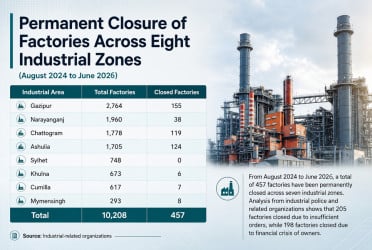
Industry-related data suggest that such closures are not isolated incidents. Between August 2024 and June this year, a total of 457 factories in seven major industrial zones across Bangladesh have been permanently shut down.
Analysis of data from industrial intelligence and related agencies shows that 205 factories closed due to insufficient work orders, while 190 shut down because of financial difficulties faced by owners. Together, these two factors account for 86.43% of all closures. Another 11 factories ceased operations due to labour unrest, while 51 were closed for reasons including political instability, banking complications, gas and electricity shortages, raw material scarcity and factory relocation.
Industrial Police officials said most factories are being closed in compliance with labour laws by issuing prior notices. However, delays in settling workers' dues have emerged as a major source of tension.
Additional Inspector General of Industrial Police Gazi Jasim Uddin said that although factories generally follow legal procedures when closing, many fail to pay wages and other benefits on time, often triggering labour unrest and necessitating administrative intervention.
Bangladesh's industrial zones currently host 10,238 factories. Gazipur recorded the highest number of permanent closures, with 155 factories shutting down out of 2,764. Ashulia saw 124 closures out of 1,705 factories, while Chattogram recorded 119 closures among 1,778 factories. Narayanganj reported 38 closures, Mymensingh eight, Cumilla seven and Khulna six. No permanent factory closures were reported in Sylhet.
Of the 457 closed factories, 108 are members of the Bangladesh Garment Manufacturers and Exporters Association (BGMEA), 35 belong to the Bangladesh Knitwear Manufacturers and Exporters Association (BKMEA), and eight are members of the Bangladesh Textile Mills Association (BTMA). Nineteen factories under the Bangladesh Export Processing Zones Authority (BEPZA) have also shut down, while 287 factories were not affiliated with any trade body. More than one-third of the permanently closed factories—151 in total—belong to the garment and textile sector.
Industry insiders attribute the closures to prolonged shortages of export orders, rising production costs, increasing raw material prices and uncertainty in global markets. In response, the government has announced incentive measures aimed at reviving distressed factories.
According to BGMEA, 322 factories have already expressed interest in receiving support, including 199 fully closed and 123 partially closed units. Their eligibility is currently being assessed.
BGMEA President Mahmud Hasan Khan said factory closures cannot be attributed to a single factor, noting that while some factories remain in crisis, others are still struggling to survive and could continue operations with appropriate support.
Business leaders and analysts argue that the crisis stems from a combination of factors, including global economic pressures, post-pandemic challenges, reduced access to bank financing, energy shortages, inflation, management weaknesses and policy uncertainties.
Bangladesh Chamber of Industries (BCI) President Anwar-ul-Alam Chowdhury Parvez said the crisis had evolved from an initial shortage of orders into a broader working capital problem, with many factories unable to open letters of credit for importing raw materials.
Dr M Masrur Reaz, Chairman and Chief Executive Officer of Policy Exchange Bangladesh, said support for distressed factories should be carefully targeted rather than provided indiscriminately. He stressed the need for third-party audits to assess the actual condition of closed factories and to determine whether they possess realistic prospects for recovery before any assistance is extended.
Source: Bonik Barta