Chattogram’s industrial sector is under mounting pressure as a worsening gas and fuel oil crisis, coupled with increased load shedding, disrupts operations. Rising raw material prices and higher transportation costs are further compounding the challenges, placing industries in the region under severe strain.
Production across more than 1,500 factories has declined by an estimated 25 to 35 percent due to fuel shortages. At the same time, costs are escalating rapidly as factories become more dependent on generators and incur additional operational expenses. Industry insiders warn that the situation is becoming increasingly unsustainable.
SM Abu Tayyab, chairperson of the Chattogram chapter of International Business Forum of Bangladesh (IBFB) , described the combined impact of rising fuel and raw material prices alongside power outages as a “cruel blow” to industry. He noted that overall production costs have risen by 20 to 25 percent in recent weeks, adding that continued disruption could make factory operations economically unviable.
Almas Shimul, additional managing director of GPH Ispat, said global increases in steel scrap prices and fuel costs have significantly raised production expenses. He noted that adjusting market prices in line with rising costs has become increasingly difficult.
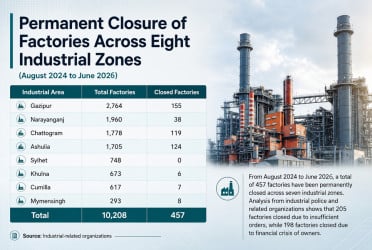
Chattogram, the country’s main commercial hub, is home to 1,676 registered industrial factories, including key sectors such as garments, re-rolling mills, shipbreaking and cement. These energy-intensive industries have been among the hardest hit, with production dropping by nearly a quarter while costs continue to climb.
The steel sector, which accounts for 62 percent of the country’s total steel factories and is largely concentrated in Chattogram, is facing acute challenges. Frequent power outages are disrupting temperature-sensitive processes in rod manufacturing, while fuel shortages have reduced output in around 50 re-rolling mills by 25 to 30 percent.
Rising global scrap prices—closely linked to fuel costs—have further intensified the pressure. International scrap prices have increased from $70 to $90 per ton, pushing up rod production costs by Tk 8,000 to Tk 10,000 per ton. Overall, steel production costs have risen by 15 to 17 percent.
The cement sector is experiencing similar difficulties. Production at nine factories in Chattogram has dropped by 25 to 30 percent, as higher fuel and gas costs combine with rising raw material prices to erode profitability.
Industry stakeholders warn that without a swift resolution to the energy crisis, the backbone of Chattogram’s industrial economy could face prolonged disruption.
Bd-pratidin English/ Jisan