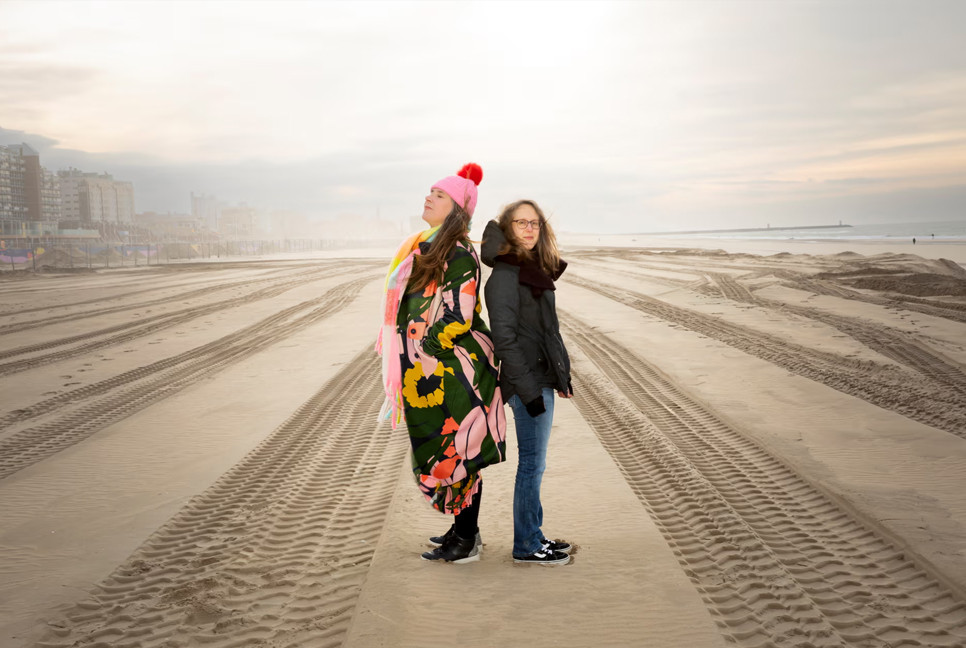
Is a slower, more mindful pace of life the answer to stress – or is it just another unachievable, privileged lifestyle brag? Meet the author who battled burnout with "a year of nothing".
How does the idea of doing nothing for a year sound? No work, no emails, no career progression, no striving or achieving or being productive. For many of us, such a thought might once have brought its own anxiety attack – surely, work is status, earning money is achievement, and being busy is a brag? But these days, a year of nothing is more likely to sound dreamy, even aspirational – there has been, as they say, a vibe shift.
Millennials are embracing the concept of #SlowLiving – the hashtag has been used more than six million times on Instagram (despite posting on Insta being fairly antithetical to its principles of a mindful, sustainable lifestyle, with much reduced screen-time). Gen Z, meanwhile, have pioneered quiet quitting and "lazy girl jobs", where one does the minimum at work to preserve your energy for the more meaningful parts of your life, be that hobbies, relationships, or self-care. And people across the generations are united to wanting to work less: in the UK, the concept of the four-day week is gaining serious traction.
To be facetious about it: hustle is out, and rest is in. And this is something Emma Gannon knows all about: the prolific author, podcaster, and Substack entrepreneur published A Year of Nothing – her account of taking an entire 12 months off – earlier this year. It quickly sold out when published earlier this summer, and has proved so popular it will now be reprinted and available to buy in November.
Looking back, there were lots of red flags... quite scary stuff – but I over-rode it, [thinking]: 'I'm busy, I've got to crack on' – Emma Gannon
Not that it was, initially, a lifestyle choice: Gannon suffered such extremely bad burnout, she had no choice but to stop working. Her account of her year of rest and recuperation is now published in two small, sweetly readable volumes by The Pound Project, charting her journey back to health via gentle activities such as journaling, watching children's TV, birdwatching, and the inevitable cold-water swimming (which Gannon knowingly acknowledges is a cliché for "Millennial writers with their bobs and tote bags", but comes to love anyway).
Having been fully on-board with the girl-boss culture of the 2010s, Gannon had already stepped away from that with her last book, The Success Myth: Letting Go of Having It All, which explored how relentlessly striving for success rarely brings true happiness. But it was experiencing complete burnout that forced her to really confront the importance of rest.
"Looking back, there were lots of red flags – feeling very confused, pulsating headaches, not being able to focus on things in the room, quite scary stuff. But I over-rode it, [thinking]: 'I'm busy, I've got to crack on'," she recalls. Suddenly, in 2022, her body went into a forced shut-down mode. "Couldn't look at a phone, couldn't look at a screen, couldn't walk down a street without feeling fragile. It was the feeling that, 'oh you can't muddle your way through this – you have to stop'. Many people with chronic burnout have to get to that point before they'll take time off [work], because we're so conditioned in this society to push through at all costs.
"But we were designed to have naps, and [walks in] the park. To go for a swim, and look at the sky. That stuff's really important," Gannon insists. And she's determined to carry the lessons from her burnout, and her recovery, into a slower, more spacious life. "Nothing is worth your health."
But she's far from ploughing a lonely furrow, here – a scan of the self-help or pop philosophy sections of your local bookshop, or indeed a glance at the list of recommended reading at the back of A Year of Nothing, reveals a flourishing crop of books encouraging us to slow the heck down.
Jenny Odell's How to Do Nothing: Resisting the Attention Economy became a sensation in 2019, linking our frazzled brains to how profit-hungry technology and social media use up our attention and distract us. She advocated re-wiring our awareness to the natural world around us, and to our own interiority.
Odell is also part of a wave of writers encouraging active resistance to the relentless "goal-oriented" expectation that, "in a world where our value is determined by our productivity", every hour and minute of our time should be put to good use – if not at work, then in self-improvement. Resisting the pressure to always be optimising can also be found in Oliver Burkeman's surprisingly comforting 2021 book Four Thousand Weeks – which reminds us that life is brief, and we will never get everything on our to-do list done. Rather than seeking to be ever-more efficient, he argues that we should focus on what really matters (spoiler alert: it's probably not hitting inbox zero), ditch perfectionism and completism, and live more fully in the present.
And it seems the idea of doing nothing is catching on: you may have noticed the recent proliferation of titles about niksen, the Dutch term for "doing nothing, intentionally". Olga Mecking's book Niksen clearly chimed with readers when published in the pandemic, and has been followed by a wealth of others, many in the Little Book of Hygge mould; it seems we love to take easily-digested lifestyle advice from northern European nations.
Even the word "rest" itself has become something of a buzz term. Published in 2022, Pause, Rest, Be by yoga teacher Octavia Raheem helps readers going through big changes or periods of uncertainty to slow down and turn inwards. Rather than using yoga to sweat your way to Instagrammable tight abs, she emphasises what the practice can tell us about self-knowledge, peace and stillness.
The Art of Rest by Claudia Hammond also has a practical bent: its chapters lay out the 10 most relaxing activities identified in global research, as well as arguing for the importance of intentional winding down – whether that be taking a bath or reading a book or spending time in nature. "Rest is not a luxury," Hammond writes, but "a necessity". Meanwhile Katherine May's book Wintering has the subtitle The Power of Rest and Retreat in Difficult Times, and forms a lyrical account of the author learning to accept the seasonality of life: that there are fallow periods when, rather than pushing on through, we need to step back and nurture ourselves. "Slowing down, letting your spare time expand, getting enough sleep… resting [is considered] a radical act now, but it is essential," she writes.
Granted, some have merely advocated doing nothing as a means to an end: Alex Soojung-Kim Pang's book Rest has the subtitle Why You Get More Done When You Work Less, positioning over-working as a productivity problem rather than an existential one. But perhaps it is notable that it was published in 2016, when the value of relaxing still had to be put forward in service of achieving more. Today, we're more likely to advocate for time off for the benefit of our mental health, our spiritual wellbeing, a sense of work-life balance, and even just for fun.
Such books are not created equal: there's a world, frankly, between Odell's radical but often academic theorising – explicit in its anti-capitalism and liberal in its use of terms like "phenomenology" – and cosy, pastel-hued books encouraging you to take a bath or play with crayons. But this itself is striking: surely, something must really be afoot, to be straddling TikTok trends, lofty essay writing and easily-digestible self-help books.
So why has there been such a turnaround in the Western world, from hustle culture and leaning in and girlbossing, to quiet quitting and radical rest and slow living? The reason is simple: we're all just so, so tired.
That's Gannon's theory, anyway: "Everyone's reeeeally tired. We're all struggling in some way to keep all the balls in the air," she tells the BBC. "We have a body and a mind that need to be looked after, and I don't think we do [that], really."
Technology is a big factor: it turns out, being able to answer emails on our phones didn't really make us more efficient, it just made us work more. The omnipresence of social media encourages us to document every inch of our lives, mining them for content and continually working to bolster our own individual brand. The rise of tracking apps, too, turns leisure activities, exercise, and even the barest necessities of life like eating and sleeping into data, that can be compared and improved upon: you can track your sleep, log your breakfast, time your run, record what movie you watched, monitor your menstrual cycle.
\For the many beginning to turn against the culture of relentless business, the pandemic was a game-changer. Obviously it was a horrific time, and not at all quiet for many – but for substantial numbers, work paused, or was conducted at home for the first time. For some, commutes vanished, as did usual distractions. Many had little choice but to slow down, or do nothing. And some people realised they never wanted to go back.
The hashtag #SlowLiving leads you to umpteen photos of country farmhouses and wafty white women arranging flowers – is it just a different kind of lifestyle brag?
It may also be a generational shift. Millennials have been called a burnout generation – and the combination of being raised to work hard in order to succeed, and then graduating with a mountain of debt into an unstable post-financial crash world has, as is well-documented, been a serious challenge for many.
Books explicitly tackling burnout have also become big business in recent years. They stretch from those that diagnose the social-political reasons for it, as in Anne Helen Petersen's book Can't Even: How Millennials Became the Burnout Generation – which explored how capitalism and the drive for profit and productivity funnelled this generation into exhaustion – to practical guides for overcoming it with rest and re-evaluation, like Emily and Amelia Nagoski's Burnout: Solve Your Stress Cycle or Selina Barker's Burnt Out: The Exhausted Person's Six-step Guide to Thriving in a Fast-paced World. Notably, all of these were published in 2020.
Gannon blames the parents for this generational phenomenon: "Baby boomers are very consumerist, they statistically buy the most technology, own the most property, they love things and money and success, as a generation – and I think the kids of baby boomers, Millennials, have wanted to impress them, basically. They were told: go and achieve and be successful and then [your parents] can be proud of you. That's been really hard for us to unpick."
Chronic burnout is, at root, the result of living under global capitalism – and deciding to live at a slower pace is a reaction against the acquisitive, never-satisfied mindset capitalism promotes. Gannon hopes that the current movement away from always seeking more status or stuff, and towards having more time, might be a healthy sign for our society. "People are really cottoning on to the fact that if you've got a roof over your head and you can pay your bills, what else do you need?"
Meanwhile slow living has been accused of being too focused on unobtainable lifestyle aesthetics – on Instagram, the hashtag leads you to umpteen photos of country farmhouses, wafty white women arranging flowers, and a lot of warm-neutral toned bed linen, for some reason. Is doing less at risk of becoming just a different kind of lifestyle brag?
Many of the healing activities Gannon writes about cost money: retreats, reflexology, life-coaching, umpteen holidays and stays in cabins. So, I ask her, what do you do if you're burned out because you're working two jobs just to make ends meet, and can't take time off?
Gannon is quick to acknowledge how lucky she was to be able to stop working, but suggests it's a mind-shift, as much as anything – that just allowing yourself to take a day or a week out can help. And, she insists, it's worth remembering that old adage: that the best things in life are free.
She recalls a day when she was really struggling with the burnout, and all she managed to do was take a walk, and buy a £1 bunch of daffodils. The simple action of stretching her legs, and then putting the cheering yellow flowers in a vase, was enough to get her through the day. "It's really not about where you go or what you see – it's just, I want to do something that's going to lift my spirits. We all know that doesn't cost money."
Source: BBC
Bd-pratidin English/Lutful Hoque