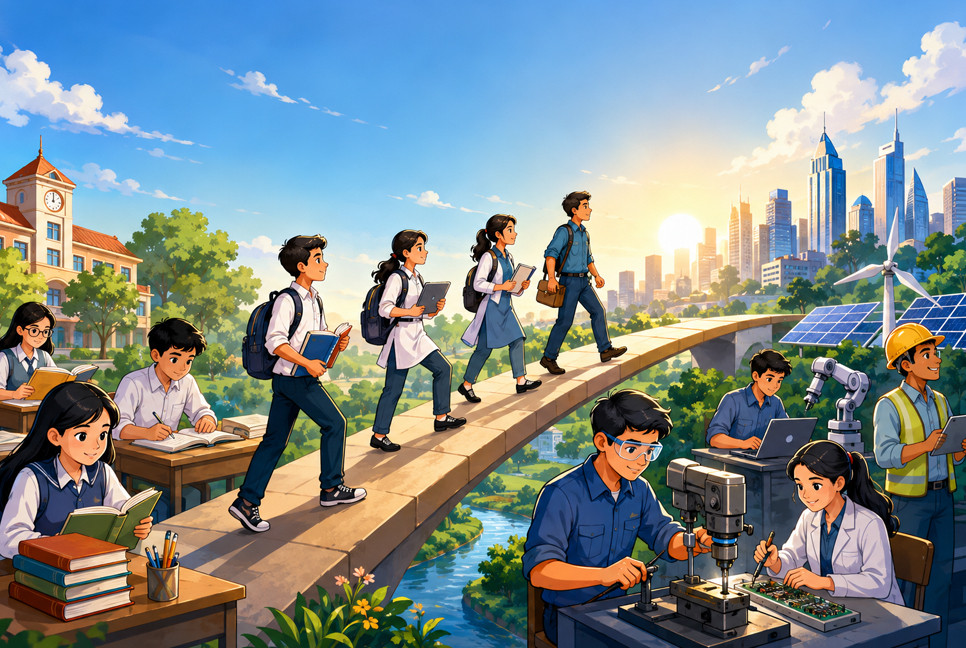
The government in the national budget for forthcoming 2026-27 fiscal year is set to allocate Tk47,591.12 crore for the education sector – second-largest development allocation in the layout – betting that skills investment now is the only way to stop a large young population from becoming an economic liability rather than an asset.
The sum represents 15.86% of the total Tk3 lakh crore development budget, funding roughly 107 projects across primary, secondary, higher, technical and madrasah education.
The broader fiscal picture is equally ambitious: a national budget projected at Tk9.3 lakh crore, a revenue target approaching Tk6.95 lakh crore, inflation brought down to roughly 7.2%, and GDP growth nudged up to 6.3%.
Of the education allocation, Tk43,173.04 crore will come from domestic sources and Tk4,418.08 crore from foreign assistance.
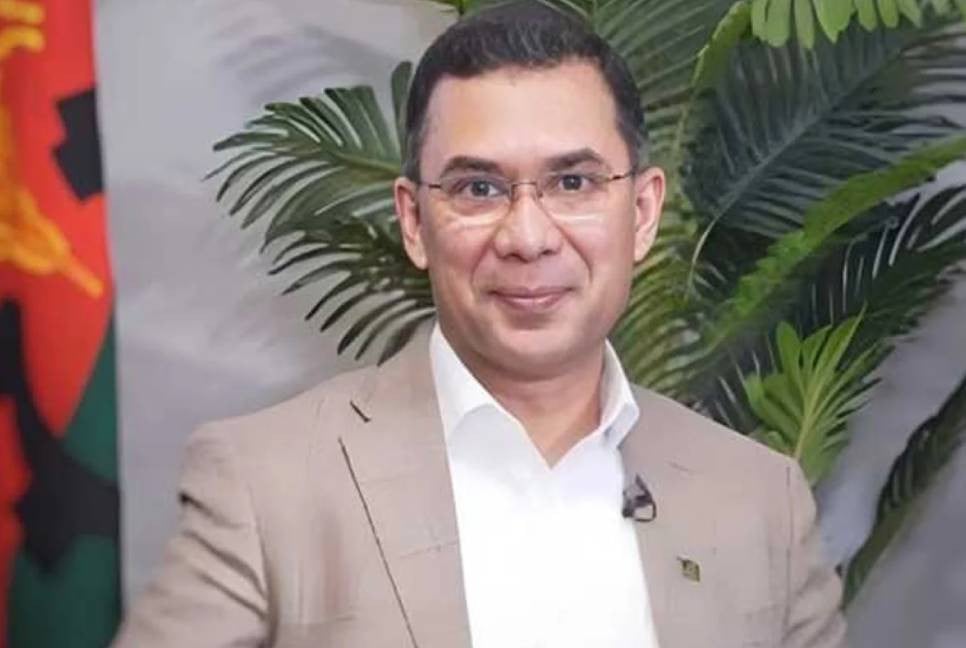
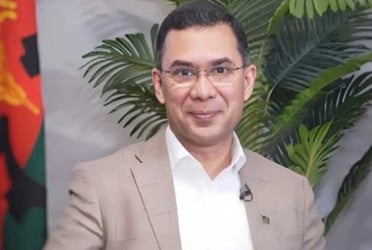
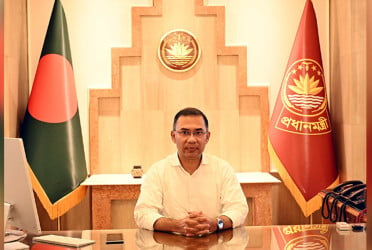
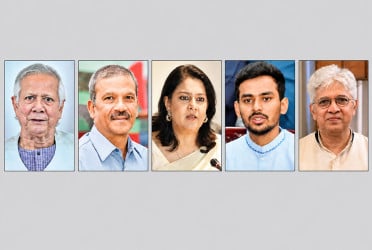
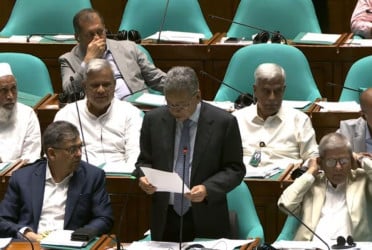
Speaking after a National Economic Council meeting on Monday, Finance Minister Amir Khosru Mahmud Chowdhury was direct about what drives the push.
"If we want to successfully utilise the demographic dividend, there is no alternative to investing in education and health," he said, adding that the government intends to raise combined spending on both to around 5% of GDP in the coming years.
He was equally candid about the limits of conventional schooling.
"We do not want students to complete SSC, HSC, honours and master's degrees only to remain unemployed. We want more young people to enter technical and vocational education so they can gain practical skills and secure jobs at home and abroad,” he said.
The year-on-year increases across education divisions are striking.
The Secondary and Higher Education Division jumps to Tk20,835 crore from Tk6,190.14 crore – a rise of around 237% – while the Ministry of Primary and Mass Education climbs to Tk19,441 crore from Tk8,058.18 crore, up roughly 141%.
The Technical and Madrasah Education Division rises to Tk6,123 crore from Tk3,147.11 crore.
The government plans to spend those sums on school and university infrastructure, teacher training, digital learning tools, vocational centres and skills programmes tied explicitly to both local and overseas labour markets.
The Technical and Madrasah Education Division alone carries five projects worth Tk27,011.29 crore, among them the NextGen Education Programme, renewable energy vocational training and initiatives to raise the quality of madrasah instruction.
The Secondary and Higher Education Division is running 46 projects worth Tk20,397.05 crore, covering university expansion, aviation and aerospace education, climate resilience and modern school infrastructure.
The Ministry of Primary and Mass Education has 11 projects worth Tk79,981.41 crore, including the Fifth Primary Education Development Programme, digital learning expansion and literacy work for children currently outside the school system.
Funding partners include the Asian Development Bank, World Bank, UNICEF, UNESCO, JICA and GIZ.
The urgency behind these numbers sharpens when set against what Bangladesh Bureau of Statistics data shows: around 65% of the population is of working age and nearly 28% are young people – figures that place the country squarely inside a demographic window economists say will remain open only until around 2037-38.
Yet technical education currently reaches just 0.81% of the population aged five and above, according to census data.
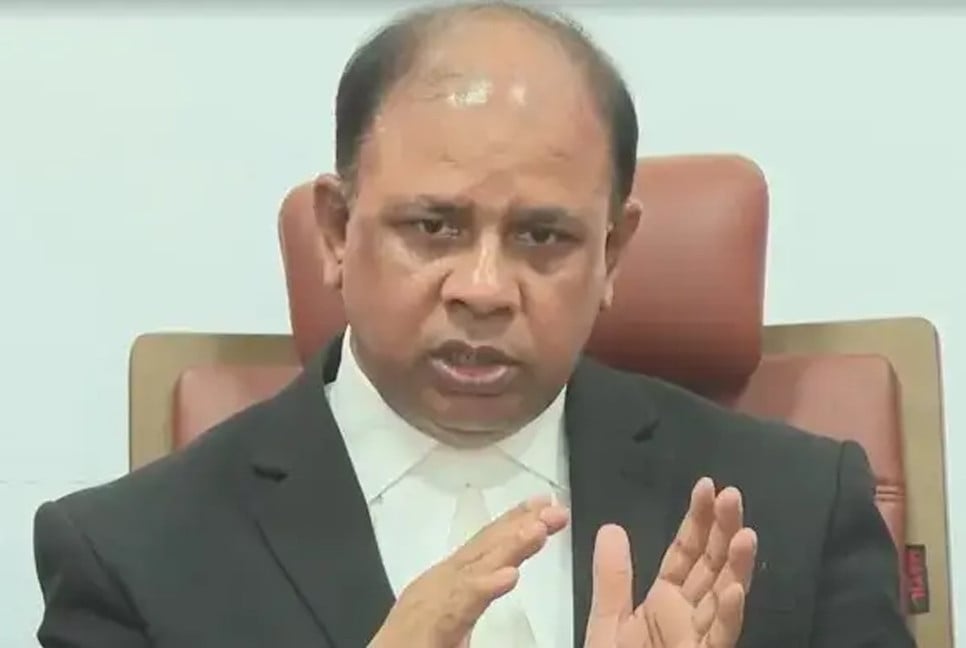
Dr Mustafa K Mujeri, former chief economist of Bangladesh Bank and executive director of the Institute for Inclusive Finance and Development, put the problem plainly.
“We are producing graduates, but not enough skilled workers,” he said, noting that the country has long underinvested in quality education and skills training despite its large youth cohort.
Spending figures for the current fiscal year suggest execution remains the harder challenge: the Ministry of Primary and Mass Education used only 24.99% of its FY26 allocation in the July-April period, the Secondary and Higher Education Division spent 45.27%, and the Technical and Madrasah Education Division drew down 33.56%.
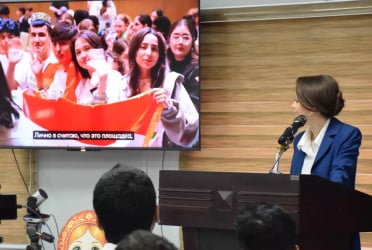
Education Minister ANM Ehsanul Hoque Milon, speaking at the Education World Forum 2026 in London, said Bangladesh also needs to rethink what schooling is actually for – moving away from exam-driven rote learning towards creativity, problem-solving and emotional development.
He flagged the government’s “One Teacher, One Tab” initiative as part of a broader digital push, and cautioned that artificial intelligence should narrow educational inequality rather than widen it.
The money is committed; the question is whether the machinery exists to spend it well.
Courtesy: Daily Sun.
Bd-pratidin English/TR