A severe gas supply crisis has suddenly emerged in the textile sector, including ready-made garments, which is the country’s top export-earning sector. As a result, industrialists and exporters have become deeply concerned. The crisis has prompted four industry associations to issue advertisements in the media to draw the government's attention.
According to a recently published advertisement, although gas prices have increased by over 300% in recent years with the promise of an uninterrupted supply, factories in this sector have been facing a severe gas shortage for the past two weeks.
As a result, production in many factories has been partially or fully shut down. Since the factories are unable to maintain production, global buyers are receiving products via air freight at additional costs to meet delivery deadlines. This is causing exporters to suffer significant financial losses.
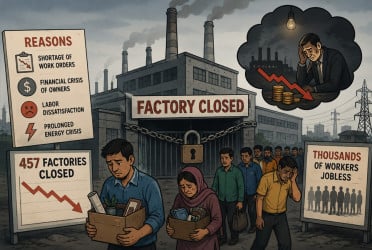
Meanwhile, industrialists have stated that the gas crisis has caused chaos in the industrial sector. Within just one year, hundreds of factories have shut down, export income has decreased, investment has stalled, and employment has not increased.
If the industrial sector is not saved, economic growth will come to a halt. Therefore, strong initiatives must be taken to meet gas and electricity demands in the industry. Entrepreneurs fear that if the gas supply is not increased quickly, domestic production will decline, and export earnings will be severely affected. This will further exacerbate the dollar crisis.
In this context, Shawkot Aziz Russell, President of the Bangladesh Textile Mills Association (BTMA), told the media that despite repeated appeals to the relevant government departments to resolve the crisis, entrepreneurs have yet to receive any solution. Therefore, they were compelled to publish advertisements to attract the government’s attention.
He added that even though government authorities have repeatedly raised gas prices in the name of ensuring an uninterrupted energy supply, many factories have closed due to a lack of adequate gas, and several others are on the verge of closure. On one hand, the government talks about attracting foreign investment, while on the other hand, domestic investors are shutting down factories and heading toward bankruptcy. He further stated that although the government has made various plans and promises regarding the energy crisis, none of them have been implemented.
According to Petrobangla sources, the current gas demand in the country is approximately 4,200 million cubic feet. On Sunday, 2,666 million cubic feet of gas was supplied, resulting in a shortfall of 1,534 million cubic feet. Of the 2,666 million cubic feet supplied, 1,835 million came from domestic gas fields, and 831 million came from imported liquefied natural gas (LNG).
Mohammad Faruque Hassan, former president of BGMEA, the top association of apparel manufacturers and exporters, said that the gas crisis in the industry has worsened. He called for increased LNG and LPG imports, along with the drilling of new wells. He emphasized that this process should be made regular. If necessary, a portion of export income (in foreign currency) should be specifically allocated for fuel imports.
The advertisement also stated that, despite the severe crisis, no planning or roadmap has been provided by the relevant government bodies, particularly the Ministry of Energy, BERC, Petrobangla, and Titas. Therefore, considering the overall situation, the government must immediately ensure an uninterrupted gas supply to the textile and garment sector as a top priority, at any cost.
The government should also take steps to stop system losses, disconnect illegal connections, instruct BERC, Petrobangla, and Titas to avoid profit-making motives, and withdraw VAT at all levels of gas supply.
Citing the main reason for the sudden gas crisis, the advertisement stated that to increase electricity and fertilizer production, gas supply to industries has been reduced. Within the Titas network alone, daily gas supply to the industrial sector has decreased by 100 million cubic feet. Additionally, about 20% of gas is lost during processing (system loss).
Factories under BTMA, BGMEA, BKMEA, and BTMA contribute about 85% to the country’s exports. Even though export-oriented businesses should be prioritized in gas supply, this is not happening. As a result, these key export-earning institutions are unable to operate their production normally due to gas shortages.
Most textile mills and garment factories have reported zero gas pressure. If this situation continues, the $70 billion investment in the textile and garment sector under BTMA, BGMEA, BKMEA, and BTMA will be under serious threat.
The advertisement also mentioned that if the crisis continues, the country’s economy will be negatively affected. Exports will decrease, foreign reserves will decline, and the government’s recent initiatives to repair the macroeconomy will be hindered. There will also be concerns over bank loan repayments and the payment of workers’ wages.
What is more alarming is that no new jobs are being created, and there are concerns over whether the wages and benefits of current workers can be paid.
Bd-pratidin English/ Jisan