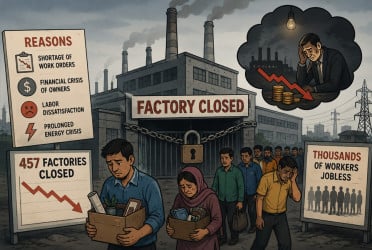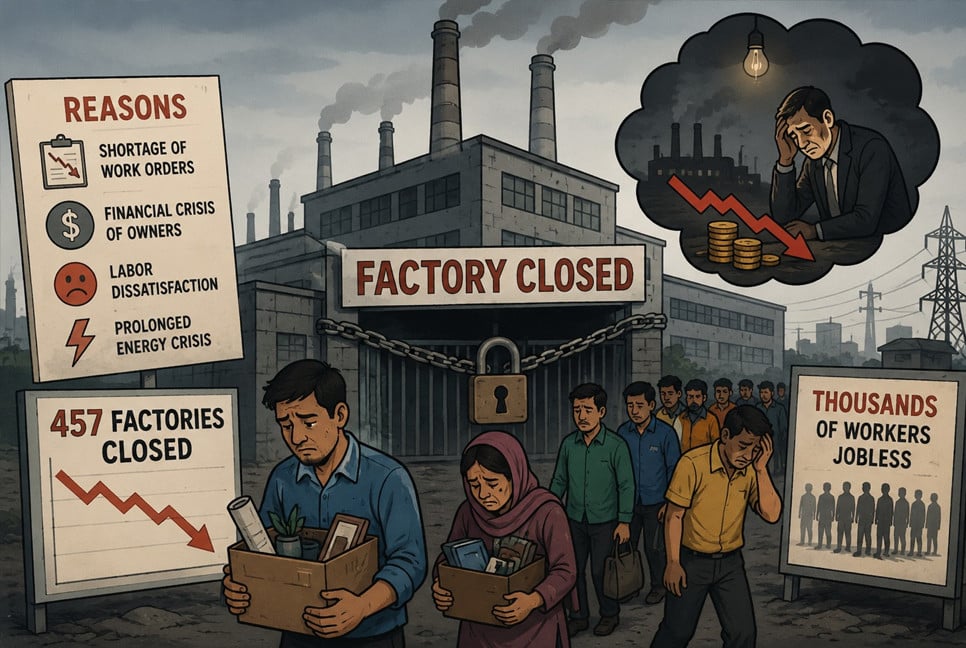
Due to a shortage of work orders, financial crisis of owners, labor dissatisfaction and a prolonged energy crisis, 457 industrial establishments in the country have been permanently closed in the last two years. Thousands of workers have lost their jobs.
Industry stakeholders say that the decline in global demand, geopolitical instability and various internal crises in the country have put the industrial sector under great pressure. According to relevant sources, 398 of the 457 factories that have been closed are located in the industrial areas of Gazipur, Ashulia and Chattogram.
The latest closures were announced on Tuesday for Unique Designers Limited and Unique Washing and Dyeing Limited in Gazipur. After being temporarily closed since June 16, the two establishments permanently stopped production activities. According to information from law enforcement agencies, about 1,800 workers have lost their jobs as a result of the closure of these two factories.

According to the data, 287 of the closed factories are outside the ready-made garment sector. The remaining factories include 108 members of the Bangladesh Garment Manufacturers and Exporters Association (BGMEA), 35 members of the Bangladesh Knitwear Manufacturers and Exporters Association (BKMEA), eight members of the Bangladesh Textile Mills Association (BTMA) and 19 companies under the Bangladesh Export Processing Zones Authority (BEPZA). In the five months up to May 31 this year, 79 factories laid off a total of 7,784 workers due to a decline in production and orders.
Earlier, major garment exporter Al-Muslim Group laid off about 1,900 workers from its knitwear and denim factories. Industry stakeholders say that the decline in demand for garments in the global market, bankruptcy of international buying institutions, banking complications, raw material shortages, political instability, war and geopolitical situations are having a negative impact on the industrial sector.
However, as an initiative to reopen closed factories, Bangladesh Bank has launched a pre-finance scheme of Tk 20,000 crore for large industries and the service sector. In addition, a separate fund of Tk 5,000 crore has been formed for the cottage, micro, small and medium enterprises (CMSME) sector.
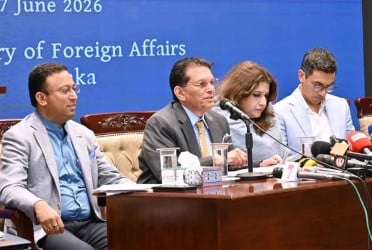
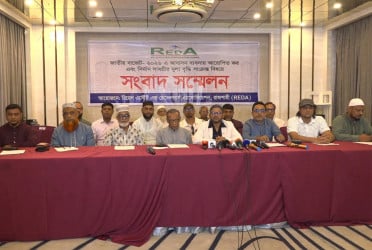
Bangladesh Bank has already sought information from garment sector organizations about closed and partially closed factories. In this regard, in a meeting held with BGMEA member factories on June 14, entrepreneurs complained that due to the strict conditions of the financial assistance package announced by the central bank, especially small and medium entrepreneurs are not able to avail these benefits.
BGMEA President Mahmud Hasan Khan said that it is not possible to reopen all closed factories. Many institutions do not have the capacity, and the CIB reports of many are also not satisfactory. He said that the decline in global demand, decrease in work orders, inefficiency of some factories, bankruptcy of buyer companies and inability to export products on time due to political and natural disasters are some of the reasons for the closure of factories.
BGMEA vice president Shihab Uddoja Chowdhury said, “About 200 closed and 123 partially closed factories have expressed interest in accepting the financial assistance package announced by the government. Factories that are not able to produce at full capacity should be given priority. It is possible to increase employment and export income within a short time if they get effective capital.”
He also said, “Most small and medium entrepreneurs are being deprived of financial assistance due to collateral-related conditions. Therefore, I call for providing loans at 7 percent interest and loan rescheduling with minimum down payment for the CMSME sector.”
BGMEA said that two audit firms will be appointed to inspect the interested factories. Based on the reports of these firms, the organization (BGMEA) will make necessary recommendations to Bangladesh Bank.
Bd-pratidin English/Lutful Hoque