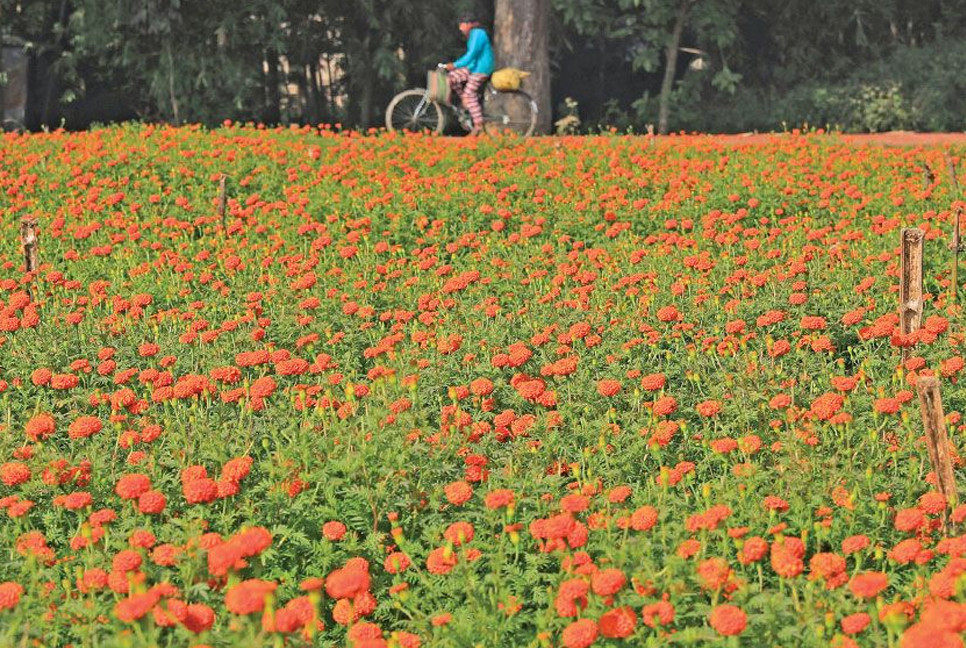
Flower growers in Godkhali, Jashore – widely known as Bangladesh’s “flower capital” – are entering their busiest season with cautious optimism, hoping that a stable political environment in the coming weeks will help them achieve their Tk600 crore sales target during the winter festivals.
Despite earlier setbacks from heavy rainfall and lingering concerns over political uncertainties, farmers say robust production and rising demand ahead of Victory Day have strengthened their expectations for a successful season.
Even so, many note that any unrest in the run-up to the national election could still dampen demand or disrupt transport to markets nationwide.
Victory Day on 16 December traditionally marks the first major event of the season, and growers say they have completed their preparations. Yet the political climate has tempered what is usually a period of high optimism. Farmers reported that unusually heavy rainfall earlier in the year delayed planting. While fields are now in full bloom and production looks strong, they remain unsure whether sales will match expectations.
Rubel Hossain, a grower in the area, said December to February is the peak window for flower cultivation and trade, driven by Victory Day, Christmas, New Year celebrations, Pahela Falgun, Valentine’s Day, and International Mother Language Day.
“Marigold, chrysanthemum, rose, gerbera and gladiolus are now blooming beautifully in the fields,” he said, adding, “We’re spraying vitamins and pesticides to retain the marigold buds. Prices of all flowers have already started rising, and we expect further increases before Victory Day.”
Another grower, Ismail Hossain, said farmers typically prepare months in advance for the winter festivals.
“But this year, prices crashed at the start of the season. We’re not sure if they’ll recover during the major occasions. Everything depends on the country’s political climate. Still, we remain hopeful,” he said.
Located around 18 kilometres from Jashore town, the Godkhali flower market sits beside the Jashore-Benapole highway. Each dawn, farmers arrive with freshly harvested flowers as wholesalers and retailers from across Bangladesh gather to buy in bulk. An estimated Tk500-600 crore worth of flowers is traded annually in the area.
During a visit on Saturday morning, growers were seen arriving on bicycles and vans laden with vibrant arrangements. Roses were selling for Tk3-4 per stem, tuberose for Tk8-15, gerbera for Tk8-10, marigold at Tk100 per thousand, gladiolus for Tk6-8 and chrysanthemum for Tk2-3 per stem. Saiful Islam, another grower, said winter remains the busiest period for both production and sales.
“Today roses sold for a maximum of Tk3 per piece. Prices of roses and marigolds are the lowest right now. But prices of other flowers are rising. We are hoping Victory Day will boost the market – depending again on the political situation.”
According to the Department of Agricultural Extension in Jashore, commercial flower cultivation covers about 600 hectares in the district, producing 13 varieties and supporting the livelihoods of more than one lakh people.
Arizul Islam of Kulia village said he cultivated tuberose on one bigha of land at a cost of Tk60,000.
He has already sold Tk2 lakh worth of flowers and expects to earn another Tk3 lakh from what remains in the field.
Meanwhile, Tayeb Ali of Patuapara said rose production had surged this year, putting downward pressure on prices. “Rose production is high this year, which is why prices have fallen. Marigold prices have also dropped for the same reason,” he said.
Abdur Rahim, president of the Jashore Flower Production and Marketing Cooperative Society, said demand often declines when political instability forces national events and festivals to scale back.
“Still, we are hoping prices will rise during the upcoming occasions,” he said.
Nurul Islam, agriculture officer for Jhikargacha upazila, said around 600 hectares in Godkhali currently produce 13 flower varieties commercially. “More than one lakh people depend on this sector for their livelihood. We are assisting all flower farmers with their production,” he added.
Source: Daily Sun
Bd-pratidin English/ ANI