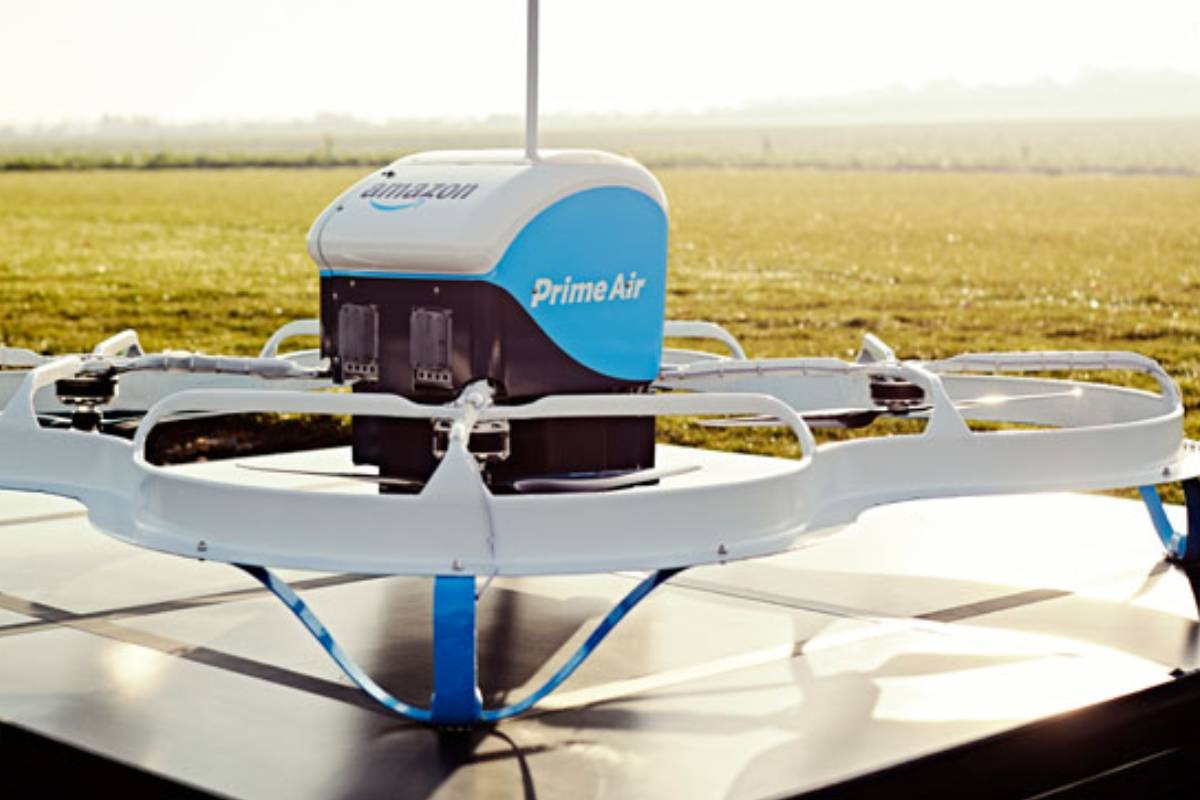
A drone delivery unit of Amazon has withdrawn from an industry trade group, citing safety concerns over its opposition to proposed rules on collision-avoidance systems for drones, reports Reuters.
In a previously unreported letter seen by Reuters on Thursday, the company’s drone unit Prime Air said it was leaving the Commercial Drone Alliance because the group’s stance on key safety issues was incompatible with its own principles.
The letter, sent late Wednesday, said Prime Air’s detect-and-avoid system had successfully performed collision-avoidance maneuvers in two potential mid-air incidents during more than 70,000 drone flights.
“These events could have led to catastrophic safety consequences, including loss of life,” the company said.
The dispute centers on a proposal by the Federal Aviation Administration that would require drones to be equipped with systems capable of detecting and avoiding aircraft that are not broadcasting their position, possibly due to equipment failure.
The Commercial Drone Alliance has opposed the requirement. Instead, the Washington-based group has argued that aircraft operating below 500 feet (152 meters) should be required to broadcast their position using satellite-based or electronic identification systems.
The proposed rules are part of broader federal efforts to accelerate drone operations beyond the visual line of sight of their operators, a key step for expanding commercial drone services. The regulations have not yet been finalized.
Members of the alliance include companies such as Skydio, Zipline and Wing Aviation, a subsidiary of Alphabet.
The group said Thursday it was disappointed to see Prime Air leave but noted that its members have conducted millions of safe drone flights. It argued that a performance-based regulatory framework, rather than specific technology mandates, would better support safe operations while encouraging innovation and competition.
Prime Air said the safe integration of drones into national airspace remained its top priority.
“This requires rigorous, capability-based standards — including requirements mandating drone technologies capable of detecting non-cooperative crewed aircraft,” the company said.
The term refers to aircraft such as planes or helicopters that are not transmitting identification or location signals and may not be communicating with air traffic control.
Prime Air said one of the potential collisions it cited involved a helicopter that was not broadcasting its position through the safety system known as Automatic Dependent Surveillance-Broadcast (ADS-B). Without its detect-and-avoid system, the company said, the incident could have resulted in a catastrophic outcome.
“The risk of a drone collision with a crewed aircraft is not theoretical,” the company added.
Concerns over crowded airspace have grown following a fatal accident near Washington, D.C. in January 2025, when a passenger jet operated by American Airlines collided mid-air with a helicopter from the United States Army, killing 67 people and prompting safety recommendations from the National Transportation Safety Board.
Bd-pratidin English/ Jisan