The 13th parliamentary election is knocking at the door. Campaigning is under way across the country, and tension is rising along with it. Election campaigning is gradually turning violent – this is the biggest concern surrounding this election.
The people of this country have long been deprived of their voting rights. In the last three elections, voters were unable to cast their votes. This time, voters are eager to vote. However, alongside this enthusiasm, there is also anxiety and fear. People remain concerned about the security situation on polling day. These concerns are not unfounded.
Since the start of the election campaign, incidents of violence have been increasing across the country. The closer election day comes, the more heated the political environment becomes. Tension and intolerant behaviour among candidates are being observed in various places. If the environment is not normal on election day, ordinary voters will be afraid to go to polling centres. This will raise serious questions about the acceptability of the Bangladesh election.
The United States, along with all development partners, has said that it wants to see a free, fair, and participatory election in Bangladesh. The European Union and several donor countries have also explained what they mean by a participatory election.
According to them, voter turnout is the key measure of a participatory election. The Foreign Affairs Adviser has assured that more than 55% of voters will participate. However, this will only be possible if voters actually go to polling centres. Ordinary citizens who are not loyal to any party will not risk their lives to vote. This is the biggest challenge for the government ahead of the election.
According to the latest data, 274 incidents of violence have occurred across the country over 53 days during the current election period. The Chief Adviser’s Press Wing reported that these incidents were recorded between 12 December 2025 and 1 February 2026 (up to 9pm).
Violence related to the 13th National Parliamentary Election includes 16 cases of intimidation or aggressive behaviour, 15 attacks on candidates, five killings, and 89 clashes between rival supporters. In addition, there were three incidents involving illegal weapons, nine cases of threats and intimidation, 29 complaints of obstruction to campaign activities, 20 attacks involving vandalism and arson targeting election-related offices or institutions, 17 blockades and protests, and one attack on minorities. There were 70 other types of violent incidents.
According to Press Wing data, during the 10th National Parliamentary Election (2013–14), 530 incidents of violence resulted in 115 deaths and 315 injuries. During the 11th election (2018–19), 414 violent incidents led to 22 deaths and 780 injuries. During the 12th election (2023–24), 534 incidents of violence resulted in six deaths and 460 injuries.
These statistics show that although the intensity of violence varies from election to election, each election has seen significant conflict and a large number of injuries.
As election day draws closer, the political field and election environment are becoming increasingly violent, according to the human rights and legal aid organisation Ain o Salish Kendra (ASK). The organisation says that, compared with December, the number of incidents of political violence, as well as deaths and injuries, increased significantly in January. ASK reported that in December there were 18 incidents of political violence, resulting in four deaths and 268 injuries. In January, the situation deteriorated sharply.
In just one month, 75 incidents of violence were recorded, with 11 deaths and 616 injuries.
Analysing the January data, ASK noted that violence remained on an upward trend throughout the month. From 1 to 10 January, there were eight incidents in ten days, resulting in five deaths and 26 injuries. From 11 to 20 January, there were 18 incidents in ten days, with two deaths and 176 injuries. From 21 to 31 January – after election campaigning began on 22 January – violence reached its most severe level. In just 11 days, 49 incidents occurred, resulting in four deaths and 414 injuries.
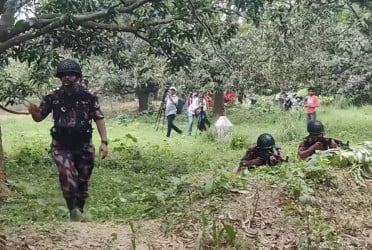
Even ahead of the election, the police force has not been able to become fully effective. The police administration has yet to reassure the public by rising above fear. Just before the election, controversy has emerged over the renaming of RAB.
On 3 February, the Home Affairs Adviser officially announced the change. The black-uniformed RAB will no longer be seen. This specialised police unit will be known by a new name. The government has decided to change both the name and the uniform of RAB.
After a meeting of the Core Committee on Law and Order at the Ministry of Home Affairs, the interim government’s Home Affairs Adviser, Lieutenant General (Retd.) Md Jahangir Alam Chowdhury, informed journalists of the decision. The Rapid Action Battalion (RAB) will now be called the Special Intervention Force (SIF). Along with changes in name and uniform, reforms will also be introduced in the unit’s operations.
The question has arisen: was such an announcement really necessary just one week before the election? Analysts believe this could cause members of this elite force to become more withdrawn, further weakening security during the election period.
As a result, the public’s main reliance for the election is the army. On 3 February, the Army Chief reassured the public about the election. Army Chief General Waker-Uz-Zaman said that the government, the Election Commission, the police, and the army, navy, and air force are all committed to holding the national election, and that there is no chance the election will not take place.
He made these remarks during a visit to Gazipur district and a meeting with law enforcement officials. He also said that on election day the army would take action against those who engage in intimidation or try to prevent voters from going to polling centres. Those who commit crimes will face punishment in accordance with the law.
However, political analysts believe that to make the election participatory, political parties must behave responsibly. They must remember that if the election becomes controversial, they themselves will suffer the greatest loss. Therefore, in the final days of campaigning, their main responsibility is to reassure the public – to ensure that voters go to polling centres and can freely express their opinions. Political parties must abandon the mentality of capturing power at any cost.
Regardless of which side wins, a festive election that reflects the people’s verdict will be a victory for the people and for democracy. All political parties will benefit from this. By contrast, a violent election without voters will destabilise the country, hinder democratic progress, and ultimately harm the very political parties participating in the election.
Bd-pratidin English/TR