After assuming office, the current interim government undertook several initiatives to encourage foreign investors. Ashik Chowdhury was appointed Executive Chairman of the Bangladesh Investment Development Authority (BIDA). A high-profile investment summit was organised in Dhaka, and the chief adviser visited several countries, urging investors to invest in Bangladesh.
However, over the past 17 months, the overall state of investment in the country has been disappointing.In terms of cumulative foreign direct investment (FDI) stock, the United Kingdom is Bangladesh’s largest source country. Yet compared to fiscal year 2023-24 (FY24), net FDI inflows from the UK declined by 40.71% in FY25.
This is despite the fact that in March last year, BIDA Executive Chairman Chowdhury Ashik Mahmud bin Harun visited the UK to attract investment.
During his stay in London, he held meetings with senior UK government officials, leading British companies, and expatriate Bangladeshis.
In January last year, the BIDA executive chairman visited the United States, where he signed an energy supply agreement with Louisiana-based energy company Argent LNG.
However, according to updated data from Bangladesh Bank, in FY25 more investment was repatriated to the United States than the amount of new investment that entered Bangladesh from the US.
China is another major source of investment in Bangladesh in terms of FDI stock. The chief adviser visited Beijing in March, followed by the participation of a significant number of Chinese investors at an investment summit held in Bangladesh the following month.
Subsequently, in July last year, the BIDA executive chairman visited China and led a high-level BIDA delegation to Shanghai.
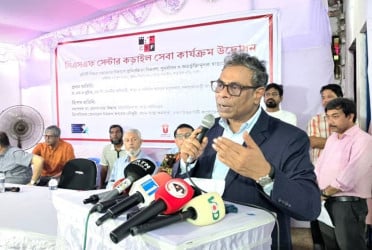
At the Bangladesh-China Investment Seminar 2025, Ashik Chowdhury, as the keynote speaker, invited Chinese investors to invest in Bangladesh’s power, textile, and IT sectors.
These visits generated visible interest and investment commitments.
Yet in the last fiscal year, China’s net FDI inflow to Bangladesh declined by 3.3%.
During the tenure of the interim government, various seminars and summits have been organised at home and abroad to attract investment. BIDA has publicised that these events received positive responses from investors. In reality, however, these efforts have not translated into tangible results.
In FY25, investment proposals worth Tk66,057 crore – both domestic and foreign – were registered with BIDA in the private sector, representing a 58% decline compared to the previous fiscal year. The number of proposed projects also fell.
Analysts say that instead of harbouring unrealistic expectations of overnight change or promoting its own image, the interim government should have prioritised addressing the core obstacles to investment.
The first step in initiating investment activity is registration. After that, investors seek approvals from various government agencies, arrange financing, build infrastructure, and attempt to implement proposed projects.
Registration reflects investor interest at an initial stage. Recently, a decline in interest among both local and foreign investors has been observed.
According to the Economic Survey 2025, in the completed FY25, investment proposals worth Tk66,057 crore across 970 projects were registered with BIDA. In FY24, proposals worth Tk156,998 crore across 1,064 projects were registered. Thus, within one year, the value of registered investment proposals declined by nearly 58%.
From many of the countries visited by representatives of the current interim government to attract investment, both actual investment inflows and new investment proposals have declined.
After assuming office as BIDA Executive Chairman in September 2024, Chowdhury Ashik Mahmud bin Harun visited the United States, Japan, the United Kingdom, Qatar, China, Malaysia, Turkey, and Korea up to October last year. Among these, he visited the US in January, Japan in February, the UK in March, and Qatar in April as part of the chief adviser’s delegation.
Thus, during FY25, he visited these four countries. During this period, no investment came from Qatar, net FDI from the UK declined by 40.71%, and more investment was repatriated to the US than entered Bangladesh.
Compared to the previous fiscal year, the value of registered investment proposals from Japan and the UK also declined in FY25.
No new investment proposals from Qatar were registered during this time.
After the interim government took office, foreign investment fell sharply.
In the first six months of FY25 (July-December), foreign investment dropped to nearly one quarter of the level recorded during the same period of the previous year – a decline of more than 71%.
Experts believe foreign investment has declined due to the absence of improvements in the business-friendly environment, coupled with weak growth in domestic investment.
Local industrialists say that without an increase in domestic investment, foreign investment will not grow either.
Mustafizur Rahman, distinguished fellow of the Centre for Policy Dialogue (CPD), said, “We have institutional weaknesses in terms of ease of doing business. There is also ongoing political uncertainty. As a result, new foreign investment is not coming. Those foreign investors already in the country are reinvesting their undistributed profits. When private-sector credit growth domestically is only 7%, attracting foreign investment is difficult.”
According to Mustafizur Rahman, attracting foreign investment requires addressing issues such as a stable law-and-order situation, corruption, and deficiencies in governance and accountability.
Investors also say that BIDA continues to operate in a bureaucratic manner, with approvals for proposals delayed for months. For example, a local company proposed sending just US$30,000 to a foreign ice cream company to bring in a franchise. Even after three months, approval had not been granted.
The question, investors ask, is how foreign investment can be expected if BIDA delays approvals in this way.
There are also allegations that foreign investors face harassment. A social media post by a Chinese businessman about long delays in obtaining an “on-arrival visa” at Dhaka’s Hazrat Shahjalal International Airport has gone viral. Charlie Tian, owner of Xinjiang Akiya Sports Co. Ltd., expressed his frustration on his LinkedIn profile.
In his post, Charlie Tian said that it takes only four hours to fly from Guangzhou to Dhaka, but after landing, completing the on-arrival visa process can take another one to two hours.
He described the airport process as “extremely time-consuming and inefficient”, causing tourists, investors, and businesspeople from China to become exhausted at the very beginning of their visit.
He questioned why such inefficiency at the country’s entry point should become a major barrier if Bangladesh is truly interested in attracting foreign investment and tourism. Along with his post, he shared a photograph of the on-arrival visa counter and immigration police at Dhaka airport.
BIDA is the starting point for domestic and foreign investment through registration. According to the latest estimates from the Bangladesh Bureau of Statistics (BBS), Bangladesh’s gross domestic product (GDP) in the current fiscal year stands at Tk55 lakh crore.
Despite GDP being in the range of Tk5-5.5 lakh crore, registered expressions of investment interest – both domestic and foreign – remain limited to only Tk1-1.5 lakh crore, just 2-3% of total GDP. Moreover, due to delays in utility connections, energy shortages, and other logistical barriers, actual investment is often half – or even less – of the registered amount.
Dr Zahid Hussain, former lead economist of World Bank’s Dhaka office, described the interim government’s approach to promoting the investment situation as disappointing.
He said, “If the BIDA executive chairman and others spoke more candidly and closer to the ground, people would feel they were different from others. This is not a political government that needs to beat its own drum. Instead, if the government highlighted where the problems and barriers to investment actually lie, it would have been better. White should be called white, black should be called black, and what is unclear – grey – should be presented as such. Why is there a tendency to selectively present a positive picture? Even that would be acceptable if it reflected reality. There was no need to paint a picture based solely on hope and aspiration.”
Bd-pratidin English/ ANI