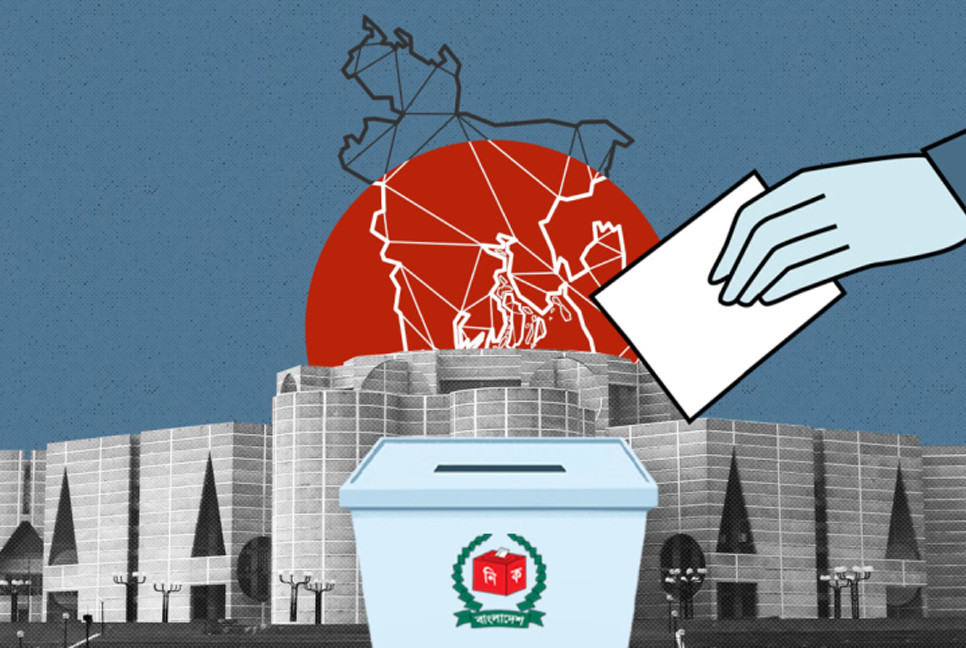
For the first time, Bangladeshi citizens living abroad are set to cast ballots in a national election, analysts say this could alter the balance of power in several closely contested constituencies.
A large number of expatriates have registered to vote by postal ballot in the 13th National Parliament election, potentially becoming decisive in races where victory margins in past polls were often just a few thousand votes.
Election observers note that in constituencies where more than 10,000 expatriate voters are registered, overseas ballots could prove a “game changer,” particularly in long-standing two- or three-way contests.
Especially in constituencies where there has been a fierce competition between two or more strong candidates for a long time, the concerned people believe that the impact of expatriate voting can be the most.
According to the Election Commission, the highest registration for voting through postal ballots was in Feni-3 constituency. A total of 16,093 expatriate voters have registered in this constituency. Next is Chattogram-15 constituency, where the number of registrations is 14,301. 13,977 people have registered in Cumilla-10 constituency, 13,658 in Noakhali-1 constituency and 12,829 expatriate voters in Noakhali-3 constituency.
The number of expatriate vote registrations in Feni-2 constituency is 12,797, in Cumilla-11 constituency 12,583, in Sylhet-1 constituency 12,458, in Cumilla-5 constituency 12,373 and in Cumilla-6 constituency 11,943.
In addition, 11,852 expatriate voters in Chandpur-5 constituency and 11,675 in Noakhali-5 constituency have registered to vote in postal ballot.
These statistics indicate that the participation of expatriates in various important and contested constituencies of the country has increased significantly. On the other hand, the lowest registration has been registered in Bagerhat-3 constituency. Only 1,595 expatriates have registered for postal voting in this constituency.
However, observers believe that even if the registration is low, the importance of expatriate voting cannot be dismissed here if the election results are very close.
The picture is also significant in terms of country-based registration. Among expatriates, the highest number of 239,186 people from Saudi Arabia have registered for postal voting.
Saudi Arabia has long been home to Bangladesh's largest expatriate population, so it was expected that the highest number of registrations would be from here. Malaysia is in second place, where 84,292 expatriate voters have registered. Qatar is in third place, with 76,139 expatriates registered from there.
Political analysts said that expatriates are generally deeply interested in the country's politics and elections. Many expatriates regularly follow the country's news, are active on social media, and are aware of the activities of candidates in their respective areas.
However, discussions are also underway on the implementation of the postal ballot system, timely delivery of ballots, transparency in vote collection and counting.
The EC said that necessary preparations have been made for the smooth receipt and counting of expatriate votes.
The concerned officials hope that this initiative will fulfill a long-standing demand of the expatriates and make their participation in the democratic process more meaningful.
Overall, expatriate votes have added a new dimension to the 13th National Parliament elections. It will be clear only after the election results are announced, in which constituencies these flying votes truly played a fate-determining role.
Reception and storage of postal ballot papers: The returning officer will assign an officer to receive and store the postal ballots received from the postal department.
In addition, the required number of supporting staff will be appointed to assist the responsible officer in other tasks including scanning the postal ballots received from the postal department.
After receiving the postal ballot envelopes by post, the responsible officer will scan the QR code given on the envelope. Then, the envelopes will be stored securely in the designated ballot boxes based on the constituency. By scanning the QR code, the seat-wise list of postal ballot distribution and receipt in the form of Form-12 will be generated from the software. The responsible officer will sign the form generated by the software every day and save it.
In addition, if the QR code is displayed as a duplicate in the software while scanning the QR code, the Returning Officer will cancel the ballot. In this case, the envelope will be saved elsewhere without opening it. The necessary scanning equipment for scanning the QR code will be provided by the Election Commission.
Counting process: A seat-wise counting room will be prepared in the office of the Returning Officer or any other convenient place for counting the postal ballot papers.
On the day of voting, immediately after 4:30 pm, the Presiding Officers will receive the boxes filled with postal ballots of their respective seats from the Returning Officer. The EC has already requested the voters to vote quickly and send them back after the symbol allocation so that the ballots are returned within the stipulated time.
Bd-pratidin English/TR