Over the past year and a half, one of the greatest sources of fear for the country’s private sector has been what is widely described as “case trade”.
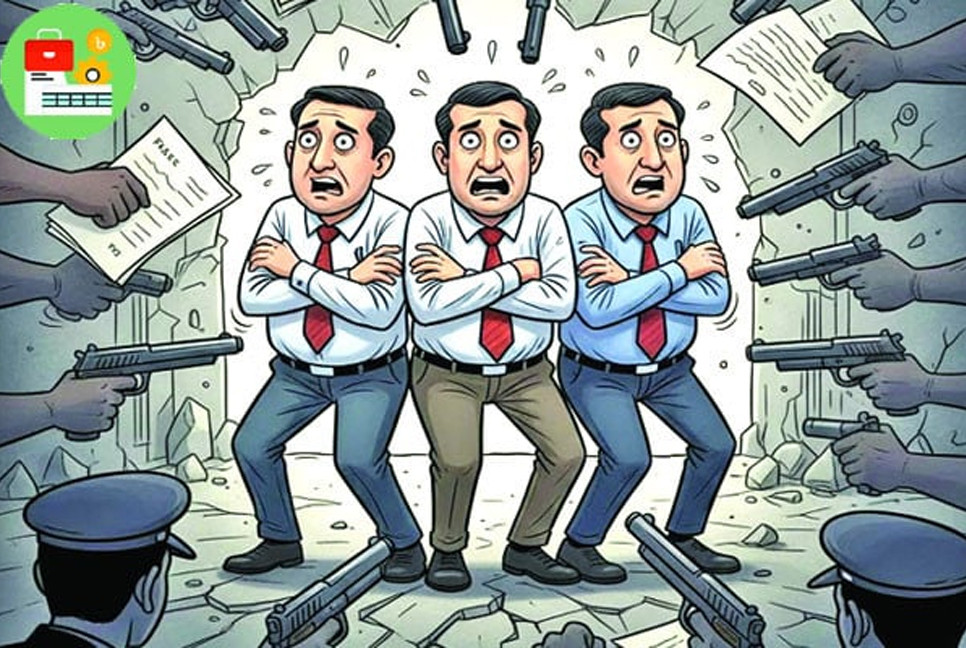
False cases are being filed to extort money from businesspeople. Once a case is lodged, large sums are demanded. If those demands are not met, mob violence is unleashed.
At a time when the private sector is already nearly paralysed, these fabricated cases have forced many investors to shut down their businesses.
Experts believe this trend will plunge the national economy into a deep crisis in the future.
Following the fall of the Awami League government on 5 August 2024, cases were filed at police stations across the country over killings during the July mass uprising.
Many cases were also filed over injuries. Alongside actual perpetrators and suspects, numerous individuals have been named as accused purely to harass them. These include businesspeople, professionals, individuals residing elsewhere, and even non-political figures.
Allegations abound of a racket in which assurances are given that names will be removed from cases, affidavits are offered claiming that individuals were mistakenly named, or promises are made to declare accused persons innocent in police reports – all in exchange for money.
There are also allegations that individuals are being deliberately framed after rivals provide financial inducements.
According to police headquarters data, at least 1,499 cases have been filed over deaths, injuries, and other incidents related to the July uprising. Of these, 599 are murder cases, while the remaining 900 involve other charges. More than 10,000 people have been arrested in connection with these cases. The total number of accused is close to one million, including at least 2,000 established businesspeople and industrial entrepreneurs.
After the fall of the Awami League government following the student–public uprising, widespread instability gripped industrial factories and business establishments across the country. Attacks, arson, extortion, and attempts to seize ownership have become commonplace.
Several factories have already been vandalised and looted. In many cases, when extortion demands were not met, murder cases were filed against owners. In some instances, personal grudges have been given a political colour and transformed into criminal cases. Some business owners are being threatened with cases, while in certain areas businesses have even been forcibly taken over – sometimes involving influential leaders of political parties.
Business leaders say that businesspeople do not belong to political parties. They keep the wheels of the economy turning through their work. Ordinary businesspeople must be freed from harassment. If fabricated cases are not withdrawn, new investment will be obstructed, closing off opportunities for job creation. At the same time, many owners will be forced to shut down factories, leaving thousands of workers unemployed. Foreign investors, too, will lose interest in investing in the country.
Businesspeople say that although there were hopes of industrial growth following the mass uprising, those hopes have now been replaced by fears of chaos. They are demanding security from the government. Without guarantees of safety, fear will not subside, and many are unable to run their businesses properly.
Speaking on condition of anonymity, officials of several large business groups said cases have been filed against their top executives. Out of fear of arrest, owners are no longer coming to their offices, disrupting operations. At times, it appears that owners may shut down their businesses altogether. This fear has spread among employees as well. If factories close, thousands will lose their jobs, leaving workers deeply anxious about their future.
Inquiries reveal that the heads of several leading companies are currently staying abroad. Owners of medium-sized businesses have also left the country out of fear. Many are observing the situation from outside and have decided to return only if conditions improve – otherwise, they may never come back. Some have already decided to wind up their businesses. If the situation continues in this direction, the national economy will face severe challenges.
Former FBCCI President Mahbubul Alam said that ordinary businesspeople – excluding identified political figures – must be spared from cases. If general businesspeople remain terrified, supply chains will be disrupted. To keep the economy moving, their security must be ensured. Keeping businesspeople free from harassment is in the national interest, he said.
Former BGMEA director Rajib Chowdhury said the only solution to the current crisis lies with the government. Only the government can free ordinary businesspeople from this situation if it chooses to act. If business owners remain afraid and avoid their factories, those enterprises will not survive, he warned. Many factories may shut down within months. He noted that murder cases have been filed against former vice-presidents of BGMEA and leaders of major export-oriented companies – cases filed while they were abroad on business. It is widely known that they have no political affiliations.
Meanwhile, several businesspeople are unable to return to the country due to fear of arrest. Without their owners, these businesses are deteriorating day by day. With owners abroad, officials are struggling to manage salary payments, raising fears of delayed wages. Failure to pay wages on time could spark labour unrest.
Discussions with stakeholders reveal that production in factories and establishments is being disrupted under these circumstances. The negative impact is particularly severe in factories whose owners are abroad. This will have a major adverse effect on exports.
Stakeholders view the harassment and abusive murder cases filed against businesspeople – who make significant contributions to the national economy – as part of a deep conspiracy to destroy the industrial sector. They warn of a plot to destabilise the country’s main export sector, the ready-made garments industry, in order to corner the government. Buyers are becoming alarmed as murder cases are filed against the heads of major industrial groups. Legal experts say that filing false murder cases against prominent businesspeople is not only an abuse of the law but also contrary to the creation of a business-friendly environment.
Investigations show that most First Information Reports (FIRs) follow a similar pattern. The first 10 to 20 accused typically include top Awami League leaders and several influential police officers. In most cases, the complainants do not even know the accused, nor have the accused ever heard of the complainants.
On 25 August, such a case was filed at Dohar Police Station in Dhaka. Tracing the address listed in the FIR revealed that one of the accused – a man over sixty with no political identity – is one of the country’s top business figures. He told the media: “I have not even been to Dohar in the last ten years. I have spent my life doing business, and whoever is in government, we naturally maintain relations with them. But we have never engaged in politics. A murder case has been filed against me even though I have not been to Dohar in ten years. I do not understand why or how. I appeal to the government not to humiliate us like this.”
The complainant in the case, Shajahan Majhi, admitted that he does not know most of the 174 people named as accused, including the industrialist. When asked why he filed the case, he told the media that it was a political case and that he named whoever the leaders instructed him to name.
Recently, posing as a lawyer, an individual demanded 30 million taka from the owner of a well-known business group and several of its officials. They were threatened that failure to pay would result in their being named as accused in cases related to deaths during the student–public movement. The impostor claimed to have the backing of highly influential figures and warned that unless the full amount was paid, a case would be filed against the group’s owner.
When attempts to extract the money through negotiations failed, a murder case was filed through the court at Dhanmondi Police Station. The racket did not stop there. Soon afterwards, further pressure was applied, with threats of additional cases if money was not paid. When no payment was made, another murder case was filed at Paltan Police Station – despite the fact that the businessman had never been involved in politics.
Police officials concerned have acknowledged the existence of indiscriminate cases. They told the media that it is true that fraud rings are engaging in case trade and harassing innocent businesspeople and citizens. These matters, they said, have been reported to the Ministry of Home Affairs.
The government has repeatedly stated that legal action will be taken against those who file harassing cases. Yet over the past 17 months, not a single person has been punished for filing false cases. The government also promised that fabricated cases would be withdrawn – but that assurance has yet to be implemented.
Bd-pratidin English/TR