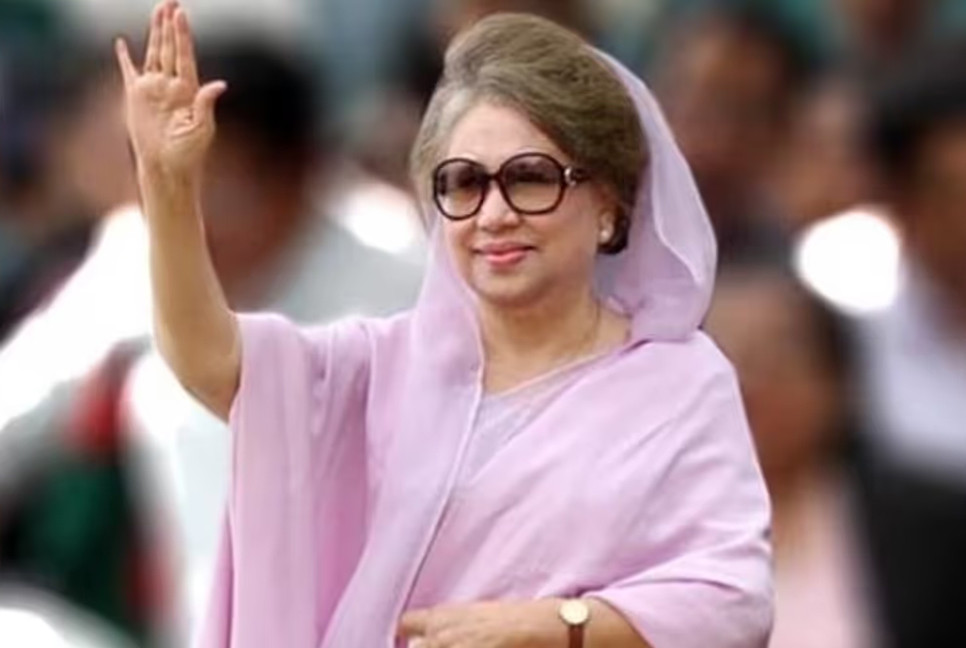
It was 1981. She had lost her husband. No one at the time could have imagined that a housewife would enter politics. After the assassination of Ziaur Rahman, the then Vice-President, Justice Abdus Sattar, became Acting President and Chairperson of the BNP.
In the early hours of 24 March 1982, Army Chief General Hussain Muhammad Ershad staged a military coup and ousted Justice Sattar from power. Thereafter, Justice Sattar gradually lost influence in party politics.
Following the killing of Ziaur Rahman, leaders and activists of the BNP—the political party he had founded—were left largely directionless. Serious questions arose about the party’s leadership and future. The party leadership was divided and internal conflicts were intense. Although Vice-President Justice Abdus Sattar assumed the role of Acting President, he was widely regarded in political circles as a “weak-willed” individual, and at 78 years of age he did not inspire confidence even within the party.
The late BNP leader Moudud Ahmed wrote in his book Ongoing History: Some Moments, Some Words that the greatest fear of the military and the ruling clique at the time was Khaleda Zia. This was because she could have emerged as the strongest contender for the presidency.
As a result, pressure grew within the BNP to bring Khaleda Zia into active politics. After Justice Sattar retired from politics, Khaleda Zia was appointed Acting Chairperson of the BNP on 12 January 1984, and Chairperson of the party on 1 May the same year. From that point onwards began Khaleda Zia’s political journey with the BNP, a journey that would see her lead the party for more than four decades.
Meanwhile, military ruler Hussain Muhammad Ershad toppled the BNP-led government and seized state power. From the very beginning of her leadership, Khaleda Zia was therefore forced to confront adverse circumstances. From then on, she had to advance through continuous movements and struggles.
In the fight to restore democracy in the country, she was imprisoned repeatedly. Even in her seventies, a former prime minister was forced to spend the final years of her life behind bars. Khaleda Zia’s unwavering stance on political and democratic issues earned her recognition as Bangladesh’s uncompromising leader. Beyond her firmness, she repeatedly demonstrated extraordinary patience in politics.
It was 1986. Bangladesh was supposed to resume its journey towards democracy. General Ershad arranged an election. At that time, the Awami League, the BNP and Jamaat-e-Islami jointly decided to boycott the polls, as all had pledged not to take part in any election held under Ershad. However, in the end, both the Awami League and Jamaat-e-Islami participated in the 1986 election organised by Ershad.
All had taken a collective oath not to contest elections under Ershad, declaring that anyone who did so would be branded a national traitor. Yet within just 48 hours, the Awami League and Jamaat-e-Islami reversed their position and joined the election. It was at this moment that the people of the country clearly realised how firm and unyielding Khaleda Zia was in her political stance. Eventually, the autocratic ruler Ershad fell in the face of a mass uprising.
Khaleda Zia later came to power through elections and served as Prime Minister on three occasions. From 1991 to 2008, she contested every parliamentary election held during that period. In some elections she stood in five constituencies, and in others in three, winning in every case.
In 2007, a military-backed government illegally assumed power. After the army-supported caretaker government took office, Khaleda Zia was arrested. In an interview with BBC Bangla, her former Deputy Press Secretary Syed Abdal Ahmed said that the so-called “One-Eleven” government had decided to send Khaleda Zia abroad. However, despite facing severe oppression and abuse, she refused to leave the country, honouring the promise she had made to the people of Bangladesh that she would not go into exile.
Subsequently, after the Awami League came to power, it abolished the caretaker government system through unlawful interference in the higher judiciary. In response, the BNP and several other political parties announced that they would not participate in elections held under a partisan government.
As a result of boycotting the one-sided election of 5 January 2014, the BNP had no representation in parliament. Politically, the party came under extreme pressure. The greatest challenge Khaleda Zia faced at the time was a series of conspiracy-driven corruption cases filed against her. Numerous BNP leaders and activists were implicated in cases, many were subjected to enforced disappearances and killings. Despite this, Khaleda Zia actively kept the BNP intact. Repeated attempts to break the party failed, and under her leadership the party’s leaders and activists remained united.
While Khaleda Zia was confronting political challenges, her personal life suffered a devastating blow around 2015. After her husband, she lost her younger son, Arafat Rahman Coco, while striving to uphold her promise to restore democracy in the country. Had she left the country in 2008, this tragedy might not have occurred. Yet even then, she continued to lead the party for the sake of the nation.
During the Awami League’s rule, on 8 February 2018, a court sentenced her to five years’ imprisonment in the conspiracy-driven Zia Orphanage Trust corruption case, later increasing the sentence to 10 years. She was also sentenced to prison in another politically motivated corruption case by the then authoritarian government.
Her health deteriorated severely in prison. Due to the lack of proper medical treatment during prolonged incarceration, she developed multiple serious illnesses. During the Covid-19 pandemic, Khaleda Zia was released on special conditions by executive order while undergoing hospital treatment. Even after her release, the then authoritarian government did not allow her to travel abroad for advanced medical care. Although she remained BNP Chairperson, she became largely inactive in politics from that point onwards. The party’s main leadership was gradually assumed from London by her elder son, Acting Chairperson Tarique Rahman.
There is no form of persecution that the Awami League did not inflict upon Khaleda Zia. After losing her husband, she lost a son; one case after another was imposed upon her. Countless party leaders and activists were subjected to enforced disappearances and killings. Efforts were also made in various ways to sideline her elder son from politics. Moreover, the political theatrics of the Awami League’s authoritarian ruler Sheikh Hasina became routine. Yet amid such immense suffering, Khaleda Zia continued to call for unity among the people and wished for peace across the country.
Following the fall of fascist Sheikh Hasina in the July 2024 uprising, Khaleda Zia was fully acquitted of all sentences by presidential executive order on 6 August. The previous day, 5 August—when Hasina fled the country—Khaleda Zia, while hospitalised, delivered a video message from her cabin calling on the nation to protect the country.
For months and years, BNP leaders and activists were subjected to brutal repression while being kept in prison. Many were victims of enforced disappearance and killing. Yet even during that dark and unbearable period, she spoke words of hope: “Those who love the country can never harm it.” In the final moments of her life, she left the people of the country with a profound message: “Not destruction, not revenge, not vengeance; let us build a society based on love, peace and knowledge.”
This was her politics: love over hatred, peace over violence, and unity over vengeance. Khaleda Zia’s ideals, and her deep love for the people and the country, make it clear that there is no alternative to unity if Bangladesh is to remain self-reliant and prosperous.
Author: Professor, Department of Marketing, University of Dhaka