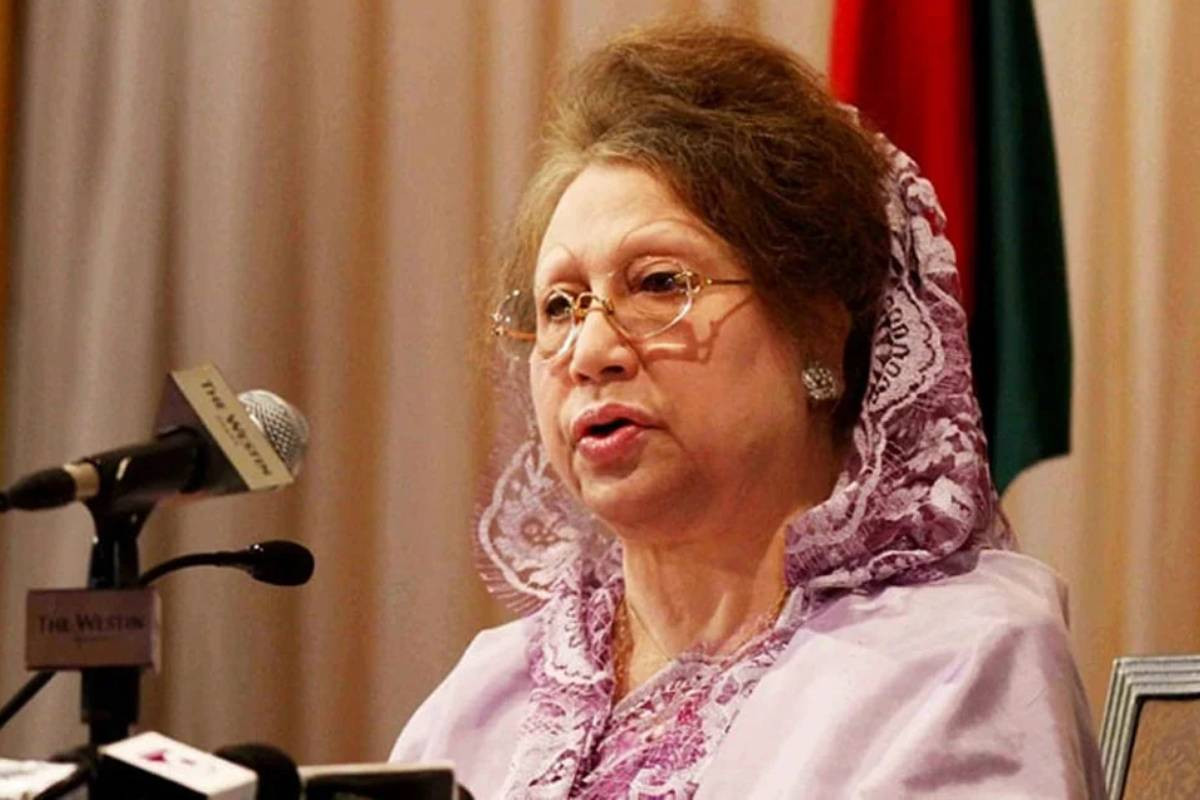
Begum Khaleda Zia rose to national leadership after winning the general elections held in the aftermath of the 1990 mass uprising. With her victory, she became the first female Prime Minister of Bangladesh and the second female Prime Minister of a Muslim-majority country in world history.
During her first term in office (1991–1996), Bangladesh regained macroeconomic stability, laying the groundwork for stronger economic growth in the years that followed. One of her key policy goals was to reduce the country’s heavy dependence on foreign aid, which had peaked during the final years of the HM Ershad regime.
Her close associate and Finance Minister, M. Saifur Rahman, played a crucial role in restoring economic discipline by emphasizing prudent fiscal management and macroeconomic stability. At the end of the previous regime, Bangladesh was almost entirely reliant on external assistance, a situation her government worked to reverse.
Major fiscal reforms were introduced during her tenure, including the implementation of Value Added Tax (VAT) and strengthened revenue collection. These measures helped improve economic governance and restore investor confidence. During her first term, Bangladesh’s GDP grew at an average annual rate of 4.5 percent, compared to 3.6 percent during the preceding period.
Her government enacted several landmark laws to strengthen financial and economic institutions, including the Banks and Companies Act (1991), the Financial Institutions Act (1993), and the Bangladesh Securities and Exchange Commission Act (1993). The establishment of the Privatization Board and the Securities and Exchange Commission further reinforced market confidence.
Education, particularly for girls, was a major focus of her administration. In January 1994, a nationwide stipend program for female students was introduced, alongside free education for girls up to Class 10. This was followed by initiatives such as the Women’s Secondary School Assistance Project (Phase II), the Women’s Secondary School Project, the Secondary Education Sector Development Project, and the Women’s Secondary Education Scholarship Project.
The Food for Education Programme, launched in 1993, was expanded to 1,255 unions by 1996. By 2001, with support from the World Food Programme, food assistance was extended to primary school students nationwide.
These initiatives led to notable improvements in gender parity in education. In 1991, the ratio of boys to girls in schools stood at 55:45; by 1996, it had narrowed to 52:48. Primary school enrollment increased significantly, with girls’ participation rising by approximately three million within five years.
In October 1993, The New York Times observed, “Now as Prime Minister, Mrs. Zia is giving great emphasis to girls’ education and technical training.”
The ready-made garment (RMG) sector experienced rapid expansion under her leadership. According to the Bangladesh Institute of Development Studies (BIDS), employment in the sector grew by 29 percent between 1990 and 1995. The number of garment factories increased from 834 in 1991 to 2,353 by mid-1996, while export earnings rose more than threefold.
Environmental protection also gained prominence during her tenure. Her government formulated Bangladesh’s first National Environmental Policy in 1992 and enacted the Bangladesh Environment Protection Act in 1995, providing a formal legal framework for environmental governance.
Soon after the BNP government took office, intensified persecution of the Rohingya population in Myanmar forced around 270,000 refugees to enter Bangladesh through the Cox’s Bazar border. Begum Zia provided them shelter and pursued diplomatic efforts for their repatriation.
Bangladesh raised the issue at the United Nations, and during her visit to the United States in March 1992, she urged President George H. W. Bush to pressure Myanmar. Subsequent negotiations facilitated by the UN High Commissioner for Refugees led to the repatriation of 229,483 Rohingyas.
Her government had been in power for only two months when Cyclone Gorky struck in April 1991, causing widespread devastation along the coast. With disaster management capacity still limited at the time, the Prime Minister personally visited affected areas and oversaw relief efforts. At her request, military forces from the United States, the United Kingdom, China, India, Pakistan, and Japan joined a large-scale humanitarian mission known as Operation Sea Angel.
Learning from the disaster, her government initiated a coastal green belt project in 1993 to mitigate future cyclone damage. The Asian Development Bank approved the project in March 1995, and the loan agreement was signed the following month. This green belt later played a significant role in reducing the impact of subsequent cyclones.
Bd-pratidin English/ Jisan