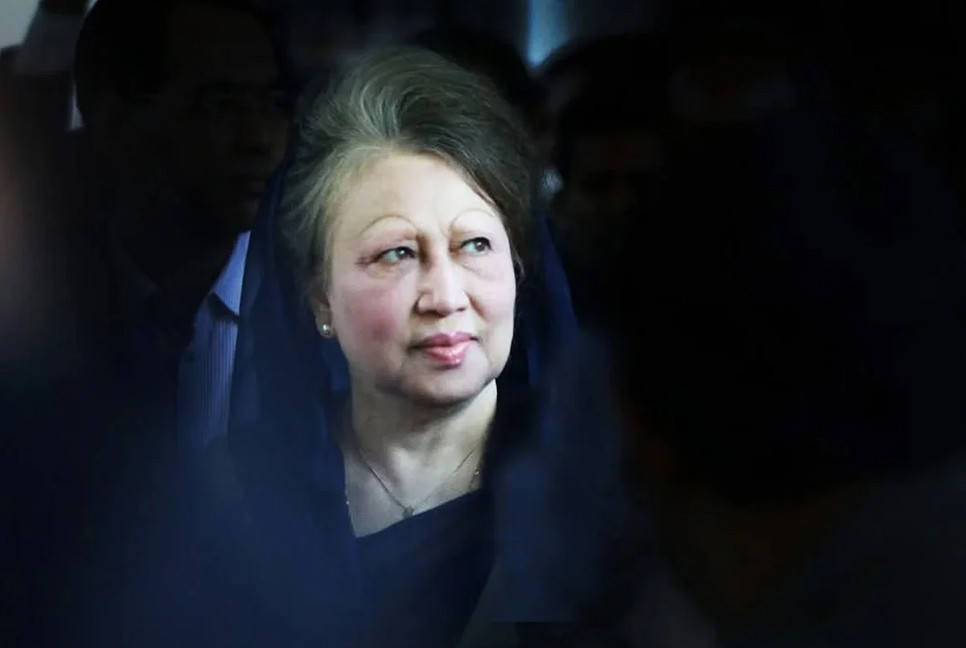
Among the few stars who have shaped or continue to shape the leadership sky of Bangladesh, Khaleda Zia has carved out a distinct place for herself with her own stature. For more than four decades, she has walked the difficult path of politics and, step by step, drawn a portrait of herself through intellect, hard work, sacrifice, and love—one that can truly be described as incomparable. Rising above everything, she became the standard-bearer of democracy and emerged as the symbol of Bangladesh’s unity.
On 30 May 1981, martyred President Ziaur Rahman was brutally assassinated in a military coup at the Chattogram Circuit House. In the grief-stricken and shattered sky of Bangladesh, vultures spread their wings. To save the country and prevent the party from disintegrating, a housewife stepped forward—Khaleda Zia, the wife of martyred President Ziaur Rahman. On 3 January 1982, she joined the Bangladesh Nationalist Party (BNP). Soon after, vulture-like military rule took form and tore apart Bangladesh’s democracy with its ruthless grip.
Khaleda Zia then began the second struggle of her life. On 26 March 1971, before the sun had risen, in the dim pre-dawn darkness, nearly 300 soldiers of the 8th East Bengal Regiment marched along the railway line toward Kalurghat Bridge with anxious yet resolute steps. The leader was the unit’s second-in-command, Major Ziaur Rahman.
As the troops passed by his residence, his associate Lt Shamsher Mobin said, “You are leaving, but sister-in-law and the children are at home.” Major Zia replied, “On the spot, we are all soldiers. I am the leader. So about the families of the three hundred men coming with us—if I cannot protect their families, I should not protect mine.”
Thus began the first struggle of the great leader’s noble wife, with uncertainty and fear as constant companions. Khaleda Zia spent terrifying nights with her two young children. The next day, she moved to the house of a close relative in Chattogram and stayed there until mid-May. On 16 May 1971, she came to Dhaka and, for security reasons, kept moving between relatives’ homes. But eventually, on 2 July 1971, she was arrested by the Pakistani occupying forces from a relative’s house in Siddheshwari. Until 16 December 1971, she remained interned at Dhaka Cantonment with her two children. While her husband was engaged in armed resistance against the Pakistani forces in the Liberation War, she was fleeing in fear for her life with two innocent children. This fear haunted her until the final day of the war. Nine months of flight and internment enriched her with wisdom, prudence, and a deep sense of life. She acquired an indomitable strength of uncompromising resolve, whose reflection became evident after 1981.
Her second struggle was the struggle to restore democracy against an autocrat. It was the struggle to restore the sovereignty of the people’s will. It was the struggle to re-establish the Bangladesh Nationalist Party and Bangladeshi nationalism. After being elected BNP Chairperson in 1984, she not only prevented party fragmentation and restored discipline but also built an indomitable resistance and simultaneous movement against the “world’s shameless ruler” through alliance politics. Throughout the murky journey of politics, she was repeatedly confined to her home, imprisoned, betrayed, and subjected to vulgar political indecency. Yet she never lost her grace or compromised. She fought relentlessly for a system that reflected the people’s will.
In 1986, when the simultaneous movement to end military rule and return to democracy peaked, the Awami League betrayed the movement by participating in a compromised election with the autocrat. Her decision to boycott the 1986 election stands as a prime example of her political maturity. She emerged as a truly national leader, for whom power was secondary to the country and its people. This love for the nation and her uncompromising firmness turned her into one of the brightest stars. Tireless labor, relentless public outreach, and indomitable strategy bore fruit on 4 December 1990, when Hussain Muhammad Ershad announced his resignation, formally stepping down on 6 December. Under a neutral caretaker government, BNP won the Fifth National Parliamentary Election, and on 20 March 1991, Khaleda Zia took oath as the country’s first female Prime Minister.
Entering politics meant an entirely new life for her—one marked by immaturity, fear, imprisonment, and obstacles. Through all these trials, she demonstrated patience, steadiness, and confidence.
After political turmoil and ups and downs, upon completing her third term as Prime Minister, she entered the third struggle of her life on 11 January 2007. The army-backed caretaker government of One-Eleven not only imprisoned her but also physically tortured her eldest son, Tarique Rahman, leaving him almost disabled. Corruption cases were filed against her younger son Arafat Rahman Koko and others. The objective was to isolate her from politics and render her irrelevant. Yet she neither broke nor lost hope and rejected all proposals of exile. However, she paid a heavy price—both her sons had to go abroad for advanced medical treatment.
Through deep collusion and conspiracy with the army-backed caretaker government, the Bangladesh Awami League secured a majority in the 2008 national election. On 6 January 2009, Sheikh Hasina took oath as Prime Minister. From then on, Sheikh Hasina unleashed all state machinery not only to politically but also personally humiliate Khaleda Zia—evicting her from her home, attacking her motorcade, filing weapons cases, obstructing her political activities, and placing her under house arrest. Despite all this, her popularity never diminished. In 2018, the authoritarian Sheikh Hasina government sentenced her to 18 years of rigorous imprisonment in two fabricated corruption cases to permanently banish her from politics. Yet the national leader stood firm, refusing any compromise or submission.
Facing a mass uprising, then Prime Minister Sheikh Hasina resigned on 5 August 2024 and fled to neighboring India. Khaleda Zia was released from prison on 6 August. On 21 November 2025, after six years, she appeared before the public for the first time by attending the Armed Forces Day ceremony. In January 2025, a five-member bench of the Bangladesh Supreme Court overturned her conviction in the 2008 corruption case. She was freed from false charges, but prolonged imprisonment and medical neglect made her largely reclusive even after receiving treatment abroad.
Khaleda Zia is not just a political leader; she is an institution in Bangladesh’s politics and society. By restoring parliamentary democracy in 1991, she strengthened the country’s democratic process. Her three terms as Prime Minister, her role as a female leader, women’s empowerment, political participation, and women’s rise in decision-making hold immense significance in national history. She served as party leader, opposition leader, and Prime Minister—leaving a lasting impact on Bangladesh’s politics.
Starting as a housewife, she emerged in the early 1990s as one of Bangladesh’s most powerful political leaders through political turmoil and personal tragedy. Those who sought to place her in politics only to control the party from behind failed, as Khaleda Zia surpassed them all through merit and extraordinary personality. Her unyielding mental strength, courage, uncompromising stance, and patriotism—much like her husband’s—made Begum Zia unique in politics.
She is a woman who became Bangladesh’s first female Prime Minister, who led a political party, who sought to change people’s lives—sometimes successfully, sometimes amid controversy. Her life is not merely personal; it is a chapter in Bangladesh’s political and social history. Her rise, journey, sacrifices, and struggles teach us that power, struggle, sacrifice, and decisions are never easy. Yet in the judgment of history, Khaleda Zia’s name remains inseparable. She was and remains the symbol of “democracy, nationalism, and national unity.”
For the past two weeks, she has been undergoing treatment in a critical condition at a hospital in the capital. This is the fourth struggle of her life. The people of Bangladesh are praying to the Almighty for this extraordinary leader’s recovery.
Come back to us, leader. Bangladesh needs you dearly at this moment.
Writer: Senior Research Fellow, Foundation for Strategic and Development Studies.