The people’s love for Begum Khaleda Zia is an immense blessing from Almighty Allah for her. The public’s affection for her party, the BNP, also stems from her uncompromising role in bringing down the autocratic Ershad regime and restoring people’s rights.
Even after leaving the office of prime minister two decades ago, and despite attempts by the Fakhruddin–Moeen Uddin caretaker government and later the Sheikh Hasina administration to tarnish her reputation through accusations, defamation and mockery while keeping her imprisoned, the people’s love for her could not be erased from their hearts. Since she was admitted to the hospital in critical condition, the anxiety, tears, and prayers across the country have shown how deeply the people love her.
Why do the people love her so much? After taking oath as the country’s first female prime minister in 1991, she fulfilled her responsibilities for the next five years rising above greed and self-interest. The public saw in her the image of the martyred President Ziaur Rahman, who had been killed in a conspiracy a decade earlier. When the Fakhruddin–Moeen Uddin caretaker government that came under the so-called “1/11” attempted to pressure her into leaving the country, she firmly declared, “I will not leave the country or its people. This country is my only home. I have nothing outside this country, no other address.”
Whom will the people love—Begum Khaleda Zia, or those who run to a neighbouring country at the slightest personal danger and join in slogans like “Mera Bharat Mahan”?
Begum Khaleda Zia’s condition remains critical, and she is not out of danger. Since her admission to Evercare Hospital, reports of her deteriorating health continued. However, on Friday, the medical board treating her shared some hopeful news: as she is suffering from pneumonia, the mucus in her lungs is being cleared. Still, complications in her heart, liver, kidneys, and lungs persist. A slight improvement in one area is followed by deterioration in another. Doctors say they are hopeful because she is responding to the treatment and the medicines are working. Whether she will be taken to London by air ambulance for advanced care depends on the medical board’s final decision. If everything goes well, she will be flown to London soon. The people will anxiously await her recovery and return.
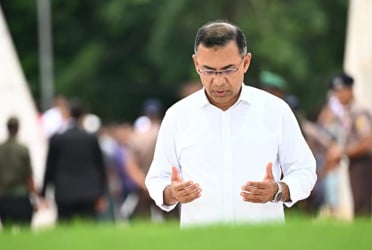
Last Wednesday, in one of my writings, I discussed Begum Khaleda Zia’s critical physical condition and the importance of BNP Acting Chairman Tarique Rahman being by his mother’s side while she stands at the threshold between life and death. I also raised questions about the reasons for his absence from the country during such a moment, especially on the eve of a national election, and the role he might play in guiding the nation through this crisis.
Saleh Shibli, the member in charge of the BNP Media Team, contacted me from London to provide updates on Khaleda Zia’s treatment arrangements. He also mentioned that there is confusion in the media about the various statements regarding Tarique Rahman’s return or the delay in his return. When asked whether security concerns were the main reason for his not returning, Shibli said security is indeed one factor, but not the primary one. After Khaleda Zia was admitted to Evercare Hospital, speculation grew—especially in Bangladeshi media—about Tarique Rahman’s return. When he wrote on social media that his decision to return was “not under his sole control,” many believed the key reason for his hesitation was security concerns. Later, law enforcement agencies stated that the highest level of security had been arranged for him and that he could even receive Special Security Force (SSF) protection upon arrival in Bangladesh.
The government would make a decision in due course. In Bangladesh, the President, the Prime Minister, and individuals of equivalent rank receive SSF protection. Recently, the government declared BNP Chairperson and former Prime Minister Begum Khaleda Zia an “extremely important person,” granting her SSF security. Intelligence sources also confirmed that there is no security threat preventing Tarique Rahman from returning, and that he would receive maximum protection.
The government may have ensured the “highest” degree of security for Tarique Rahman. But history proves that there is no such thing as absolute or foolproof security. Even within the most trusted circles, danger can lurk. In July 1987, during a guard inspection in Colombo, a Sri Lankan Navy personnel broke rank and struck Indian Prime Minister Rajiv Gandhi hard on the shoulder with his rifle. No one can know what anyone harbours within their mind—only the Creator knows that.
Outside those protected by the SSF, Tarique Rahman is currently the most important political figure in Bangladesh. He has loyal supporters willing to give their lives for him, and equally, there are those who harbour deep resentment and may seek to harm him. It is widely known how he was subjected to brutal physical torture during the 1/11 regime, leaving him nearly disabled. Therefore, unless absolute security is ensured for his return, movement, and participation in the upcoming national election campaign, the parliamentary election scheduled for February may fall into uncertainty—a situation undesirable for all. The nation wants the election to be held on time so that the unelected interim government can hand over power to an elected administration without delay.
Unwanted incidents take only a moment to occur. In the blink of an eye, tragedy can strike. Readers may recall the assassination of Philippine opposition leader Senator Benigno Aquino on 21 August 1983 at Manila International Airport, despite a heavy security presence of more than a thousand soldiers and security officers. Aquino had been one of the fiercest critics and strongest rivals of President Marcos. After three years of self-imposed exile in the United States, he was returning to contest the expected election. When asked about the risks to his life during the flight, he famously said: “I am aware of the danger. Murder is a part of public service in the Philippines. If a bullet kills me, so be it.”
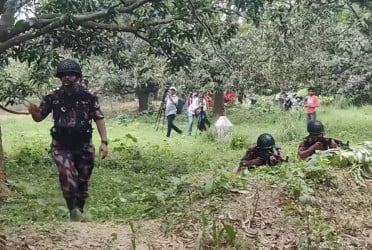
When the aircraft landed, soldiers boarded the plane and took him into custody. As they escorted him toward a vehicle waiting to take him to prison, an assassin shot him. Before the soldiers could react, they saw Aquino lying on the tarmac in a pool of blood. Only one bullet, fired with deadly precision, struck his head. The assassin was immediately killed by soldiers. President Marcos later said the killer was a “professional assassin.” Are there no such sharpshooters in Bangladesh? A retired Bangladeshi army major once wrote in a Facebook post about his shooting skills, saying something to the effect of: “Just tell me which seed you want me to hit.” For trained personnel, hitting a target is no challenge. And there are always criminals and professional killers with similar abilities. Illegal sniper rifles also circulate in the country. Therefore, every possible risk to Tarique Rahman’s life must be eliminated.
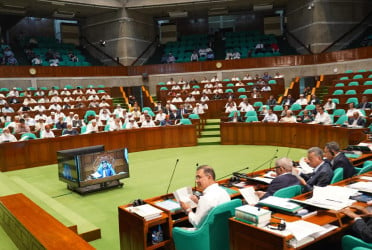
The people of Bangladesh are now confronted with several major issues, the most important of which are: Begum Khaleda Zia’s recovery, Tarique Rahman’s return, and the national parliamentary election scheduled in only two months. There is no doubt that the Awami League and associated militant groups—acting on the instigation of Sheikh Hasina, who is fleeing conviction in India in a crimes-against-humanity case—will try desperately to carry out acts of sabotage to disrupt or undermine the election. Law enforcement must take strict measures to prevent such activities in advance. Additionally, no other issue should be allowed to create an excuse to delay the election, and all relevant authorities must remain alert to this.
Author: Senior journalist based in the United States.