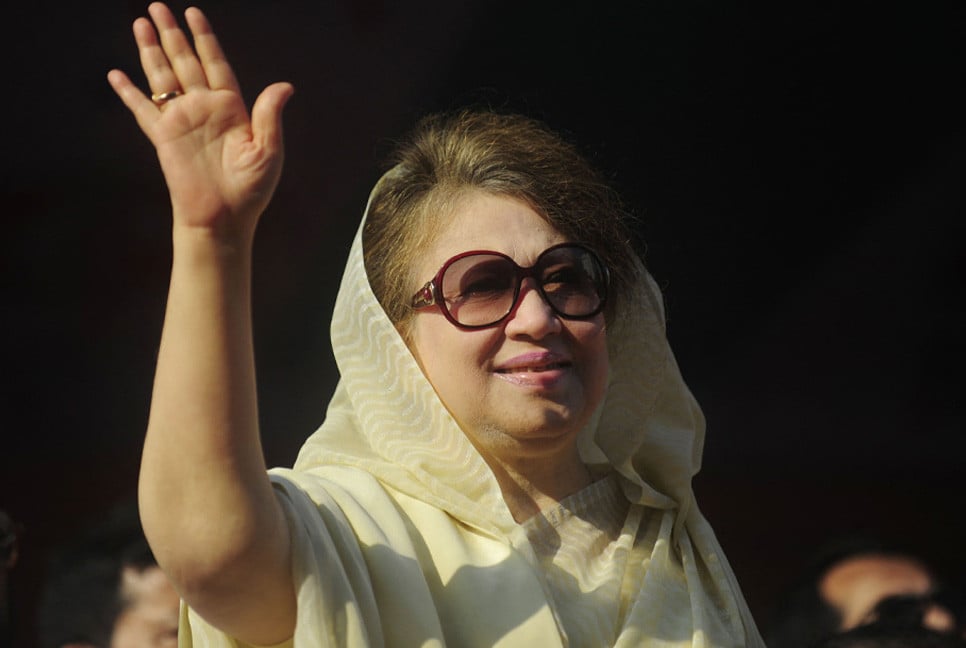
BNP Chairperson Begum Khaleda Zia has played a key role in every major democratic movement in Bangladesh, starting with the anti-Ershad protests, and has consistently been successful in defending democratic rights.
Known as an uncompromising leader, Begum Khaleda Zia is the heart of Bangladesh’s nationalist movement. She was elected prime minister of Bangladesh three times with overwhelming popularity. She was the first female prime minister of Bangladesh and the second female prime minister in the Muslim world.
After President Ziaur Rahman was martyred on 30 May 1981 by a group of miscreants within the military, leaders and activists at various levels of the Bangladesh Nationalist Party urged Begum Khaleda Zia to join the party. She joined BNP on 3 January 1982 as a primary member. In March 1983, she became the party’s Senior Vice Chairman. On 1 April 1983, she delivered her first speech at the party’s extended meeting. When Justice Abdus Sattar fell ill, she served as the Acting Chairperson of the party. On 10 May 1984, she was elected unopposed as the Chairperson of the party. Under her leadership, BNP experienced full organisational growth.
In 1983, under the leadership of Begum Khaleda Zia, a seven-party alliance was formed. During the same period, a movement against Ershad’s military rule began. Starting in September 1983, she led the BNP and the seven-party alliance in launching the anti-Ershad movement. At the same time, under her leadership, the seven-party alliance jointly coordinated movement programmes with the 15-party alliance led by the Awami League. The five-phase movement continued until 1986.
However, on the night of 21 March 1986, Awami League President Sheikh Hasina decided to participate in the election under Ershad, which disrupted the united movement. The 15-party alliance eventually split into groups of eight and five parties. The eight-party group joined the election. Begum Zia continued the movement using the seven-party and five-party alliances and rejected the election.
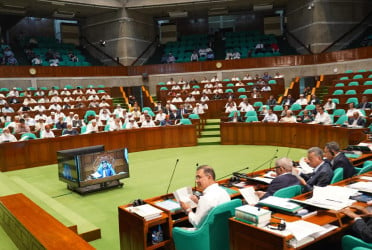
From 1987, Khaleda Zia began the “Oust Ershad” one-point movement. As a result, Ershad dissolved Parliament. The united movement resumed. After eight long years of tireless and uncompromising struggle, the BNP won an absolute majority in the parliamentary election held on 27 February 1991. In that election, Begum Khaleda Zia contested five constituencies and won all of them. She became prime minister on 19 March 1991. Her government reestablished the parliamentary system. On 2 April, she introduced the bill in Parliament on behalf of the government. On the same day, she brought the Eleventh Amendment Bill allowing Chief Justice Shahabuddin Ahmed, head of the caretaker government, to return to his post. On 6 August 1991, Parliament unanimously passed both bills.
After being elected in the Sixth National Parliamentary Election in 1996, Begum Khaleda Zia became prime minister for the second time. In the Eighth National Parliamentary Election, the BNP-led four-party alliance won overwhelmingly, forming the government, and Khaleda Zia became prime minister for the third time.
Since joining BNP as a primary member on 3 January 1982, she has been arrested five times. She was first arrested on 28 November 1983 during the anti-Ershad movement. Her second arrest was on 3 May 1984, and the third on 11 November 1987. On 3 September 2007, she was arrested along with her two sons, and on 11 September 2008 she was released on a High Court order. Most recently, on 8 February 2018, Judge Dr Md Akhtaruzzaman of Dhaka’s Special Judge Court-5 sentenced her to five years in the Zia Orphanage Trust case. That same day, she was taken to the old central jail beside the court, where she remained the only inmate. Despite committing no crime, she had to remain imprisoned for years as a victim of Sheikh Hasina’s political vengeance.
The Sheikh Hasina government evicted Bangladesh’s most popular leader, Begum Khaleda Zia, from her home. Her two sons—key figures in the nationalist movement, BNP Acting Chairman Tarique Rahman and Arafat Rahman—were harassed with false cases. Arafat Rahman’s premature death resulted from this persecution. The inhumane treatment inflicted on Khaleda Zia is unforgivable. As an uncompromising leader, she has repeatedly proven her resolve. For her struggle to establish democracy, she will forever remain a leader cherished by the people of Bangladesh.
Bd-Pratidin English/ AM