Even after 28 years since the signing of the Chittagong Hill Tracts (CHT) Accord, there is still confusion over its expectations and actual outcomes. For millions of hill residents, the assessment is particularly relevant: has the peace accord brought genuine peace to the hills, or has it only added complexity? Before the Accord, various national political parties, through the Parbatya Chattgram Jana Samhati Samiti (PCJSS), created unrest in the hills under the guise of ‘peace forces’. These forces established a reign of extortion, murder, abduction, and terror, despite their nominal titles.
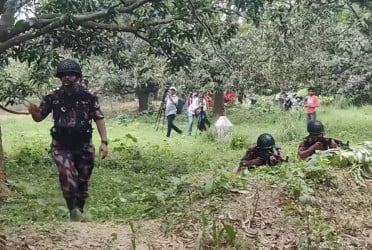
Even after divisions emerged among these groups post-accord, terror did not stop. Only military vigilance has curbed it to some extent. Civil administration or other forces are largely ignored by these armed groups. The Bangladesh Army, committed to safeguarding independence and sovereignty, continues to prevent any attempts to destabilize the CHT. This commitment frustrates the criminal networks, who periodically hype demands for military withdrawal and attempt to rally intellectuals, teachers, and NGOs in support.
On 2 December 1997, the government signed a peace accord with the JSS to ensure peace in the hill districts. Named the ‘Peace Accord’, it failed to bring the intended calm. The perpetrators of unrest merely reorganized and intensified violence under new or old banners. Various armed groups such as PCJSS-MN Larma group, United People’s Democratic Front (UPDF-Reform), Kuki-Chin National Army (KNF), and Mro National Party/Army (MNP), claiming to protect their own ethnic interests, continued extortion, murder, abduction, and territorial dominance.
After the accord, although armed groups gained freer mobility, they continued extortion activities. They divided the CHT into zones of influence and maintained terror through killings and abductions. Some UPDF factions even staged fake incidents of sexual assault to incite communal tensions, often with support from India. The reduction in army camps post-accord was seen as an opportunity by these groups to regroup and strengthen.
Currently, there are 90 army camps in Khagrachhari, 70 in Rangamati, and 50 in Bandarban, totaling 210. Security analysts consider this insufficient given the terrain and strategic challenges. Remote border areas require constant monitoring and rapid response to safeguard sovereignty. Expanding camps is under the Ministry of Defence’s authority, but field units are maximizing current capacity and taking preventive measures against misinformation.
Extortion, abductions, and killings by the UPDF and allied groups continue. Since 2009, approximately 332 people have been abducted by armed groups, including hill community members, and around 89 have been killed, including 16 military and security personnel. Records also include the abduction of five students from Chittagong University. This issue is not confined to the CHT alone but is a significant regional challenge, often manipulated politically and influenced by foreign actors. While some local and international organizations call for demilitarization, real experience shows the army remains the main guarantor of peace and stability in the hills.
For local hill communities, the army is a symbol of security. Over time, the Bangladesh Army has contributed not only to security but also to development: constructing schools, hospitals, roads, and bridges; providing medical care; and delivering food aid to remote villages. These efforts have earned the trust of local residents. People in remote areas of Bandarban, Rangamati, and Khagrachhari recognize that without army patrols, peaceful nights are impossible.
Sustainable peace in the hills requires not just political agreements but also security. Reducing army presence endangers local communities and weakens national security, as the CHT is a strategic region bordering Myanmar, involving complex issues like the Rohingya crisis, border instability, and cross-border drug trafficking. A stable administrative system is unimaginable without army support.
Army presence in the CHT balances development and security. Peace in the hills must also be built through participatory governance and development initiatives. The army acts as a bridge, integrating education, healthcare, infrastructure, and social cohesion. In recent years, army-run medical camps, educational supplies distribution, and agriculture and water projects have brought tangible improvements to local lives.
These are not merely humanitarian efforts—they build trust. Resolving the CHT issue is essential for national unity. Historically, the hills have a long, painful history of terrorism and killings. During British rule, the region was largely outside direct administration, governed by local kings and ethnic leaders. During Pakistan’s era, neglect led to social unrest and eventually armed group formation.
While the JSS, formed in 1972, demanded autonomy, land rights, and participation in development, conflict persisted, affecting many Bengalis due to political instability and local leadership dynamics. Between 1980 and 1992, conflicts with armed groups killed nearly 400 army personnel and at least 30,000 Bengalis, displacing hundreds of families. The post-1997 peace accord failed to curb armed groups fully.
Internal security and border threats remain primarily the army’s responsibility. From the beginning of anti-terror operations in the CHT, the army has coordinated with other forces. Covering the unique terrain of the CHT—Rangamati, Khagrachhari, and Bandarban—the Bangladesh Army operates under extreme risk to maintain peace, harmony, and development. The army’s initiatives have significantly improved living conditions, infrastructure, and trust in the region. Attempts to remove the army now could jeopardize not only the CHT but the entire country.
Author: Journalist-Columnist