“I had two brothers. Now both are gone,” said Fatema Begum, sister of 28-year-old Imran Khan from Adityapur village of Madaripur Sadar upazila. “Imran gave Tk22 lakh to a middleman named Shipon Khan to go to Italy. When he reached Libya, Shipon demanded Tk20 lakh more. My father sold everything and paid it. Then Shipon told us that Imran was shot dead at sea, and they threw his body away.”
Fatema spoke over the phone on Friday, breaking down in tears. Her elderly parents – 80-year-old Tyeb Ali and 65-year-old Rehena Begum – are now left with nothing. After their eldest son Rayhan died seven years ago, Imran had been the family’s last hope.
Middleman Shipon is also from the same village. He has been living in Libya for 10 years. Shipon sent many people to Italy through illegal routes, not only from his own area but also from different parts of Madaripur.
Locals claim that over the past several years, he has sent more than 50 youths to Italy. His brother Selim Khan directly assists him in this work. After Imran’s death, Selim and other family members fled home.
Fatema said after graduating from Madaripur Govt College, Imran was unable to find a job or a proper legal way to migrate to a European country.
He is one of four Bangladeshis who were shot dead by traffickers on 13 November after two boats carrying 95 irregular migrants, including 26 Bangladeshis in the first boat, capsized off the Libyan coastal city of Al Khums.
His story mirrors that of countless others deceived, harassed, tortured, or killed by reckless middlemen.
Experts observe that the gradual closure of several key international labour markets for Bangladeshis is pushing aspiring migrant workers towards middlemen, giving human trafficking syndicates – already operating with impunity due to weak prosecution and delay in justice – greater opportunities to exploit them.
Consequently, the stream of bodies of the victims and repatriation of irregular workers – many deceived, abused, or tormented abroad, especially in Libya – keep growing, and their families, along with the survivors themselves, are being forced to endure prolonged fear and uncertainty.
“Human trafficking in Bangladesh has gone unabated for two reasons. Firstly, the number of international destinations for Bangladeshi workers has decreased significantly, limiting the options for legal migration. Secondly, the syndicates involved in human trafficking hardly face punishments amid delays in trial proceedings,” migration expert Asif Munier told the media.
“If you look at the human trafficking trend of our country, the way towards Malaysia and Libya are two crucial routes of the crime. Especially, the tendency of sending workers to Italy through Libya, crossing the Mediterranean, has escalated in recent years. Police have to play a proactive role to arrest criminals to stop this,” he added.
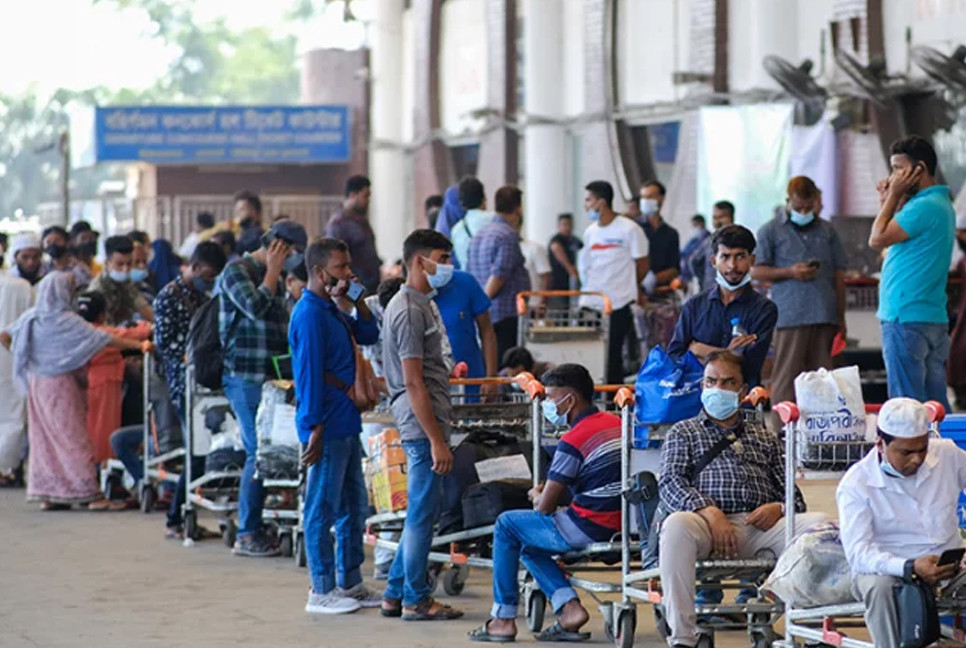
Some 63,952 Bangladeshi workers have returned from different countries in the first 10 months of this year, according to Expatriates’ Welfare Desk at Hazrat Shahjalal International Airport. Crucial labour markets like the UAE, Oman, Bahrain, Malaysia and Qatar are either closed or shrunk.
Bangladesh has emerged as the leading country of origin for people attempting to reach Italy by crossing the Mediterranean via Libya, according to Frontex, the European Border and Coast Guard Agency.
At least 92,427 Bangladeshis made their way to Europe through this route, with many others perishing during the dangerous journey from 2009 till last year. In the first six months of the current year, at least 9,735 Bangladeshis travelled to Italy through this perilous route, according to the Frontex findings.
People from at least 10-12 districts in Bangladesh, including Madaripur, Shariatpur, Sylhet and Sunamganj, are desperately trying to reach Europe through this route.
On the other hand, some 48,000 undocumented Bangladeshi aspirant workers have voluntarily returned from Libya since 2011. According to the Labour Welfare Wing of the Bangladesh Embassy in Tripoli, a total of 7,171 Bangladeshis have been repatriated to Dhaka from June 2023 to date.
BRAC’s Migration Program, in its recent information, indicates that human traffickers are no longer relying solely on sea routes. The routes of human trafficking have been expanded to Dubai-Serbia-Slovenia to Italy, or via Saudi Arabia to Russia from the Dubai-Libya to Europe route.
Besides, traffickers are now using visit visas, conference invitations, work permits, and even Hajj visas to materialise their purpose. According to BRAC, traffickers lure Bangladeshi women to Dubai with promises of work in beauty parlours or restaurants and then force them into dance clubs and the sex trade.
In addition, Bangladeshis are falling victim to brutal cyber scams. Simultaneously, under the pretext of sending people to Europe, traffickers are sending Bangladeshis to countries across Central Asia, including Nepal and Kyrgyzstan.
Moreover, traffickers are currently using countries such as Algeria, Mauritania, Tunisia, Russia, Cambodia, Vietnam, and Serbia.
A total of 4,546 cases were filed on human trafficking charges from 2019 to January this year. Some 19,280 individuals have been named as accused in these cases, according to the Ministry of Home Affairs and the Bangladesh United Nations Network on Migration (BDUNNM) Counter-Trafficking in Persons Technical Working Group.
On the completion of judicial proceedings, only 157 people were convicted. Among them, 24 received life sentences, and 133 were given different terms of imprisonment. It means less than 1% has been brought to justice.
Despite the severity of the allegations in these cases, there is no notable instance of exemplary punishment. In contrast, over the past six years, 3,141 people have been acquitted in human-trafficking cases. The highest number of acquittals occurred in the last two years.
The Daily Sun contacted various wings of the Ministry of Expatriates’ Welfare and Overseas Employment to know what measures the government is taking to prevent human trafficking.
Officials of the ministry did not wish to provide a clear statement on the issue. Senior Secretary Dr Neamat Ullah Bhuiyan asked this correspondent to talk to the adviser, saying he is not fully aware of this.
Assistant Inspector General (Media) of Police AHM Shahadat Hossain described human trafficking as an international and organised crime involving a network of racketeers, brokers, and collaborators abroad.
“Poverty, unemployment, the desire to migrate, and the lure of fraudulent job offers are all challenges in controlling human trafficking. Often, victims themselves approach brokers through family or relatives, which makes collecting evidence and testimony difficult. Because international legal procedures are lengthy and complex, swift trials are often not possible,” he told the media.
The police official also said efforts by law enforcement agencies alone are not enough to prevent human trafficking, stressing the cooperation of the families, society, and international stakeholders.
Asif Munier, however, sees a lack of coordination between the Ministry of Home Affairs and the Ministry of Expatriates’ Welfare and Overseas Employment regarding human-trafficking incidents.
“The Ministry of Foreign Affairs also needs coordination with the governments of the countries where Bangladeshis go for work. The current interim government is having to focus more on the internal political context and law-and-order situation. As a result, enforcement of laws related to migration-related crimes may be receiving less priority,” he said.
Courtesy: Daily Sun.
Bd-pratidin English/TR