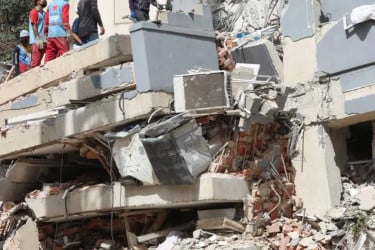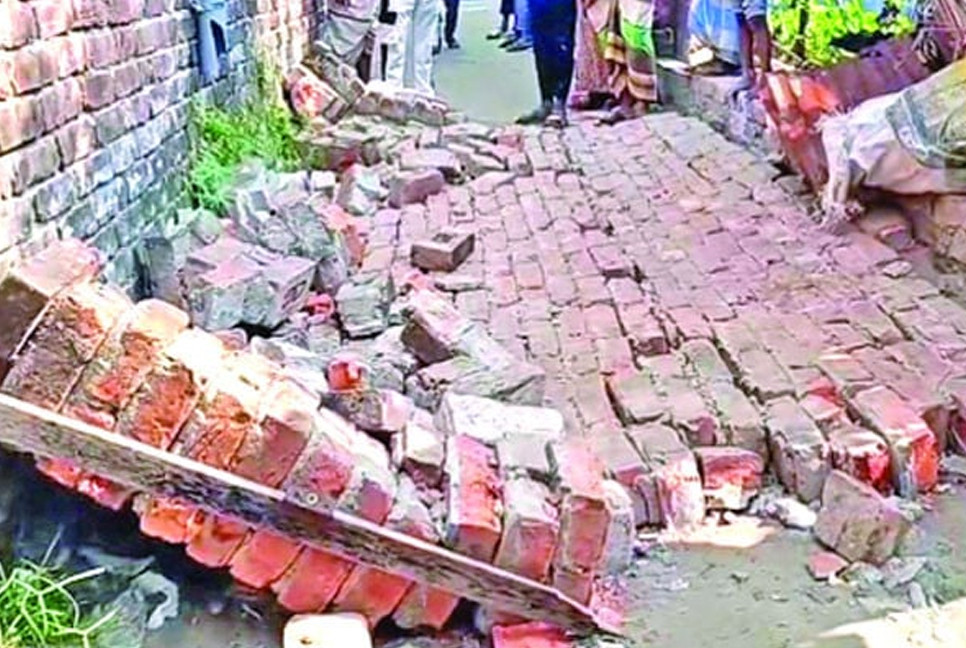
Many buildings in Old Dhaka, Sylhet and Chattogram are at grave risk of collapsing and becoming ruins in a strong earthquake.
In the event of a major earthquake, six lakh buildings in Dhaka are at the highest risk, most of which are in Old Dhaka. In addition, Sylhet is located in one of the most vulnerable earthquake areas in the country. This district is under the influence of the neighboring Dawki Fault and locally generated earthquakes. The old buildings here will be reduced to ruins only if there is an earthquake of magnitude 5.7. Similarly. There are 3 lakh 82 thousand 111 buildings in Chattogram city, of which 70 to 75 percent of the buildings are at risk of becoming ruins.
Experts fear that an earthquake of magnitude 8.2 to 9 on the Richter scale is likely to occur in the future. The capital is most at risk, and population density, unplanned urbanization, construction of buildings in violation of building codes, poor road infrastructure and lack of necessary preparation have created this risk.
As a result, there is a risk of extensive damage in moderate to severe earthquakes. Mehedi Ahmed Ansari, a professor at the Department of Civil Engineering at Bangladesh University of Engineering and Technology and an earthquake researcher, said, "If buildings are built without following building codes, the damage will be greater - this is normal. As a result, it is important to identify risky buildings now and take action. Especially in case of the unplanned buildings that are still being built in big cities of the country including Dhaka and Chattogram, the risk of danger is increasing.”
Our staff reporter from Sylhet said that Sylhet is being shaken repeatedly by earthquakes. Sometimes the earthquake originates from the Dawki fault in Meghalaya, India, adjacent to the Sylhet border, and sometimes the origin is in various places in Sylhet division.
Experts say that the number of earthquakes is increasing as local faults or fractures that have been inactive for a long time are becoming active. As a result, the risk of disaster is increasing in Sylhet, which is in the 'danger zone' of earthquakes. They fear that if the earthquake felt in Dhaka last Friday had occurred in Sylhet, old buildings would have been reduced to rubble. They have identified Sylhet as one of the country's most vulnerable areas for earthquakes due to its geological structure. One of the reasons for this is the Dawki Fault in Meghalaya, India. On June 12, 1897, an earthquake originating from that fault turned a large part of greater Sylhet to rubble, which is known as the 'Big Bhuishal' in the history of Sylhet. After that, earthquakes have occurred from that fault at various times, but no major damage has been caused. But this active fault has repeatedly indicated major earthquakes and disasters.
In May 2021, 20 earthquakes were felt in Sylhet within 10 days. Of these, some originated near the Dawki Fault. The rest originated in Sylhet Division. At that time, 22 buildings were identified as risky.
Dr. Zahir Bin Alam, Professor of the Department of Environmental and Civil Engineering at Shahjalal University of Science and Technology, sees the Dhaka earthquake on Friday as a warning sign for Sylhet. According to him, the 'Madhupur Fault Line', the origin of the 5.7 magnitude earthquake felt in Dhaka, had been inactive for so long. It has suddenly become active. Expressing the fear that old buildings will be turned into rubble if a 5.7 magnitude earthquake is felt in Sylhet, Dr. Zahir Bin Alam said, "The damage to new buildings in Dhaka has been minimal. If such an earthquake occurs in Sylhet, there is a risk that old and non-engineering buildings will be reduced to rubble."
He mentioned that Sylhet has only 30-40 percent capacity to deal with major disasters. The entire suburban residential area of the city has been built by filling in the water bodies. There are also many high-rise buildings here. Therefore, there is a risk of more damage in that area if a major earthquake occurs.
Our correspondent from Chattogram said that there are currently 382,111 buildings in Chattogram city. Of these, 70 to 75 percent of the buildings are at risk of earthquakes. There is a possibility of extensive damage if an earthquake of magnitude 7.5 to 8 occurs because Chattogram city is one of the earthquake-prone areas of the country, and the buildings there do not have any earthquake-resistant systems.
According to sources from the Chattogram Development Authority (Chowk), there are currently 382,111 buildings in the city. Of these, 278,05 are single-storey buildings, 90,444 are two to five-storey buildings, 13,135 are six to 10-storey buildings, 527 are above 10 floors and 10 are above 20 floors. Educational institutions, hospitals and clinics are at the highest risk. There is no necessary equipment for rescue operations in a major humanitarian disaster. The lanes in most areas are very narrow. There is no room for rescue vehicles or ambulances to pass.
On April 13, 2016, at 7:55 pm, a 6.99 magnitude earthquake in Chattogram caused 12 buildings to collapse in the city. On November 21, 1997, a 6.1 magnitude earthquake caused casualties when a five-storey building collapsed in the city.
Chowk Superintendent Engineer Kazi Hasan Bin Shams said, “Chattogram is an earthquake-prone area. Therefore, if a major earthquake occurs, 70 to 75 percent of the city's buildings will be damaged.”
Former vice-chancellor of Chattogram University of Engineering and Technology (CUET) earthquake expert Professor Dr. Mohammad Jahangir Alam said, “All three sources of earthquakes are close to Chattogram. Therefore, if an earthquake measuring 7.5 or more on the Richter scale occurs, 75 percent of the city's buildings will face disaster. Major structures including the port, Eastern Refinery, Cox's Bazar, Matarbari will be damaged. Most of the city's buildings have been constructed without following building codes. Moreover, the buildings do not have any earthquake-resistant measures.”
(Translated by Lutful Hoque)