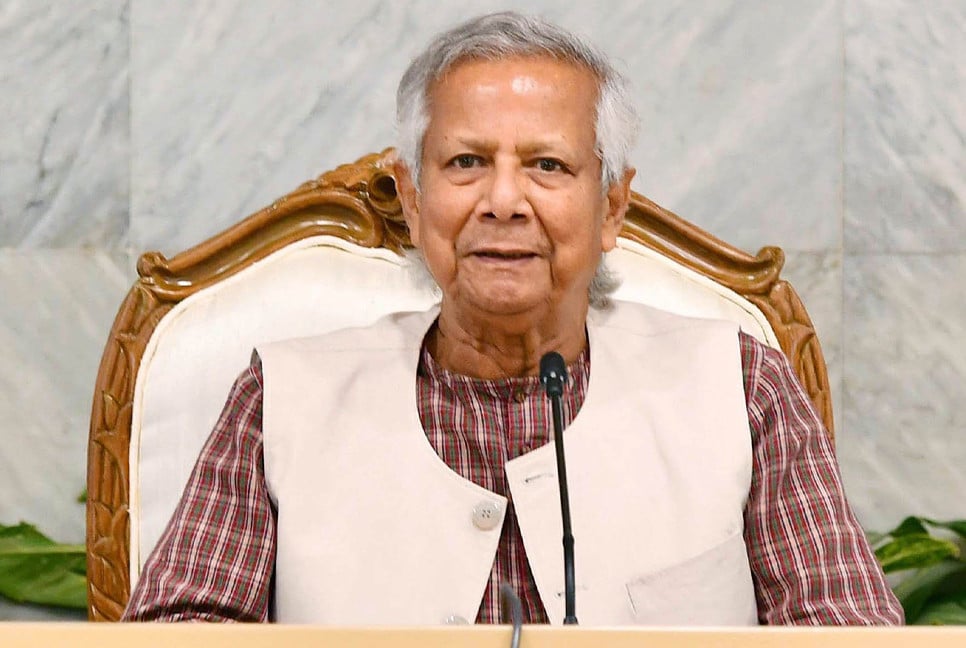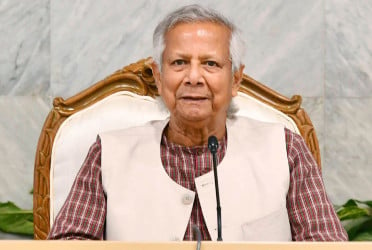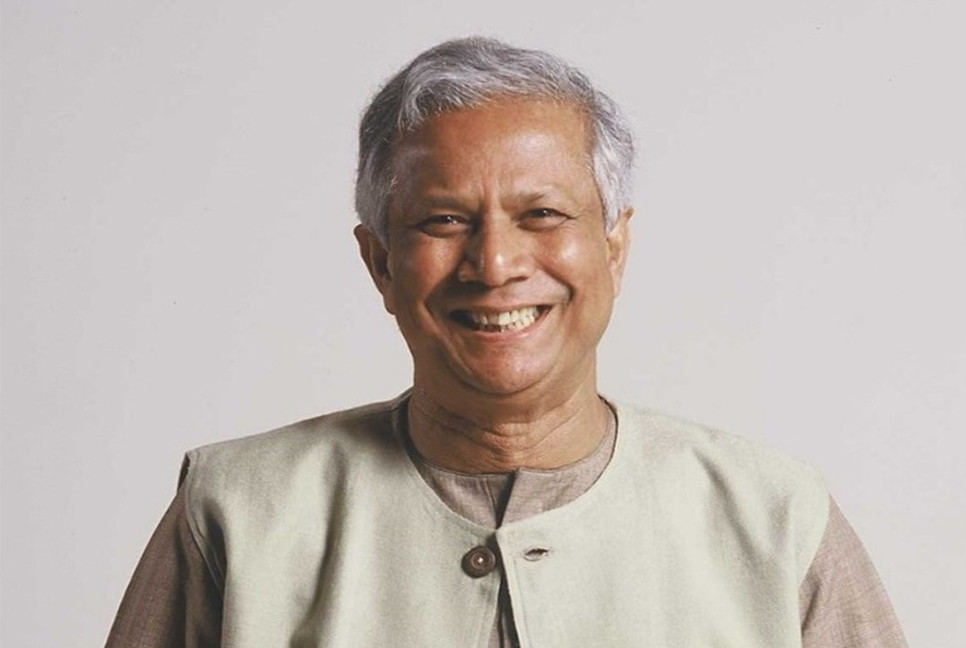
On 8 August last year, at a critical moment for the nation, Prof Muhammad Yunus assumed responsibility for the country. After three days without a government, this Nobel Peace Prize-winning and widely respected figure was unanimously chosen as Chief Advisor as a symbol of national consensus. Immediately after taking office, he threw himself into the effort to rebuild a shattered nation. Prof Yunus set three major objectives upon assuming office.
The first was state reform – repairing the structure of the state so that no form of fascism could ever rise again. He undertook a series of reform initiatives aimed at healing the wounds of the state and building the nation envisioned by the martyrs of the July Revolution.
The second objective was justice for the July massacre. Ensuring accountability for the indiscriminate killings of students and citizens during July-August of last year became one of Prof Yunus’s central pledges.
The third was to establish democracy through a free and fair election and ensure a peaceful transfer of power to an elected government.
For the past one and a half years, the interim government has been working toward these three core goals.
Under the leadership of Prof Muhammad Yunus, the interim government formed 11 reform commissions. Of these, the National Consensus Commission was created with the heads of six key commissions: Constitution, Electoral System, Judiciary, Anti-Corruption Commission Reform, Police Reform, and Public Administration Reform. Professor Yunus himself served as its chair.
The National Consensus Commission reviewed 166 significant proposals and possible implementation methods from the six reform commissions. The recommendations of the Health Sector Reform Commission, Local Government Reform Commission, Media Reform Commission, Women’s Affairs Reform Commission, and Labour Reform Commission were not included in this process, though the government has been implementing parts of those recommendations as well.
Over nearly nine months, the National Consensus Commission held consultations with 30 political parties and alliances on the proposals from the six commissions. Consensus was reached on 84 proposals, which formed the basis of the July National Charter, signed on 17 October (the NCP and four left-leaning parties did not sign). Of these 84 proposals, 48 were related to the constitution. To implement them, the July National Charter (Constitution Reform) Implementation Order was issued, and a referendum will be held. In his national address on 13 November, the Chief Advisor announced that the referendum and national elections would be held on the same day.
Although political parties still differ on some points, the government has succeeded in formulating a clear roadmap for state reform.
The government’s second priority is the trial of the July massacre. Immediately after assuming office, the Chief Advisor initiated steps to ensure a transparent investigation and justice. The United Nations High Commissioner for Human Rights personally conducted an investigation into the massacre and the crimes against humanity committed in Bangladesh. In an unusually short time, the UN Human Rights Commission published its report on the July-August 2024 massacre and human rights violations, laying a strong foundation for prosecution.
Under Prof Yunus’s directive, the International Crimes Tribunal was reconstituted. The tribunal began its first case proceedings on 17 October last year. On that day, the first case (initially miscellaneous) against Sheikh Hasina began, and an arrest warrant was issued.
At first, Sheikh Hasina was the sole accused. Later, on 16 March this year, former IGP Chowdhury Abdullah Al-Mamun was added. After several extensions, the tribunal’s investigation agency submitted its report to the Chief Prosecutor’s Office on 12 May. For the first time, former home minister Asaduzzaman Khan’s name appeared in this report, making him the third accused. On 1 June, the prosecution submitted formal charges against all three.
With the submission of formal charges, the miscellaneous case officially became a full case. On 10 July, the tribunal framed the charges. That same day, former IGP Mamun applied to become an approver (state witness). On 3 August, Chief Prosecutor Mohammad Tajul Islam presented the opening statement, broadcast live on television. After the opening statement, the first witness – Khokan Chandra Barman, who had been seriously injured during the July uprising – gave his testimony, marking the official beginning of the trial.
A total of 54 witnesses, including NCP Convener Nahid Islam, testified. Testimony concluded on 8 October. Arguments began on 12 October and ended on 23 October. Finally, on 13 November, the tribunal announced that the verdict would be delivered on 17 November.
It took 397 days from the filing of the case to the announcement of the verdict.
On 17 November, the International Crimes Tribunal delivered its 453-page judgment, divided into six sections.
The tribunal found that the crimes of all three accused, including Sheikh Hasina, were proven. Sheikh Hasina received the death penalty on two charges. Former Home Minister Asaduzzaman Khan Kamal was also sentenced to death on one charge. Former IGP Chowdhury Abdullah Al-Mamun, who became an approver, received five years’ imprisonment.
With this verdict, the interim government under Prof Yunus fulfilled another major responsibility. The remaining July massacre cases will now proceed through the regular judicial process.
The last major responsibility of Prof Yunus is to conduct a free, fair, and impartial national election. He has confirmed that the election will be held in the first half of February next year.
No one believes that this government has succeeded in every area over the past one and a half years. There have been failures. Law and order have not yet normalized. Mob violence, extortion, and land-grabbing remain uncontrolled. Ordinary people continue to live in fear.
The economic situation is also poor. Unemployment is rising, poverty is increasing, and many industries and factories have closed. Daily protests by various professional groups have made public life extremely difficult. Even the government admits that only a democratic administration can resolve the crisis. Hence, holding the election has become its primary duty.
If the government can organize a credible election, just as it has initiated reforms and ensured justice, Prof Yunus will remain immortal in the hearts of the Bangladeshi people. A clean, well-run election will make citizens overlook the government’s shortcomings. With a free and fair election, people will regard this government as successful.
Prof Yunus has already achieved two of his three main objectives. He is now working tirelessly to meet the electoral challenge, knowing that if democracy cannot be established through a proper election, all accomplishments will be in vain. Ultimately, no one will remember the successes; what matters is the outcome – after all, “all’s well that ends well”.