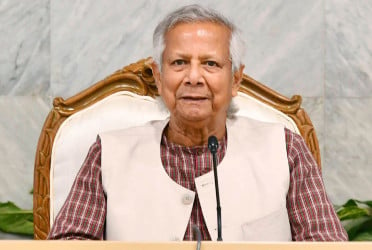
Following the path of austerity like the previous government, the interim government led by Dr. Yunus announced a contractionary budget for the current fiscal year 2025-26 to reduce the deficit. The interim government announced a budget of Tk. 790,000 crore for the year 2025-26, reducing it by about Tk. 8,000 crore compared to 2024-25. As a result, the allocation for both development and non-development sectors was also reduced.
Although revenue collection and ADP implementation increased slightly, inflation pressure could not be reduced. The level of foreign aid and debt is decreasing. On the contrary, the pressure on foreign debt repayment has increased. Economic activities are continuously contracting. As a result, the budget balance is still at risk. Due to various economic and administrative reform programs, revenue collection increased slightly in the first quarter of the fiscal year. Implementation of the Annual Development Program has also increased slightly.
Although foreign aid and debt have decreased, the government could not reduce inflation pressure. Overall inflation has decreased slightly to 8.17 percent at the end of October. Even in the peak season, the prices of vegetables, fish, meat, rice, pulses, onions, and garlic are skyrocketing. As a result, it will be impossible for the government to reduce inflationary pressure to the desired rate by the end of the year, said Dr. Zahid Hossain, former chief economist of the World Bank.
He said, “The overall budget situation is still at risk of imbalance, although it has reduced slightly compared to the previous year. It is known that there was a revenue deficit of Tk 1 lakh crore in the last fiscal year, the impact of which is also being felt in the current fiscal year. However, in the first three months of the current fiscal year, the National Board of Revenue (NBR) has collected a record amount of revenue compared to the previous year. But it is slightly less than the target.
In the first three months of the 2025-26 fiscal year (July-September), it collected Tk 90,825 crore in revenue, which is the highest record revenue collection compared to the first three months of any fiscal year so far. The revenue collection in the first three months of the 2024-25 fiscal year was Tk 75,554 crore; so Tk 15,270 crore more revenue has been collected in the first three months of the current fiscal year, with a growth rate of 20.21 percent.
But the government has reduced the demand for money as many mega projects have been excluded from the ADP. This has given some momentum to regular development activities. The exclusion of mega projects from the ADP has also reduced the government's tendency to take loans from the banking sector. According to the latest statistics of Bangladesh Bank, as of September 28, 2025, the total government debt in the banking system has decreased to Tk 5,46,435 crore, which was Tk 5,46,862 crore at the end of last June. That is, the debt has decreased by Tk 427 crore in three months. However, in the same period of the last fiscal year, the government's debt from the banking sector increased by Tk 3,726 crore. According to those concerned, the government's dependence on bank loans is decreasing due to stagnant expenditure on development projects.
Meanwhile, the pressure of debt-based development is now becoming clear in the economy. In the first three months of the current fiscal year (July-September), about $130 million more had to be repaid than the amount received in foreign loans. As a result, the tendency to repay old loans with new loans has increased and the government also has to repay loans from foreign exchange reserves.
According to the latest report of the Economic Relations Department (ERD), in the first three months of the 2025-26 fiscal year (July-September), foreign debt was written off by $1148.5 million. But during this period, $1279.9 million was repaid. In the same period of the last fiscal year, $1120 million was repaid. In comparison, this year's repayment has increased by $153.3 million, of which only the actual repayment increased by $130 million.
Despite the ambitious revenue target in the current budget, analysts believe that the tax-to-GDP ratio will remain less than 8 to 9 percent. However, 'India's tax-to-GDP ratio is 18 percent. It is important for us to go closer to that. For this, they have advised us to focus on automating the tax system. Otherwise, a huge revenue deficit will be created again at the end of the year, which will basically push the budget balance towards risk, believes Dr. Hossain Zillur Rahman, advisor to the former caretaker government.
Bd-pratidin English/Lutful Hoque