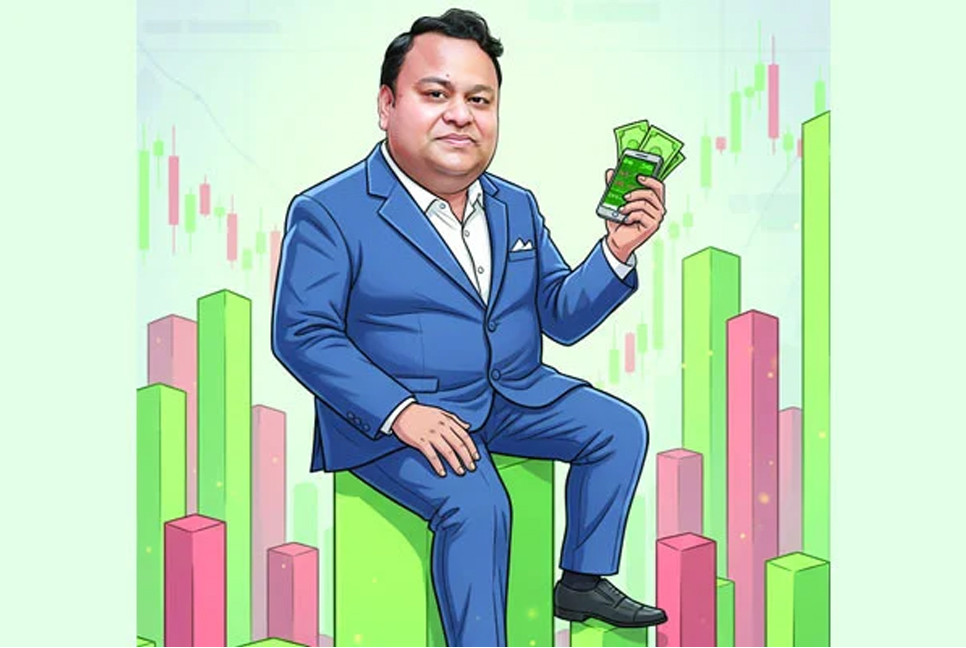
Few figures in Bangladesh’s capital market have wielded as much influence as Chowdhury Nafeez Sarafat.
Market insiders say there was hardly a decision he desired but could not sway – from extending mutual fund tenures to securing listings and distributing placement shares to powerful allies.
Race Asset Management, which began operations through the EBL First Mutual Fund, now manages 13 mutual funds, both open-end and closed-end. Ten of these funds were originally designed with a 10-year tenure but were not liquidated after maturity. Instead, reportedly under Nafeez Sarafat’s influence, their lifespan was extended by another decade.
At the time, the Bangladesh Securities and Exchange Commission (BSEC) was chaired by M Khairul Hossain, who later said, “I had initially rejected the proposal to extend the fund tenures. But the late finance minister Abul Maal Abdul Muhith sent a directive saying it could be allowed. So, I had to approve it.”
By 2013, five years after Race’s launch in 2008, the company was managing 10 closed-end mutual funds. Today it oversees 13. As of 30 June this year, the funds’ assets stood at Tk3,200 crore at cost value, with a market value of Tk2,350 crore. Insiders allege these funds were used to serve Nafeez Sarafat’s personal financial interests.
Nafeez Sarafat reportedly maintained close relations with influential figures in the banking and financial sector, including Salman F Rahman and Nazrul Islam Majumder. Majumder was brought into Nafeez Sarafat’s media ventures. It is widely believed that when Salman F Rahman encouraged investment to boost Beximco’s share price, Nafeez Sarafat followed by investing fund money into Beximco shares. However, later Nafeez Sarafat allegedly sold off those shares without Rahman’s knowledge, causing market prices to fall, which reportedly angered Salman F Rahman.
Amid this strained relationship, Nafeez Sarafat cultivated ties with former Finance Minister AHM Mustafa Kamal and the then Finance Secretary Abdur Rouf Talukder. Through these connections, he reportedly pushed for direct listing approval for Best Holdings’ IPO.
Although unsuccessful initially, he eventually succeeded in having Best Holdings listed through the then BSEC Chairman Professor Shibli Rubayat-Ul-Islam. Placement shares of Best Holdings were reportedly allocated in the names of the two daughters of former IGP Benazir Ahmed. Nafeez Sarafat allegedly used placement shares as gifts to powerful individuals and intelligence officials to maintain influence and secure benefits. As a result, his bureaucratic work reportedly faced no obstacles, and others maintained ties with him to secure their own interests. There are also allegations that he charged significant sums for lobbying.
Nafeez Sarafat generally targeted large projects, but his intense lobbying for the IPO of a smaller company, Coppertech Industries, surprised many. He had reportedly allocated placement shares of Coppertech to influential individuals and therefore pushed strongly for the company’s listing. When news surfaced of irregularities in Coppertech’s financial statements, the issue stalled.
The Financial Reporting Council (FRC) recommended disciplinary action against the audit firm Ahmed & Akhter, which was then suspended by ICAB. During this time, Nafeez Sarafat reportedly lobbied at the FRC and through a late President of the Dhaka Stock Exchange (DSE) arranged for a letter from DSE to BSEC requesting legal exemptions. BSEC eventually granted the exemptions and Coppertech was listed.
MTB Capital CEO Khairul Bashar Abu Taher Mohammad, who handled the IPO, was later appointed DSE’s Chief Regulatory Officer with Nafeez Sarafat’s support.
Despite concerns from the stock exchange, many IPOs were approved during the tenure of former BSEC Chairman M Khairul Hossain. In the Coppertech controversy, the Commission adopted a policy of not approving IPOs without exchange opinion – shifting liability toward DSE, although BSEC had the power to reject IPOs.
Furthermore, no investigation or disciplinary action was taken against Race despite multiple allegations. Even after a decision to inspect Race’s operations, it was never executed.
The Commission also extended mutual fund tenures based on recommendations said to have originated from the finance ministry, although BSEC was fully empowered to refuse.
Former BIFFL Managing Director Farmanul Islam posted on social media alleging that Nafeez Sarafat pressured for a Tk500 crore investment in Best Holdings’ bonds during a meeting attended by Salman F Rahman and Nafeez Sarafat at the Finance Secretary’s office. Shortly after, he was forced to resign.
Nafeez Sarafat also took control of several listed companies, including Unique Hotel & Resorts and National Tea Company. Through his firm Strategic Finance Ltd (SFL), he became Managing Director of Unique Meghnaghat Power, a 584 MW power plant.
Though Unique Group was the main investor, Nafeez Sarafat reportedly handled negotiations and approvals, enabling him to profit substantially with lower investment. SFL held 38.76% of the plant, Unique Hotel 37.24%, and Nebras Power of Qatar 24%. When 24% equity was sold to Nebras for US $24 million, SFL earned more than Tk100 crore in profit.
In Race, ownership was split 75% to Dr Hasan Taher Imam and 25% to Nafeez Sarafat. Disputes between the two went to court. Allegations also exist against Hasan Imam for misuse of funds, high-commission trades via Multi Securities (also Race-owned), and questionable corporate bond investments.
Race is accused of violating mutual fund regulations by conducting large block market transactions using its managed funds. For this reason, BSEC suspended block market trading of funds under Race management, as well as the block trading facility of Multi Securities & Services Ltd.
In this manner, Nafeez Sarafat allegedly caused severe disruption in the capital market, resulting in losses for countless small and general investors, while accumulating enormous wealth.