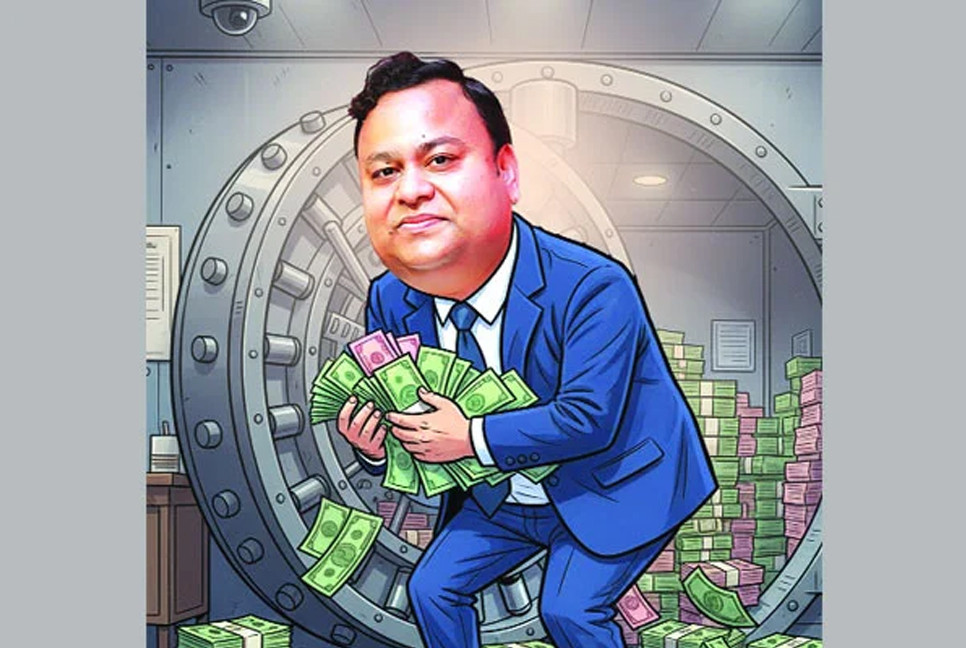
From a mid-level bank officer to one of the most powerful and controversial figures in Bangladesh’s financial sector – the rise of Chowdhury Nafeez Sarafat epitomises state-backed corruption during the Awami League era.
Virtually unknown before 2009, Nafeez Sarafat amassed an empire worth thousands of crores of taka in just 15 years through influence, manipulation, and political patronage – becoming a symbol of large-scale financial plunder.
Nafeez Sarafat began his career at Standard Chartered Bank in 1999. While still employed there, he was surprisingly appointed as an independent director of IFIC Bank. When questions were raised about how he could simultaneously serve in two banks, he resigned from Standard Chartered Bank.
In 2008, he joined ICB Islamic Bank as head of consumer banking. On his visiting card, he described himself as “MD, Consumer Banking, ICB Global Holdings.”
Even earlier, he had obtained a mutual fund licence from the Bangladesh Securities and Exchange Commission (BSEC).
Initially, he applied under his own name, but as licences were not issued to individuals, he later formed a company – Bangladesh Race Asset Management – on the advice of then BSEC member Mohammad Ali Khan. Nafeez Sarafat held a 25% stake, while his partner Hasan Imam owned the rest. Several officials who worked at BSEC during that time have confirmed this information.
After the Awami League returned to power in 2009, Nafeez Sarafat rapidly rose through political and financial networks. He first developed ties with then home minister Mohiuddin Khan Alamgir, and later forged close relations with former inspector general of police Benazir Ahmed.
His proximity to ousted prime minister Sheikh Hasina has been widely reported. The Gopalganj-born businessman used to address Hasina as “aunt,” while former finance minister AHM Mustafa Kamal was called his “uncle.” Among people in Gopalganj, he often introduced Benazir Ahmed as his “cousin.”
Within banking and capital market circles, Nafeez Sarafat was known for his connections with Salman F Rahman, former adviser to the ousted prime minister and vice chairman of Beximco; EXIM Bank Chairman Nazrul Islam Mazumder; and former Bangladesh Bank governor Abdur Rouf Talukder.
Backed by state patronage, Nafeez Sarafat built an empire spanning the banking, capital market, power, private university, and media sectors – reportedly accumulating thousands of crores of taka.
Following the fall of the Sheikh Hasina government, the Anti-Corruption Commission (ACC) formed a three-member team to investigate his wealth.
Those in the capital market say there was hardly an instance where Nafeez Sarafat sought something and was denied. Race Asset Management began with the EBL First Mutual Fund and now operates 13 funds in total. Ten of these had a maximum tenure of 10 years, but after expiry, they were not dissolved. Instead, their terms were extended by another decade due to Nafeez Sarafat’s lobbying.
At that time, the then BSEC chairman M Khairul Hossain said, “Initially, I rejected the proposal. Later, the late Finance Minister AMA Muhith wrote a letter saying it could be approved. So we had to approve it.”
In 2021, Nafeez Sarafat became a shareholder-director of the National Tea Company, a listed entity. As of 30 June, Race Asset Management’s funds held assets worth Tk3,200 crore (purchase value), with a market value of Tk2,350 crore. Since June, the Bangladesh Financial Intelligence Unit (BFIU) has frozen transactions from the company’s bank accounts.
Nafeez Sarafat also lobbied for the direct listing of Best Holdings on the stock market and for the approval of Coppertech Industries’ IPO. When allegations of financial fraud surfaced concerning Coppertech’s audit report, the Financial Reporting Council (FRC) recommended punitive measures against the auditing firm Ahmed & Akhtar.
During the ousted government, Nafeez Sarafat was regarded as a powerful “economic hitman”. His influence grew even further after the controversial 2018 general election, when several foreign observers declared the polls “fair.” Nafeez Sarafat reportedly played a key role in organising those observers, boosting his importance within the government.
In May 2020, cartoonist Ahmed Kabir Kishore and writer Mushtaq Ahmed were arrested under the Digital Security Act for drawing cartoons about Nafeez Sarafat’s alleged bank takeovers. Kishore was taken from his home on 2 May and Mushtaq on 4 May. Both were subjected to severe physical and mental torture, and their bail petitions were rejected multiple times over 10 months. Mushtaq died in prison on 25 February 2021, while Kishore was later released on bail.
After his release, Kishore told the media that during interrogation, he was questioned about a cartoon depicting a bank chairman. According to multiple sources, Nafeez Sarafat was present during the torture sessions and directly influenced the abuse of both men.
Mushtaq’s death and Kishore’s torture drew widespread condemnation from the United States, European Union, United Kingdom, Canada, France, and others. Both the UN High Commissioner for Human Rights and Human Rights Watch demanded an independent investigation.
Following the fall of the Sheikh Hasina government, the ACC has launched a formal investigation into Nafeez Sarafat’s alleged bank takeovers and misappropriation of funds in the capital market.