
Even the bottom has a bottom. Yet, Bangladesh appears to be sinking in multiple indicators—not secretly, but openly. In recent days, this decline has accelerated, with both domestic and international dimensions. From education and business to aviation training, management, airport security, fires at the Cargo Village and EPZs, and the falling standard of passports, numerous indicators point to the country’s steady slide—now making headlines globally. If this pattern continues, Bangladesh’s reputation could suffer without the need for foreign interference or conspiracies. Whether the Cargo Village fire was an act of sabotage or a mere accident, the event itself is undeniable.
A single incident like this can tarnish a nation’s image. Not just domestically, but internationally as well. It has sent a full-fledged message to the world about the fire safety system in a KPI-designated (Key Point Installation) area in Bangladesh. Only days earlier, a devastating fire struck Chattogram’s EPZ.
Meanwhile, news of workers burning to death in a fire at a garment factory in Mirpur, Dhaka, continues. Following the shutdown of mills and factories after the mass uprising, workers face renewed unemployment—at the very time these incidents occur. None of these are minor or isolated news stories. Regardless of the explanations offered, these are not events that can be hidden or denied. Even if theories of sabotage or conspiracy are suggested, they cannot be brushed aside.
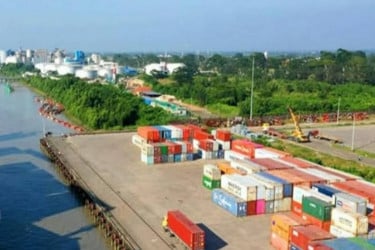
International media are covering these developments with seriousness. At the same time, news emerged that if the Chattogram Port does not revoke arbitrary and excessive tariffs within a week, port users would paralyze operations. In protest against the increased trailer entry fee at Chattogram Port, the Chattogram Prime Mover & Flatbed Owners Transport Association declared a halt to all goods transportation. Though the news concerns Chattogram, it is neither just local nor purely national—it is international.
Chattogram, known as the port city, is the commercial capital of Bangladesh. It is the gateway for both domestic and international trade. Yet the port is in chaotic disarray. Despite objections from port users, new service fees were imposed after midnight on 14 October. Nearly a 41% hike in fees for various services triggered protests organized by the Port Users Forum. Port users warned that the tariff increase would raise container handling, storage, and transport costs for exports, undermining Bangladesh’s competitiveness in international markets. Moreover, the trailer entry fee was increased from Tk57 to Tk230, prompting the Prime Mover & Flatbed Owners Association to halt all cargo movements. Any policy change at Chattogram Port—the economic lifeline of Bangladesh—has highly sensitive implications for the national economy.
The declining global ranking of Bangladesh passports is another reflection of this downward trend. The decline in international standing of the Bangladeshi passport has been a long-standing concern, and recent developments delivered yet another blow. After hopes of a post-uprising revival, the Henley & Partners Passport Index (UK-based), which ranks 199 countries and 227 travel destinations, placed Bangladesh 100th in 2025—down from 97th last year. Bangladesh now shares the same rank as North Korea, whose citizens face severe international restrictions. Bangladeshi passport holders can now travel visa-free to only 38 countries, down from 42 last year. In 2023, Bangladesh was 101st. Two decades ago, in 2006, Bangladesh ranked 68th.
This is not just about rankings. Bangladeshi travelers frequently face harassment and inconvenience abroad. Comparatively, war-torn Myanmar ranks 96th, Nigeria and Lebanon also 100th, Bhutan 92nd, India 85th, and Thailand, a competitor in garment exports, 66th.
The country’s continual descent is evident across domestic and international indicators. The recently published HSC results signal a crisis in education. This year saw the lowest pass rate in 20 years: the average pass rate across 11 boards was 58.83%, with 41.17% of students failing. Only 69,097 students earned GPA 5, a decrease from 76,814 last year. In 202 schools, not a single student passed. The number of schools achieving a 100% pass rate also declined from 1,043. Analysts debate the causes—some attribute it to genuine performance, others to disruptions after the government change affecting students’ focus. Syllabus, exam system, question design, and grading standards are also cited. What is clear: the decline in educational standards is visible and cannot be hidden.
Amid a severe business, investment, and employment crisis, teachers are protesting on streets, facing physical attacks, and participating in hunger strike. These events, alongside other sectors’ deteriorations, are harming the country’s image. Local incidents—fires at markets, shrines, and factories, disruptions at airports, and deteriorating port conditions—are increasingly visible to the international media and amplified on social platforms. Meanwhile, the education sector faces its own crises. If these issues remain unaddressed, the reputation of Bangladesh’s passport and the country itself continues to suffer globally.
After an unprecedented student-led mass uprising, such setbacks are beyond expectations. Yet, despite the potential for pride and global recognition, Bangladesh is instead presenting a series of alarming messages to the world—ignoring the many achievements that could have been a source of honor.
Author: Journalist-Columnist, Deputy Head of News, BanglaVision