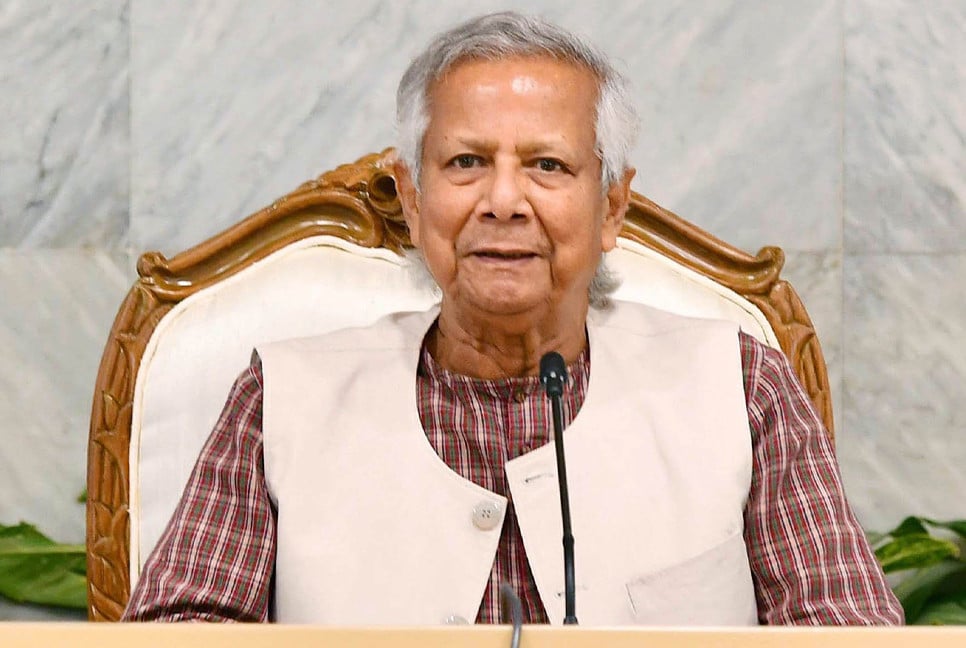
Chief Adviser Prof Muhammad Yunus has repeatedly promised that his government will deliver an election so fair and exemplary that it will set a new standard in Bangladesh’s history. Over the past six or seven months, he has said this countless times. A large section of citizens, filled with admiration and trust, have accepted his assurance wholeheartedly — they say, “Faith achieves what argument cannot.”
This group represents the ordinary people — the “aam aadmi” of Bangladesh — who, despite forming the backbone of the nation, remain politically sidelined. Another section, however, believes only after careful scrutiny through the lens of experience. They ask questions. They wonder: if the administration is preconditioned to favour one political party, can the election still be truly fair? If candidates are intimidated or driven out of their constituencies before the campaign even begins, will the interim government still be able to hold a model election?
Socrates once said that knowledge begins with inquiry — and these questions, uncomfortable though they may be, must be asked if the truth is to be known.
Essential ingredients of a fair election
Every component of a free and transparent election is equally important. The government’s recent announcement that partisan officials from past regimes will not be involved in the upcoming polls is certainly welcome. But is that enough to ensure neutrality? Removing yesterday’s loyalists does not guarantee that new ones won’t emerge.
BNP’s National Standing Committee has already expressed concern that the panel of election officers now being formed reportedly includes individuals previously affiliated with Islami Chhatra Shibir. The party has also alleged that some advisers in the interim government are behaving with bias. Given BNP’s political stature, such allegations cannot simply be dismissed as hearsay.
Even if this alignment happened by coincidence, the perception of partisanship remains dangerous. If a particular group benefits from such a process, the intention behind the election comes into question. As the saying goes, “If the intent is wrong, the outcome cannot be right.”
While the Chief Adviser’s integrity is not being questioned, it is quite possible that certain elements within the administration or among his advisers are politically biased. If this issue is not addressed now, it could spiral out of control later.
The culture of control
Unfortunately, democratic values have yet to take deep root in Bangladeshi politics. The obsession with control remains pervasive — whether covertly, through manipulation of institutions, or overtly, through muscle power. As one senior politician once lamented: “We occupy sand pits and transport stands, but they occupy the universities and administration.”
This entrenched culture of capture makes it easy to imagine how electoral mechanisms could also be engineered. Even if security outside polling centres is tight, rigging inside booths remains a real possibility. Therefore, the list of polling officials must be thoroughly reviewed and verified to prevent bias.
A level playing field is the foundation of any credible election. Ensuring equal opportunity for all candidates is the responsibility of the administration and law enforcement agencies. If election officers act with partisanship, equality collapses.
Some candidates contest elections with a “win-at-any-cost” mindset. They are willing to do anything to secure victory, while genuine democrats respect the people’s verdict, win or lose.
Lessons from 2018
In 2018, reassured by promises of a fair election, BNP and other parties participated in the polls — only to discover widespread fraud. Ballot boxes were stuffed the night before the vote. Law enforcement officials, polling officers, and ruling party cadres allegedly colluded in mass-scale ballot manipulation. Even without the infamous “night voting,” opposition candidates would have struggled to retain their deposits, given the atmosphere of fear and suppression.
That election left deep scars on public trust. Although there is no certainty that such a repetition will occur this time, concerns persist about certain elements within the government and administration. Reports already suggest that the neutrality of some field-level officials is under question.
Mob intimidation and political toxicity
Equally alarming are signs of mob rule creeping into politics. In one constituency, a group of women recently staged a “broom procession,” declaring a potential candidate “unwanted” and threatening to beat him with brooms if he entered the area. If ordinary women can express such hostility publicly, one can imagine what male political activists, armed with sticks or machetes, might do.
This culture of intimidation — mobocracy — directly undermines the fairness of elections.
The way forward
Authorities have announced that there will be no posters or conventional campaigns this time; instead, joint candidate introduction sessions will be organised. The idea is good in theory. But how can a candidate declared “unwanted” in his own area attend such an event? How can he campaign freely?
Unless this undemocratic culture changes, a truly fair election will remain elusive. The interim government must ensure a free and fair election within the declared timeframe — at any cost. There is no alternative.
The writer is a senior journalist and fiction author.