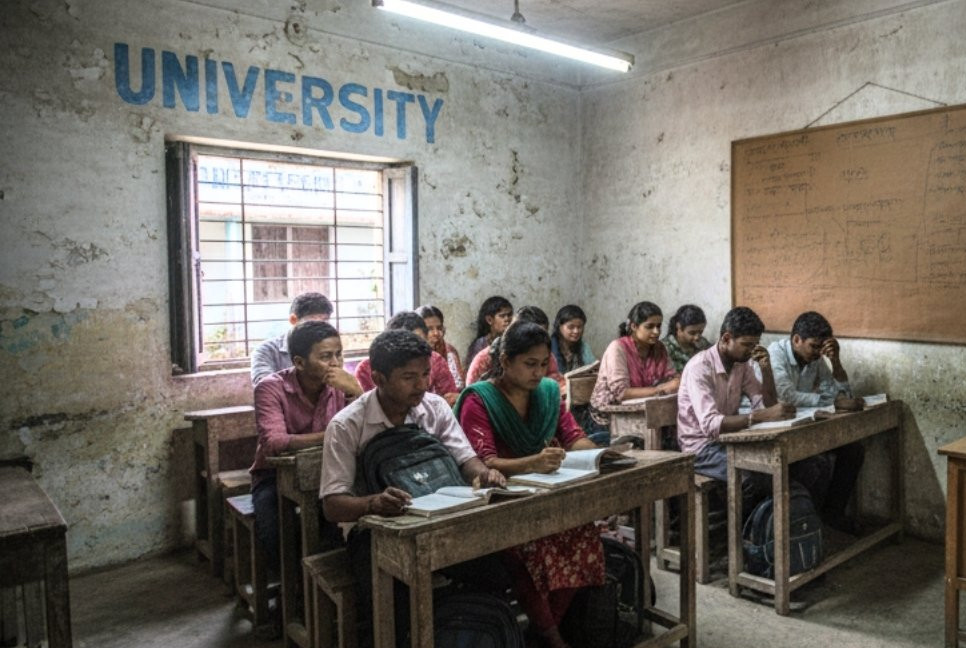
Public universities in Bangladesh are traditionally perceived as institutions with large campuses, academic buildings, residential halls, libraries, laboratories, and playgrounds. But the reality is starkly different in the case of many newly established public universities.
Most of these institutions are struggling to function, with no classrooms, no space for teachers, and not even the minimum facilities that a primary or secondary school would have. Many are running activities from a few rented rooms in nearby schools or colleges.
According to the University Grants Commission (UGC), there are currently 56 public universities in the country, of which three are yet to start academic activities. Out of the remaining, 22 universities are operating from rented or temporary campuses. Among them, the situation in 20 universities is described as “dire,” with facilities worse than a regular school.
In some cases, teachers’ offices have been arranged inside abandoned garages. While construction has started at a few campuses, most universities are still struggling to find land.
Political interests and weak planning
Education experts and UGC officials say that many of these universities were approved in recent years without proper planning or feasibility studies, mainly due to political lobbying by ministers and MPs. Unlike private universities, which require at least 25,000 sq ft of space before approval, many public universities were established without ensuring minimum infrastructure.
Professor Mohammad Tanzimuddin Khan, in charge of UGC’s public university division, said, “Some universities were established without planning and lack the necessary infrastructure. As a result, they cannot meet the minimum conditions of higher education, and this is sending the wrong message to the public.”
He suggested considering whether universities with no potential should be merged with neighbouring institutions.
Universities running on rented campuses
The universities operating from rented facilities include: Rangamati Science and Technology University, Islamic Arabic University, Chattogram Medical University, Rajshahi Medical University, Rabindra University, Bangladesh, University of Frontier Technology, Bangladesh, Netrakona University, Khulna Agricultural University, Jamalpur Science and Technology University, Sylhet Medical University, Chandpur Science and Technology University, Kishoreganj University, Habiganj Agricultural University, Khulna Medical University, Kurigram Agricultural University, Sunamganj Science and Technology University, and Pirojpur Science and Technology University.
Most of them are yet to secure permanent land for their own campuses.
Meanwhile, three universities — Meherpur University, Naogaon University, and Bogura Science and Technology University — have not started academic activities despite the appointment of vice-chancellors.
Student protests for permanent campuses
Students of Rabindra University in Sirajganj recently staged demonstrations, including road and rail blockades, demanding immediate construction of a permanent campus. Similarly, Kishoreganj University students have threatened shutdowns over delays in land acquisition.
Past policies under scrutiny
Educationists say the crisis stems from the previous government’s policy of establishing a public university in almost every district, often for political or financial gains. This has resulted in corruption in land acquisition, infrastructure projects, and recruitment of officials. Many districts now have multiple public universities, while others remain without one, creating regional disparities.
Former education adviser Dr Wahiduddin Mahmud had earlier recommended halting further activities of new universities with poor enrolment or no academic programmes until a clear policy direction is set by the government.
As a result, eight new public universities remain in limbo, with no academic activities in five and administrative work stalled in three despite appointments of vice-chancellors.
Bd-pratidin English/ ANI