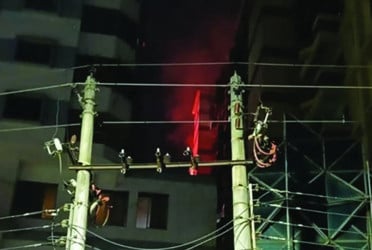
What has happened in Nepal is just like a bolt from the blue. Nepal’s government collapsed within just 27 hours following massive protests led by Gen-Z youth. The incident has stirred reactions across the world. Many are comparing it to the student protests in Sri Lanka and Bangladesh.
But in reality, it is not the same. In Sri Lanka and Bangladesh, the issue was about overthrowing authoritarianism, fighting corruption and nepotism, resisting widespread repression of the opposition, protesting torture, enforced disappearances, and killings — essentially an outburst of long-pent-up anger. Nepal’s case is entirely different.
There, fascism did not sit on people’s necks like Sinbad’s giant or weigh down like a boulder. Governments in Nepal were formed through free and fair elections. More importantly, there was a tradition of peaceful government change through elections. Hardly ever has a losing party alleged vote rigging.
What Nepal faced instead was political instability and frequent changes of government. As a result, development was hampered, and unemployment increased. Against this backdrop, when the government suddenly shut down 26 social media platforms, including Facebook, Instagram, and YouTube, the youth erupted in protest and poured into the streets.
The government claimed its intention was to curb anarchy, rumors, and social division. But the younger generation rejected this reasoning, accusing the authorities of blocking social media to cover up their own corruption and failures. They challenged the government and launched nationwide protests demanding its resignation.
It should be remembered that for young people, social media is not only a means of entertainment but also a source of income. Through these platforms, they search for jobs, engage in educational activities, and access various opportunities — while staying connected with one another. Thus, the ban felt like a gag on their voice. Thousands of youths took to the streets in Kathmandu and other cities across the country.
On social media, they used hashtags like Nepo Kids and Nepo Baby to highlight nepotism. These terms referred to young men and women who did not rise by merit but benefited from their parents’ or relatives’ influence, enjoying privileges because of family connections. It is undeniable that, like in other South Asian countries, Nepal too has influential politicians’ and elites’ children enjoying such advantages. Their wealth and luxurious lifestyles have angered the youth further.
Meanwhile, “Hami Nepal” (“We are Nepal”), a US-linked NGO, poured fuel onto the fire of protests, intensifying the uprising. Nepal, already a poor, landlocked nation, depends heavily on India for its economy and trade. India has also held long-standing political influence over Nepal, dating back to the monarchy. However, in recent years — particularly after the fall of the monarchy and the establishment of democracy — Indian dominance has somewhat diminished.
Since 2008, one or another Communist Party has formed the government in Nepal, either jointly or independently. These governments pursued closer ties with neighboring China, launching projects under China’s Belt and Road Initiative (BRI). China invested in Nepal’s roads, railways, and hydropower projects, while Nepal built multiple road links to improve connectivity between the two countries. This angered India, which at times closed the India-Nepal border, disrupting trade. Twice, India blockaded Nepal’s borders for months, causing the country’s fuel supply to run out entirely. As a result, buses, trucks, and other vehicles came to a halt. Prices of essential goods soared, as even air imports could not reach remote areas in time. To make matters worse, for the first time in Nepal’s history, communal tensions were imported, with claims that “Nepal is historically a Hindu state and must remain so.”
After the monarchy was abolished, Nepal’s new constitution declared the country a secular state instead of a Hindu state. India strongly opposed this, with various Hindu nationalist groups protesting. Pro-monarchy campaigns spread within India, while pro-monarchy demonstrations also took place in Nepal. A segment of Nepal’s population — influenced by feudal landlords and lacking education — remained loyal to the monarchy, driven by the belief that Nepal’s king was an incarnation of Lord Vishnu. This religious sentiment was stoked for years.
For decades, Nepal has also been strategically important for India. After India’s humiliating defeat in its 1962 war with China, India established a special training camp for its Mountain Brigade in Kalapani, Nepal, with the approval of King Mahendra. But this was kept secret from the Nepali public. It was only in 2000, during Prime Minister Girija Prasad Koirala’s tenure, that Communist Party leader C.P. Mainali exposed this in parliament and demanded a government statement. The government, however, refused to respond.
Later, when Communist governments came to power, discussions with India resumed. But India claimed the disputed region as its own. This triggered uproar in Nepal, and eventually, the Nepali government released a new official map showing the Indian-occupied area as part of Nepal. The map was even submitted to the United Nations for approval. That is why ousted Prime Minister K.P. Sharma Oli has since said he lost power because of his anti-India stance.
From this, it is clear that Nepal’s government did not fall because of Gen-Z protests alone. The demonstrations were merely the spark; the collapse was the outcome of a long-standing geopolitical conspiracy. Corruption and unemployment cannot be solely blamed. Behind the fall lies geopolitics — and fueling that geopolitics was the United States, unwilling to accept Nepal’s gradual shift toward China, just as India could not.
For now, an interim government has been formed. Prime Minister Sushila Karki has announced new elections for next March and pledged to investigate corruption. This is vital for Nepal’s public life. She has also promised to prosecute those responsible for the destruction of property during the protests. Preliminary estimates suggest damages worth 250 billion rupees, including devastating losses to Nepal’s lifeline tourism sector. Luxury hotels, including the Hilton, were set on fire.
The interim prime minister faces a formidable challenge. What happens next remains to be seen — but for now, Nepal’s future hangs in the balance.
The writer is a journalist and columnist