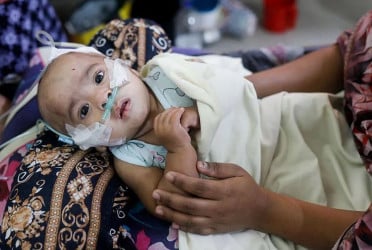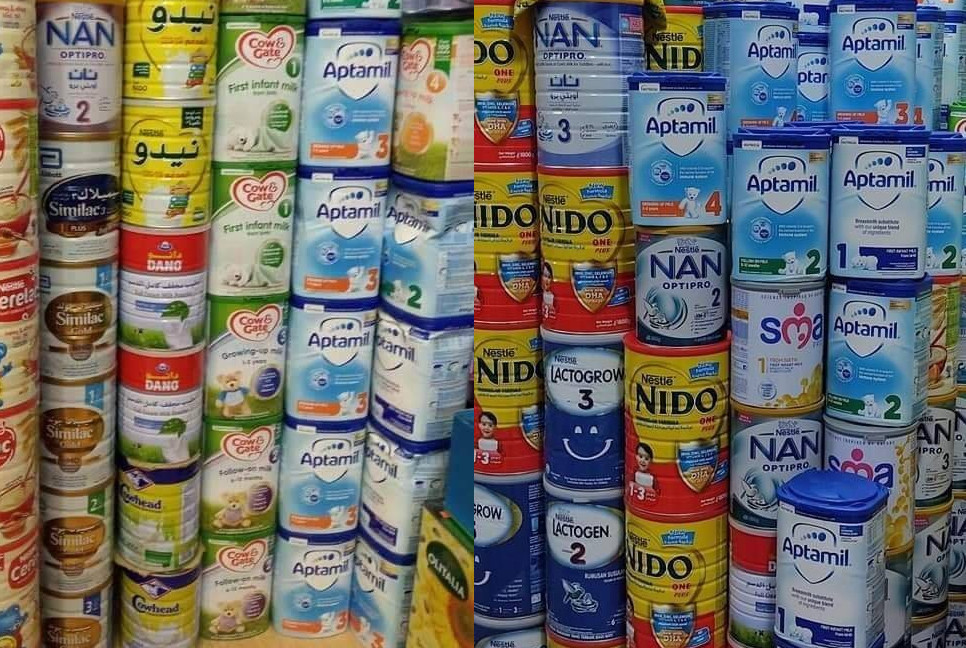
The price of baby food has risen uncontrollably. Within six months, the price of powdered milk brands such as Cow & Gate and Horlicks has gone up by 140 to 800 taka per tin. This has not only added to the suffering of parents but also made it difficult to ensure proper nutrition for children. However, this is not the first time—baby food prices have been rising every year. Market monitoring is hardly visible. As a result, analysts are holding the government responsible for the price hikes.
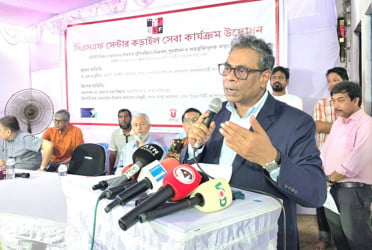
SM Nazer Hossain, Vice President of the Consumers Association of Bangladesh (CAB), said there remains doubt as to whether the government truly intends to control the market. Even when raids were carried out before, offenders were not punished under the law. On the contrary, traders involved in wrongdoing were rewarded by being included in official delegations with state leaders. Recently, the number of raids has decreased, and even when action is taken, there is no follow-up.
A market visit reveals that Horlicks is currently the cheapest among baby foods. Over the past six months, the prices of at least 8–9 baby food items, including Horlicks, Aptamil, Nido, Cerelac Fruits & Honey, and Lactogen, have increased. The price of a 500g jar of Horlicks rose by 140 taka and is now selling for 640 taka, whereas last November it sold for 500 taka. Similarly, Lactogen has gone up by 700 taka and is now 4,000 taka per tin. Nido Three Plus rose from 4,600 to 5,300 taka, Cerelac Fruits & Honey rose from 1,950 to 2,100 taka, Nido One Plus is selling at 5,100 taka, and Aptamil One costs 3,300 taka per tin. Although already expensive brands such as Dano and Marks powdered milk have not increased further, Cow & Gate has seen the sharpest rise of 800 taka.
Rahim Uddin, cashier of wholesale shop Merima Tahi Enterprise at Gulshan DNCC Market, said the baby food market in Bangladesh is dominated by multinational companies. Products from the USA, Iran, Spain, and India hold most of the market share. Since importers set the prices after bringing in goods, this directly affects the market, a trend seen over the past six months.
Nazmul Hossain, a resident of Mohakhali and a private job holder, said it has become impossible to run a household with a limited income. By the end of the month, taking loans has become unavoidable. On top of that, he has a three-year-old child at home. Since the child does not like family food, they have to provide packaged baby food as per a nutritionist’s advice. Over the past year, price hikes of these foods have become a regular occurrence.
Professor Dr. Abu Torab Md. Abdur Rahim of the Institute of Nutrition and Food Science at Dhaka University said:“The increase in prices of imported baby food should not affect the upper class and upper-middle class. However, the purchasing power of the middle and lower classes has declined. Poverty has risen in the country, which is the government’s failure. The lower classes’ ability to consume has fallen to the lowest level. As a result, not only children but all family members are suffering from malnutrition. The more hunger spreads in society, the more social unrest grows. Children growing up malnourished will face long-term problems.”
Abdul Jalil, Director (Joint Secretary) of the Directorate of National Consumer Rights Protection, said: “We regularly carry out drives to keep the market stable. If traders exceed the government-fixed prices, we bring them under punishment. However, under consumer law, if imported goods are sold at higher prices, we cannot do much. But if the NBR sets fixed values for imported goods, we can take action against dishonest traders without objection.”
Bd-pratidin English/ANI