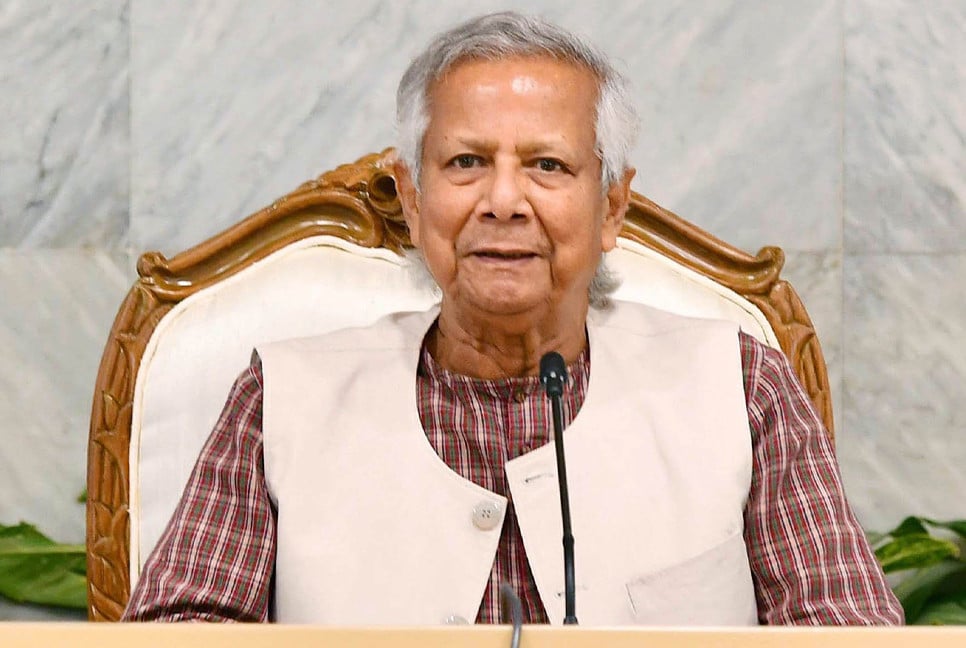
On Sunday, Chief Adviser Prof Muhammad Yunus held separate meetings with the three main political parties – BNP, Jamaat and NCP. He reiterated his firm stance on election, declaring, “The election will be held in the first half of February. There is no alternative to elections. If anyone thinks of an alternative outside of elections, it will be extremely dangerous for the nation.”
This statement by the chief adviser was both thoughtful and statesmanlike. At a time when unrest is spreading and citizens live in fear of the unknown, Prof Yunus sought dialogue with political leaders. While citizens eagerly wait for an election, attempts are being made in various ways, especially in educational institutions, to create instability. As a result, multiple questions arise: are these incidents part of a conspiracy to derail the election? Is the situation being deliberately destabilised to prevent the upcoming national election from being free, fair, and neutral?
Earlier, on Friday, clashes erupted between Gono Odhikar Parishad and Jatiya Party. A rally by Gono Odhikar Parishad, calling for a ban on the Jatiya Party, attempted to vandalise the party office. Law enforcement intervened to control the situation, leading to some unfortunate incidents. The use of force by police in political programmes cannot be condoned, as it echoes the behaviour of past autocrats. The government must investigate why the incident occurred. Encouragingly, it has already taken a firm stance by forming an inquiry committee, and the truth should soon come to light.
However, some overzealous groups are trying to drag Bangladesh’s armed forces – symbols of peace, order, and national unity – into controversy. This is deeply troubling. Especially before an election, such remarks not only complicate the process but also threaten the country’s independence and sovereignty.
We all know how tirelessly the armed forces have worked over the past year to maintain peace and order in Bangladesh. It is largely due to them that people still have some degree of security. In the past year, they have stepped beyond their barracks to tackle mobs, unrest, looting, and violence nationwide. The recent Paltan incident will surely be clarified in the investigation report, but spreading rumors, lies, and provocative statements involving the armed forces must stop immediately. Making premature comments about a force that symbolises the country’s sovereignty is highly inappropriate.
In this case, the armed police only provided assistance. Whether the immediate actions taken by field officers of the armed forces were justified can be debated, but using an isolated incident to discredit the entire institution is illogical. Those making such irresponsible remarks should also be questioned about whether they are tied to efforts to sabotage the upcoming election.
Even before the Paltan incident, university campuses were becoming flashpoints of unrest. Students at the University of Engineering enforced a shutdown with three demands, with larger programs expected soon. On Saturday night, violence at Chittagong University escalated into clashes with villagers, turning the area into a battlefield. The university was forced to close indefinitely, with Section 144 imposed to restore order.
Similar tensions have erupted at Mymensingh Agricultural University, where students clashed with authorities. At Dhaka University, the campus atmosphere is tense ahead of the DUCSU election, with many fearing that violence could overshadow the polls.
Already, nomination disputes in the RAKSU election have triggered clashes, raising doubts among students about whether these contests will truly be free, fair, and neutral. A peaceful environment is essential before the national election so that political parties can campaign and connect with the people. Yet, unrest has spread across campuses and the country soon after the election roadmap was announced. Are these merely coincidences, or signs of a hidden agenda?
On 5 August, Prof Yunus addressed the nation, announcing that elections would be held in the first half of February, before Ramadan. While most citizens welcomed this, one faction did not. They are searching for excuses to delay the polls, raising issues such as PR representation or constituent assembly elections despite the time and resource constraints.
Meanwhile, the much-discussed “July Charter” has mysteriously disappeared from the conversation. Prof Ali Riaz, Vice President of the National Consensus Commission, had pledged to finalise and announce it in August after gathering signatures. Its delay now raises suspicions that certain parties are using the vacuum to stall or sabotage elections. While NCP and others demand its release before polls, BNP claims to have already made maximum concessions. Why then has the commission fallen silent?
Bangladesh now faces a crisis. Mob violence and extortion grow, while law enforcement struggles. Only the armed forces continue to hold the line, but the situation barely remains under control. In such circumstances, there is no alternative to democracy. Only an elected government can stabilise the country.
But public patience is running thin. Debates over interim government advisers continue, while the need for rapid empowerment of the people becomes urgent. Without a representative government, unrest will only worsen, pushing Bangladesh towards chaos. None of us want to see the country become a battlefield.
This is why Prof Yunus’s understanding is timely and correct, with yesterday’s meetings proving his wisdom. The Chief Advisor has recognised that conspiracies are underway to destabilise Bangladesh, and forces wishing to revive fallen fascism will create as much chaos as needed. In the coming days, university campuses will be used considerably to serve their interests.
In this situation, elections are the only way forward. We hope political parties act wisely. Those who entrusted Prof Yunus with leadership knew his intentions were for the nation’s good. That is why he has taken responsibility in this difficult time. On 31 August, he made it clear to party leaders that postponing or avoiding elections would be dangerous for the nation.
We hope that, no matter who is behind the unrest or mob violence, they will put love of country above all, act responsibly, and work to restore peace. Only in a peaceful environment can the national polls take place in February, an election that will guide the nation and begin Bangladesh’s journey towards stability and democracy.
Audite Karim is a playwright and columnist. Email: [email protected]