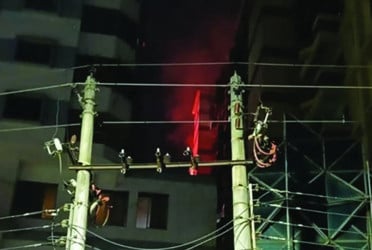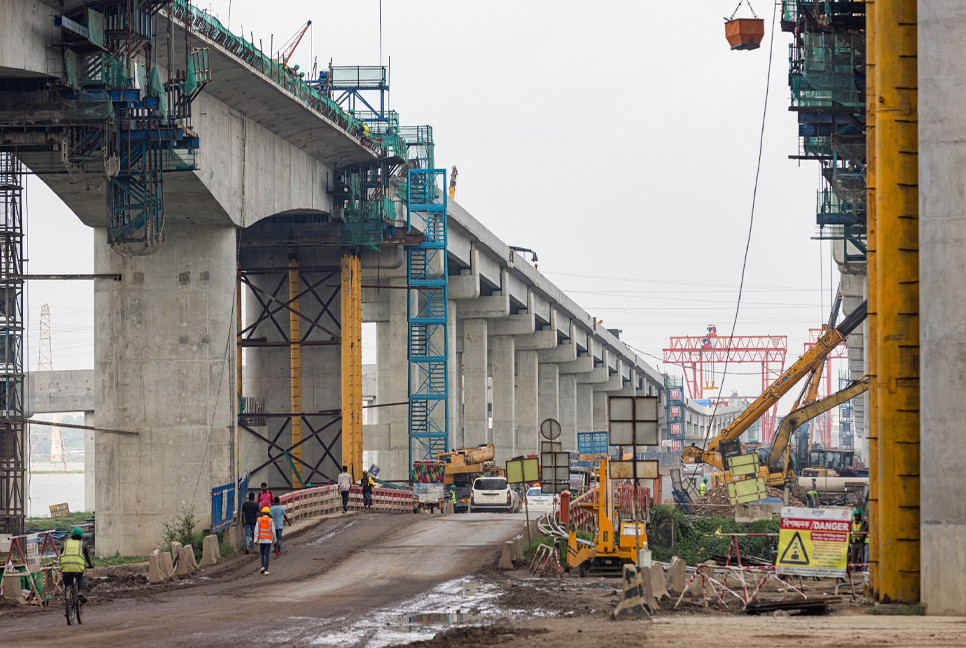
More than eight years after its approval and with over half of construction already complete, the Dhaka-Ashulia Expressway project has hit a major roadblock due to the lack of early provision for utility relocation, prompting authorities to now seek an additional Tk515 crore to shift obstructing overhead and underground lines along a nine-kilometre stretch.
The Tk17,553 crore project, designed to link Hazrat Shahjalal International Airport to the industrial belt at Chandra via Abdullahpur, Ashulia, Baipail, Nabinagar Intersection and the Export Processing Zone (EPZ), has reached 52% completion as of this August, according to the project’s implementation unit.
But critical sections remain blocked by electricity lines, gas pipelines, and roadside buildings – an oversight attributed to poor pre-feasibility and feasibility studies amid inadequate cooperation from utility agencies, and omissions in the project’s Terms of Reference (ToR).
“There was no allocation for utility shifting, so we have sought a revision in the project cost by Tk515 crore,” said Shafiqul Islam, project director of the Dhaka-Ashulia Expressway.
“The Planning Commission has given us the go-ahead and assured that the proposal will be approved in the next meeting of the Executive Committee of the National Economic Council (ECNEC).”
Of the newly requested sum, Tk490 crore is intended for relocating the Bangladesh Rural Electrification Board’s (BREB) overhead electricity lines. The remaining Tk25 crore will go to other agencies, including Dhaka Water Supply and Sewerage Authority (WASA), Dhaka North City Corporation, Power Grid Company of Bangladesh Limited (PGCBL) and United Power Generation and Distribution Company Limited (UPGDCL).
With the additional requirement, the project cost will rise to Tk18,068 crore. The budget covers construction of the main expressway, a 1.92 km two-lane Nabinagar Flyover, a 2.52 km two-lane bridge, a 500-metre overpass, five toll plazas, and the acquisition and resettlement of 40.89 hectares of land.
Project Director Shafiqul Islam said the development proposal had earmarked Tk265 crore for constructing 18 kilometres of drainage and utility ducts. By May this year, Tk53 crore had been spent, but only 20% of the work was complete.
“We have constructed a drainage line and duct,” he said. “The 11 kV and 33 kV power lines could not be relocated into the duct.”
Urban planner Dr Adil Mohammed Khan, president of the Bangladesh Institute of Planners, warned that if the ducts could not be used for utility lines, the investment would be wasted.
Calling the omission of a Tk500 crore component “unimaginable”, he described it as “a crime and professional negligence” that warrants investigation and prosecution.
“Utility relocation is a key consideration in mega projects,” Dr Adil said, adding, “When standard operating procedures are followed, this cannot happen. The sudden rise of Tk500 crore also raises questions about the validity of the cost-benefit analysis. That analysis will be null and void.”
Utilities blocking key sections
An Implementation Monitoring and Evaluation Department (IMED) inspection identified multiple obstacles along the alignment.
Between Ashulia and Savar EPZ, specifically from pier No. 420 to pier No. 774, BREB’s 33 kV and 11 kV power lines run along the roadside, making it impossible to cap the piers.
At pier No. 496, PGCBL’s high-voltage 300 kV and 33 kV lines have stalled work entirely. Further down the alignment, unshifted 33 kV lines owned by UPGDCL have halted work from piers 718 to 774.
From km 13+500 to km 21+700, Titas Gas pipelines are preventing piling works in several locations. Structural obstacles have also emerged: the E-4 Ramp cannot proceed due to a roadside building at chainage km 15+800, while the E-7 Ramp is blocked between chainage km 23+600 and km 23+971 by another roadside structure.
A troubled history from the start
The Dhaka-Ashulia Expressway was first approved at an ECNEC meeting on 24 February 2011.
In 2013, the Bangladesh University of Engineering and Technology (BUET) conducted a pre-feasibility study, which initially proposed a 35-kilometre route.
The final feasibility study, completed in August 2016, shortened the alignment to 24 kilometres.
On 22 January 2015, a Memorandum of Understanding (MoU) was signed between the Bangladesh Bridge Authority (BBA) and China National Machinery Import and Export Corporation (CMIEC), the Chinese government’s nominated contractor, to implement the project on a government-to-government (G2G) basis.
The commercial agreement with CMIEC, under an Engineering, Procurement and Construction (EPC) contract, was signed on 29 November 2017.
Financing arrangements were finalised on 26 October 2021, when the government signed a loan agreement with the Export-Import Bank of China.
The loan became effective on 10 May 2022, and the formal notice to commence work was issued to CMIEC on 20 May 2022.
Pre-feasibility gaps and agency non-cooperation
BUET’s 2013 pre-feasibility report makes clear that utility mapping was incomplete due to a lack of cooperation from relevant agencies.
The university contacted Titas Gas Transmission and Distribution Company Limited, Dhaka Electric Supply Company Limited, Dhaka Power Distribution Company Limited, Dhaka Wasa, Bangladesh Telecommunications Company Limited, and the Bangladesh Telecommunication Regulatory Commission (BTRC).
However, most agencies refused to provide detailed maps or technical drawings.
“Only limited information without any maps or drawings were obtained from these organisations,” the report stated.
“Finding no other low-cost alternative, a visual inspection of the utilities was carried out for each route alignment option. Information was also gathered from road-adjacent shopkeepers, residents, EPZ officials, local municipalities, etc. As a result, the methodology relies heavily upon the data provided by others and therefore it is difficult to guarantee the accuracy or completeness of these data sources.”
Despite this uncertainty, the pre-feasibility report recommended keeping Tk300 crore for utility relocation.
Utility relocation left out of feasibility ToR
The Bangladesh Bridge Authority later awarded a Tk16 crore contract for the feasibility study to SMEC International Pty Ltd (Australia), in joint venture with Devcon and ACE.
However, a senior BBA engineer involved in the study process confirmed that mapping and cost estimation of utility relocations were not part of the Terms of Reference.
BBA Superintending Engineer Md Ohiduzzaman said, “Inventory and cost estimation of utility relocation was not in the ToR for the feasibility study. This was a billion-dollar project, but the study budget was only Tk16 crore. Later, the responsibility for feasibility of the Dhaka East–West Elevated Expressway was also factored into the same contract. As a result, what was prepared was not up to the mark.”
The feasibility report acknowledged that 11/33 kV power lines, gas mains, water mains, and telecom cables would require relocation, but claimed that utility providers could only confirm needs once detailed design drawings were available. The consultants based their utility relocation cost estimates on “experience of the likely order of costs” rather than actual mapping.
Crucially, while the feasibility study allocated Tk2.7 crore for drainage and ducts for utilities, it made no budgetary provision for the relocation itself.
Courtesy: Daily Sun.
Bd-pratidin English/TR