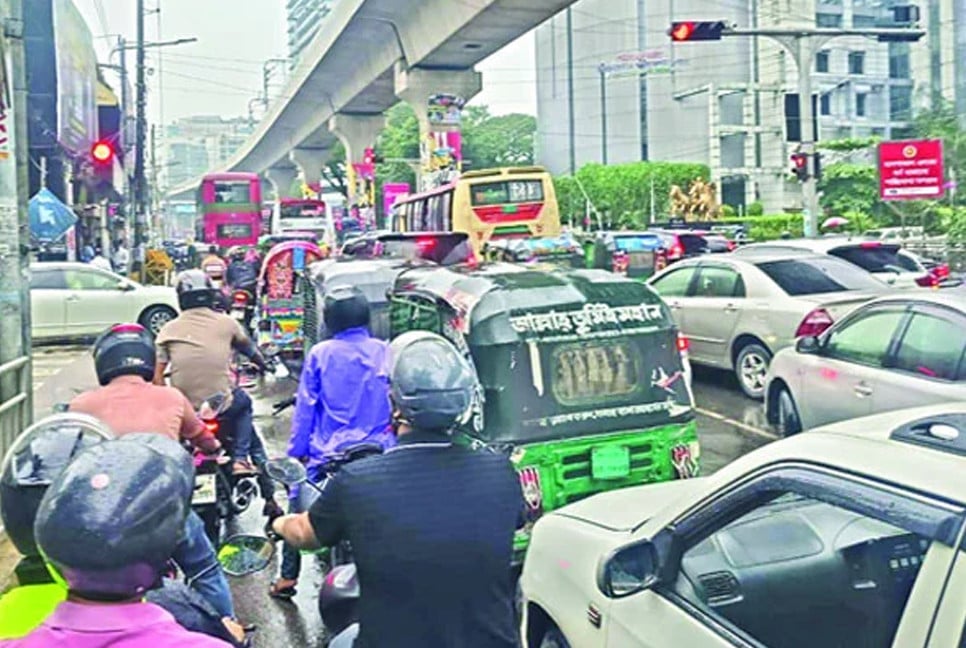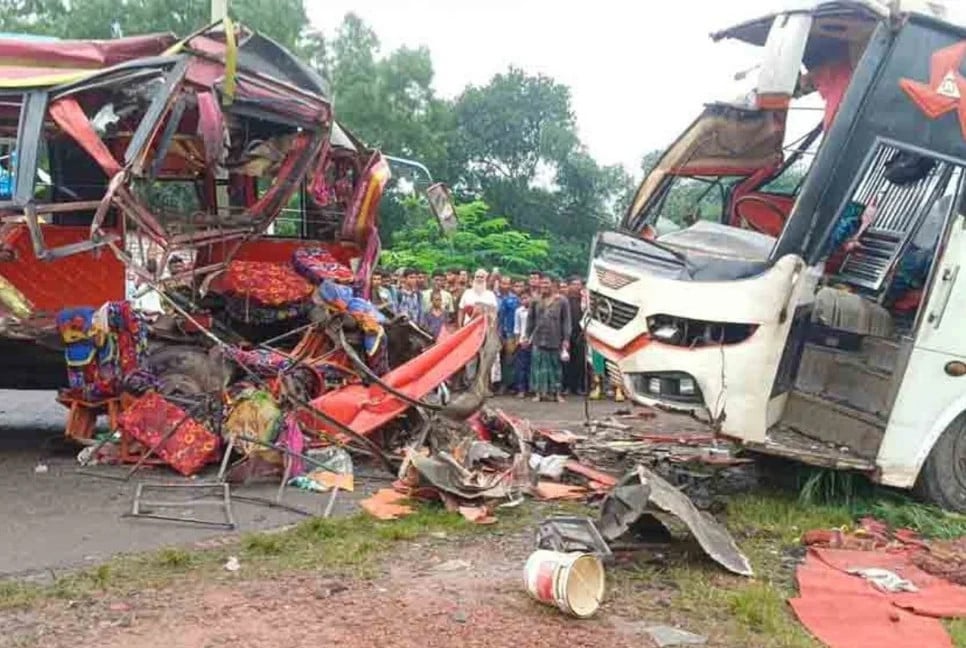
About 20 people get killed in road crashes daily in the country on an average, according to the government data, while many get injured and huge properties get damaged, but the authorities concerned have turned blind eye to it over the years apparently for the pressure from “an evil circle,” which benefits from the poor safety management.
Consequently, measures to prevent the losses of lives and properties have been ignored for years, and more depressingly for many people, this chronic problem got apparently lost among the other more urgent reform agendas of the interim government.
Concerned departments of the government including Bangladesh Road Transport Authority (BRTA), a regulatory body of the transport sector, only counts death tolls but it has no programme for making roads across the country safe, said experts.
Investigations of the government agencies had repeatedly identified some common reasons, including drowsiness and over speeding by drivers, outdated engine of vehicle and reckless race on the streets, for road accidents and forwarded an array of recommendations in this regard to the authorities, but those were never implemented.
Besides, in many cases, the victims’ families do not get any justice as they do not file cases over the accidents in a bid to avoid getting harassed in an ineffective system.
Experts said successive governments in the country have bowed down to evil circles, both in the bureaucracy and stakeholders in the sector, who make money out of the distress of the sector.
The latest interim government had an opportunity to defeat the force after the fall of the fascist Awami League government, but they lost it for not focusing on the sector and for not having the right people and enough time in hand to tackle this problem, said experts and people involved in this sector.
According to BRTA data, at least 566 people died in June in 557 road crashes which mean 19 people died on an average daily. Besides, the data of non-government organisation Road Safety Foundation said that at least 693 people were killed in 689 road crashes in June, which means nearly 23 people were killed by road crashes daily.
The road crashes continue at the same pace for the last few years and have continued the trend in the recent months.
Hazardous transport practices continue
On 6 August, Seven people, all women and children, were killed when a microbus plunged into a roadside canal in Purbo Jagadishpur area of Alaiyapur Union in Begumganj upazila of Noakhali.
The accident occurred on the Lakshmipur–Noakhali highway. The microbus Dhaka Metro- Cha 20-21264, started from Dhaka airport with 11 people on 5 August night.
The deceased have been identified as Faizun Nesa, 80, Khurshida Begum, 55, Kabita Begum, 30, Laboni Begum, 30, Reshmi Akter, 10, Meem Akter, 2, and Lamia Akter, 9
Talking to the the media on Friday, Chandraganj Highway police station officer-in-charge Mobarak Hossain Bhuiyan said that no case over the incident was filed.
He said, “I am now visiting the home of the victim. They will file a case over the incident but meanwhile, we have been conducting a drive to detain the driver.”
Commenting on the accidents, BUET’s Accident Research Institute (ARI) director Prof Dr Md Shamsul Hoque said that the microbus should not have been transporting passengers commercially and it was illegal but BRTA has not been regulating such illegal activities.
He said, “Among the government agencies BRTA and Roads and Highways Department have a big stake in making roads safer, but I noticed that BRTA has started avoiding their responsibility. BRTA now counts the death toll instead of analysing the reason behind crashes and implementing new programmes.
”The counting started with an ill motive, which is showing that the death toll is lower as some non-government organisation’s data showed that the number of deaths is increasing on the road.”
He further said the interim government had a golden opportunity but they have no focus on the sector and they don’t have enough manpower and time to bring discipline to the sector.
Dr Shamsul Huq said, “I don’t see a chance of any reform of the sector under any political government because leaders of transport owners and workers associations are political figures and they will not allow any reform in the sector. Earlier, they foiled a government initiative to bring to transport service under bus route rationalisation by staging non-cooperation.”
He also said, “The problems on roads are compounding when new expressways are constructed, while slow-moving and battery-run vehicles come on the streets in an increasing number. Now, it is very difficult to stop the vehicles on highways. We need a change in mindset of the stakeholders.”
Courtesy: Daily Sun.
Bd-pratidin English/TR