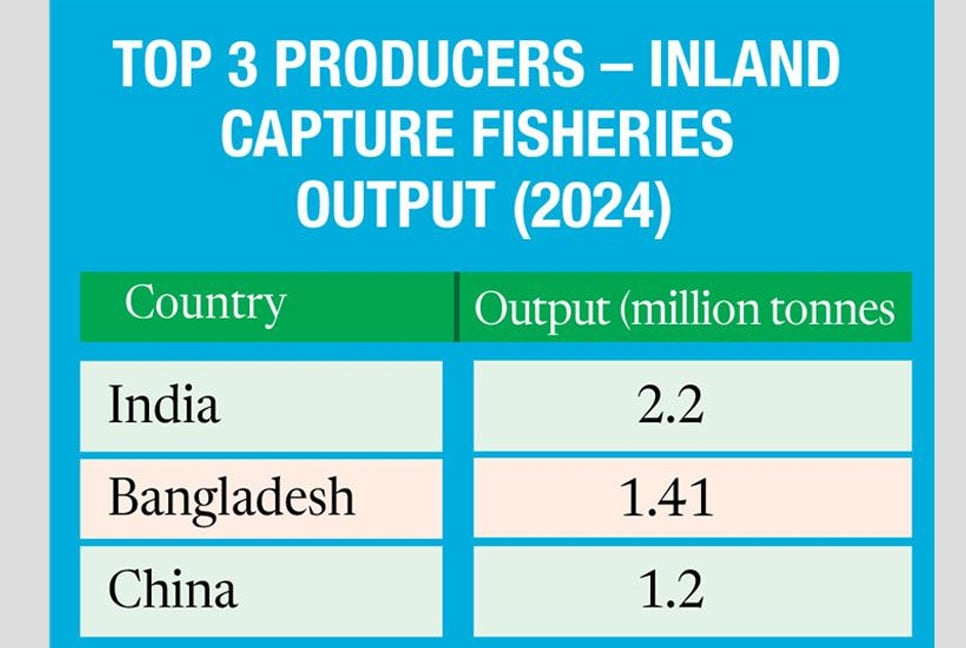
Bangladesh has once again secured the second position in global inland capture fisheries production, recording catches of around 1.41 million tonnes in 2024, according to the latest “State of World Fisheries and Aquaculture 2026” report published by the Food and Agriculture Organization Food and Agriculture Organization on 16 June.
Bangladesh also maintained its second position in 2022 and 2023.
The report shows the country accounted for 11.57% of global inland water capture fisheries production, underscoring its continued significance in global fish supply and national food security.
India remained the top producer with 2.2 million tonnes of inland catches, while China China ranked third with 1.2 million tonnes in 2024.
China’s inland catches have declined by nearly 47% compared to 2017, largely due to strict management measures, including a long-term fishing ban in parts of the Yangtze River and a policy shift towards aquaculture and culture-based fisheries.
Globally, inland capture fisheries reached a record 12.3 million tonnes in 2024, rising 5.9% compared with the average of the previous three years.
The FAO report said the increase was driven mainly by major producers such as India, Bangladesh and Tanzania, where inland fisheries remain vital for nutrition, livelihoods and domestic consumption.
However, it warned that many inland aquatic ecosystems are already heavily exploited or in decline, leaving limited scope for significant future expansion. It also pointed to ongoing challenges in data quality and statistical uncertainty in inland fisheries reporting across countries.
Meanwhile, global aquaculture production reached a new milestone of 142 million tonnes in 2024, valued at US$391 billion. Of this, 103 million tonnes were aquatic animals and 39 million tonnes algae. Asia remained dominant, contributing 92% of total output.
The top five aquaculture producers – China, Indonesia, India, Viet Nam and Bangladesh – accounted for 84% of global production, with Bangladesh retaining a strong position in the sector.
Overall, world fisheries and aquaculture production rose to a record 235 million tonnes in 2024, marking a 5.2% increase compared with 2022.
The sector generated an estimated first-sale value of $565 billion, with Asia contributing 76% of total global production.
The FAO report reaffirmed aquaculture as the main driver of growth in global fish production, while highlighting the continued importance of inland capture fisheries for food security, particularly in developing countries.
Bd-pratidin English/ ANI