Bangladesh’s renewable energy sector is struggling to expand due to high import duties on equipment, with industry leaders urging the government to prioritise clean energy to address the country’s ongoing power crisis.
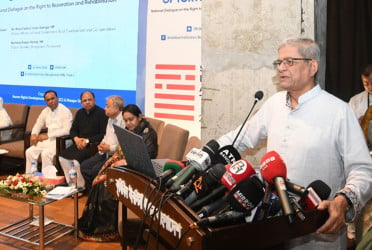
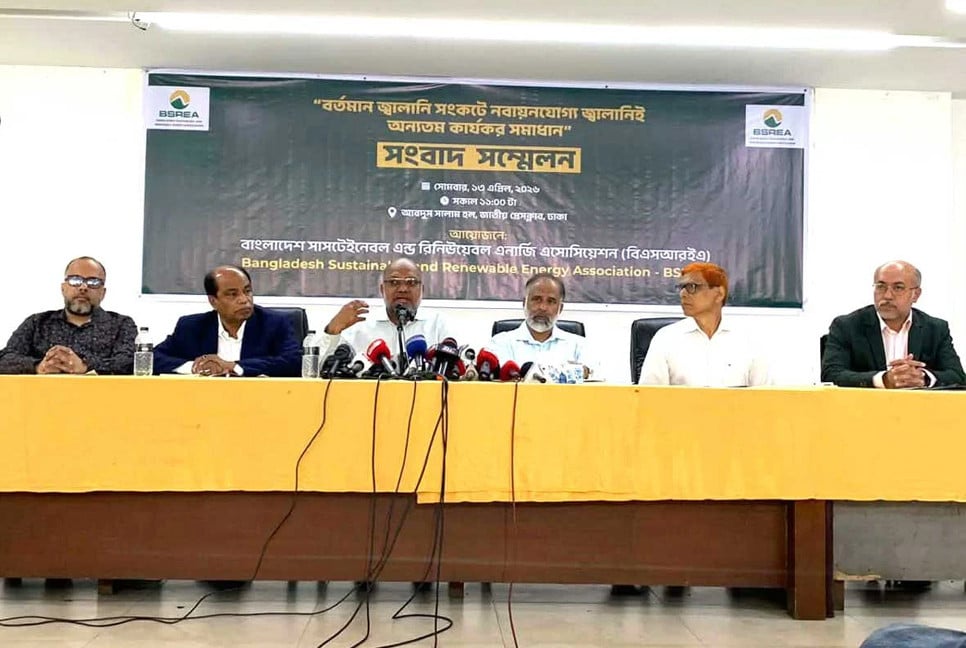
At a press conference held at the National Press Club in Dhaka on Monday , the Bangladesh Sustainable and Renewable Energy Association (BSREA) called for urgent policy support, including tax reductions and financial incentives, to accelerate the adoption of renewable energy-particularly solar power.
BSREA leaders said Bangladesh is currently facing a deepening energy crisis driven by heavy reliance on imported fuels, rising global prices, and mounting pressure on foreign exchange reserves.
The government is reportedly spending more than Tk200 crore per day in subsidies to sustain electricity generation using costly liquefied natural gas (LNG), coal, and oil-an approach they warned is economically unsustainable.
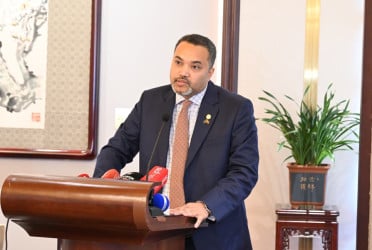
Speaking at the event, BSREA President Mostafa Al Mahmud said renewable energy remains the most cost-effective and environmentally sustainable solution in the long term, yet the sector continues to receive inadequate policy support.
He noted that import duties and taxes on renewable energy equipment currently range between 50% and 60%, creating a significant barrier to investment.
“This stands in stark contrast to the conventional energy sector, which continues to benefit from subsidies and policy advantages,” he said, describing the situation as a clear policy imbalance.
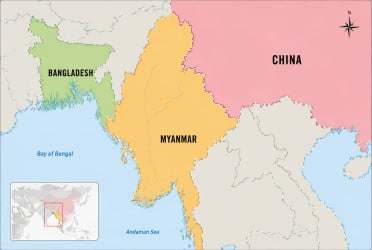
The association also pointed out that neighbouring countries such as India, Pakistan, Vietnam, and China have made notable progress in renewable energy by offering tax exemptions, lower duties, and easier access to financing. In comparison, Bangladesh has been slower to respond, leaving it more vulnerable to external energy shocks, particularly amid ongoing geopolitical tensions in the Middle East.
Global energy market volatility, partly driven by tensions involving the United States and Iran, has pushed Brent crude prices to between $115 and $120 per barrel, while risks around the Strait of Hormuz have raised concerns over supply disruptions. For Bangladesh, where more than 60% of energy demand is met through imports, this has heightened both price and supply pressures.
BSREA said Bangladesh remains heavily dependent on Qatar for LNG imports, accounting for around 70% of supply, increasing exposure to external risks.
At the same time, the country’s daily gas demand in the power sector exceeds 2,500 mmcfd, while supply has dropped to between 850 and 900 mmcfd-creating a potential shortfall of 1,500 to 1,800 megawatts in electricity generation.
The association warned that limited strategic fuel reserves-sufficient for only 35 to 40 days—further compound the risk, especially when compared with higher reserve levels in developed economies.
The impact is already being felt in the industrial sector, particularly in the ready-made garments industry, where production has declined by up to 30–40% due to gas shortages and load-shedding.
This, they said, could have serious implications for export earnings and foreign exchange reserves.
BSREA leaders stressed that the current crisis reflects deeper structural weaknesses in Bangladesh’s energy system rather than a temporary disruption, making a rapid transition to renewable energy essential.
They proposed a series of policy measures, including reducing import duties on renewable energy equipment, introducing zero-duty facilities for lithium-ion batteries, ensuring long-term low-cost financing, and fast-tracking stalled solar projects.
Additional recommendations included reviving rooftop solar programmes, simplifying net metering processes, expanding solar-powered irrigation, and offering tax incentives to attract investment in the renewable sector.
The association said that with the right policy support and investment, renewable energy could play a critical role in strengthening Bangladesh’s energy security and reducing its dependence on volatile global fuel markets.
Bd-pratidin English/ ANI