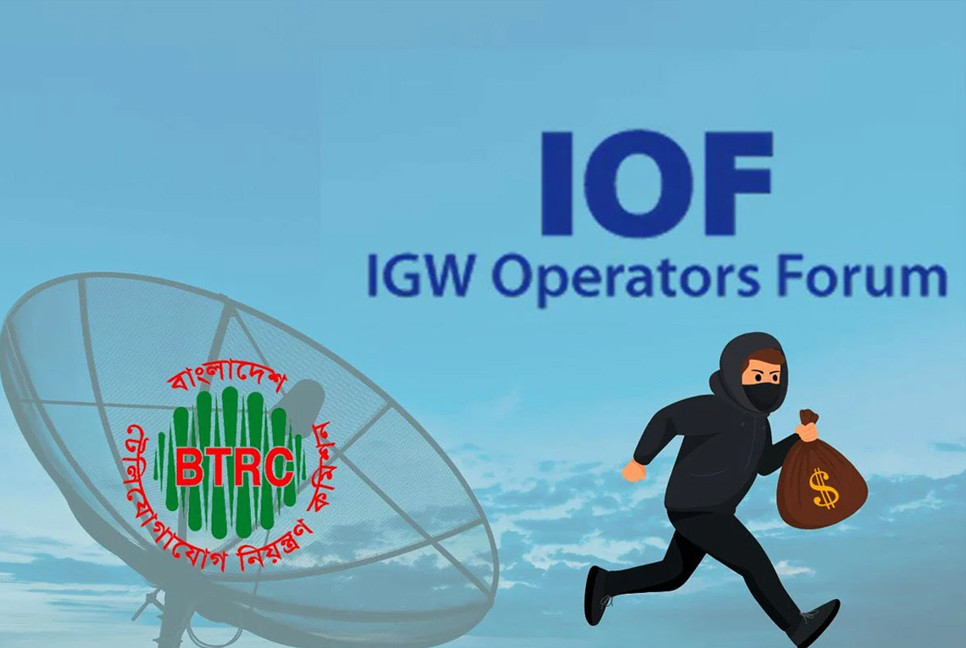
The financial irregularities surrounding the International Gateway Operators Forum (IOF) syndicate in Bangladesh’s telecommunications sector have once again come into focus following the formation of a new government. The pressing question remains: will the main architects behind the alleged scheme finally face legal action or continue to operate under protection?
According to sector insiders, nearly Tk 8,000 crore has been siphoned off from government revenues over the past decade under the guise of an experimental network topology. This process allegedly operated under the influence of seven International Gateway (IGW) operators linked to Salman F Rahman, widely known as “Darvesh.”
The Bangladesh Telecommunication Regulatory Commission (BTRC) has filed a case with Gulshan Police Station accusing individuals of embezzling Tk 568 crore from the “Market Development Fund” (MDF/MDS), a fund created under the IOF structure.
According to experts, without structural reforms, effective enforcement, and transparent auditing, the full extent of past irregularities will remain hidden. Now the focus is on how effectively investigations and policy changes are implemented.
Telecom expert Nurul Kabir stressed that a comprehensive techno-commercial audit is needed to assess the nine-year drain on the state treasury.
He noted that without forensic audits of the IOS structure, rate-setting mechanisms, and MDS expenditures, the true picture will not emerge. Attempts to contact IOF President Asif Rabbani for comment were unsuccessful.
From ILDTS to IOS: Policy deviation
In 2007, in the aftermath of the 2007–2008 Bangladeshi political crisis, the government introduced the International Long Distance Telecommunications Services (ILDTS) policy to bring discipline to international call management. Its objectives included curbing VoIP fraud, protecting revenue, and establishing a structured market. Under this three-tier system, IGW operators were responsible for bringing international calls into Bangladesh, routing them through ICX before delivering them to mobile operators.
However, in 2015, under BTRC directives, the IGW Operators Switch (IOS) was introduced. Through this system, the IOF implemented what was described as an experimental network topology. Critics argue that this IOS-based framework contradicts Clause 5.2.5 of the 2010 ILDTS policy, which mandated direct connectivity between IGW and ICX operators.
The IOS system effectively channelled all international calls through a single “common point” controlled by the IOF. As a result, the seven IGW operators gained significant influence over international call termination rates. Experts contend this arrangement violates Sections 15 and 16 of the Competition Act 2012. Allegations suggest that around 60% of total revenue was shared among seven dominant IGW operators, while the remaining 40% was distributed among 20–22 smaller operators.
Floor rates, high termination charges, and revenue loss
The government had set a minimum “floor rate” for international call termination. However, allegations indicate that calls were terminated at higher rates in practice, while revenue-sharing calculations were based on the lower floor rate. This discrepancy allowed the IOF group to retain excess profits.
Despite BTRC reducing the floor rate multiple times, call volumes declined while illegal VoIP operations increased. Daily international call traffic has reportedly dropped from 100 crore minutes to just over 10 crore minutes, significantly reducing government revenue. Experts reiterate that a full techno-commercial and forensic audit is necessary to uncover the true scale of financial losses.
MDF/MDS Fund: Where did over Tk6,300 crore go?
Under the IOF framework, a Market Development Fund (MDF/MDS) was established. According to BTRC data, more than Tk631 crore had been deposited into the fund as of 31 December 2024, with over Tk625 crore reportedly spent. Allegations claim that at least 95% of this expenditure was transferred to Beximco Computers Limited—an entity that does not hold an IGW licence.
Criminal case and 27 accused
In 2025, BTRC filed a case at Gulshan Police Station accusing individuals of embezzling Tk568 crore from the MDF. The case was lodged under Sections 73, 74, and 76 of the Telecommunications Act 2001 (amended 2010), along with Sections 420 and 406 of the Penal Code, naming 27 accused.
Among them are members of Salman F Rahman’s family and several executives of the IOF. Investigators have stated that allegations of licence violations, breach of contractual terms, fraud, and fund misappropriation are being examined. So far, 12 named accused have surrendered before the Dhaka Chief Metropolitan Magistrate’s Court and secured bail on bonds of Tk5,000 each. However, key decision-makers at the centre of the allegations remain beyond the reach of the law.
Cancellation of agreements
In a recent meeting, BTRC decided to revoke approval of operational agreements between the IOF and IGW operators. The regulator has also announced plans to introduce a new control mechanism for international call management, alongside stricter monitoring and bank guarantee requirements.
Source: Daily Amar Desh
Bd-pratidin English/ ANI