Debate has erupted over the initiative to introduce a new policy for managing street vendors in the capital. Experts say that allowing hawkers to conduct business on pavements at minimal cost, while lawful shop owners pay taxes, VAT and high rents, could create unfair competition and a new form of inequality.
Although the proposed policy aims to restore order to pavement management, urban planners have questioned both its implementation and its long-term impact. They point out that extortion amounting to billions of taka is collected daily and monthly from roadside and pavement hawkers. While this vast sum ends up in the pockets of “linemen”, politically influential individuals and a section of corrupt officials, not a single penny reaches the state treasury.
Most experts believe that the problem will not be solved merely by introducing registration, smart cards or fixed fees. Unless issues such as the tax structure, urban management, competition with lawful businesses and public inconvenience are taken into account, the policy will effectively amount to nothing more than a partial legalisation of pavement trading.
It is known that most hawkers currently do not pay regular taxes or VAT to the government. They operate without trade licences, income tax, shop rent, electricity bills or other institutional expenses. Yet, in order to continue trading on occupied pavements, they must pay daily or monthly extortion money to influential groups, linemen, political activists or corrupt officials. As a result, the government is deprived of revenue while an uncontrolled economic cycle has emerged.
By contrast, lawful shop owners in the capital must pay substantial rents to operate their businesses. In addition, they bear the burden of trade licence fees, VAT and taxes, electricity and gas bills, employee expenses and compliance with numerous government regulations. Even after incurring such costs, many traders are unable to conduct business smoothly. Traffic congestion, occupied pavements, illegal roadside stalls and restricted customer access all negatively affect their trade.
Business owners complain that pavement hawkers operate at far lower costs and can therefore sell goods at cheaper prices. This places lawful shopkeepers at a disadvantage in an unequal market. Permanent shop owners suffer particularly when similar products are sold directly outside markets on pavements. Consequently, many believe that those who comply with regulations and pay taxes are effectively becoming victims of policy discrimination.
Rezaul Karim Majhi, who runs a cosmetics business in the Shah Ali area of Mirpur, said: “My shop rent is Tk12,000. At the end of the year I have to pay licence fees to the city corporation, and every month staff salaries and other costs add another Tk20,000 to Tk30,000. It has become difficult to support my family. Yet each pavement trader in front of our market earns at least more than Tk1,000 a day. Now it feels like I may have to leave my permanent shop and move onto the pavement.”
Urban experts say that any business operating over the long term must eventually be brought under an institutional framework. Simply charging fees and issuing smart cards will not solve the problem. Such measures do not guarantee an end to extortion, nor do they establish a clear revenue system. In their view, if the government genuinely wishes to bring hawkers under a lawful framework, it must create a transparent tax and registration system based on income, type of goods, location and scale of business. At the same time, pavements must strictly remain pedestrian-friendly.
Another major question raised by experts is why a separate hawker policy has been formulated only for Dhaka North and South City Corporations. The same problems exist in other metropolitan cities, district towns and municipalities across the country. Complaints regarding pavement occupation, uncontrolled hawking and extortion are longstanding in cities such as Chattogram, Khulna, Rajshahi, Sylhet and Cumilla. Experts fear that a Dhaka-centric policy may create a discriminatory situation nationwide.
Urban expert Professor Dr Adil Mohammad Khan said that the Local Government Division’s hawker policy had been designed solely around Dhaka North and South City Corporations, whereas an integrated policy for all urban areas of the country should have been introduced. According to him, “A national framework for hawker management across the country should have been developed first, with more detailed guidelines later added to reflect Dhaka’s realities. Focusing only on Dhaka has long been our tendency, while urban problems outside the capital receive little policy attention.”
He added: “At times the government must enforce the law strictly. Conducting business by occupying pavements is not legally valid. For those who are genuinely impoverished, the government already has separate social safety-net programmes. They can be supported through food assistance, employment schemes or family-based support programmes. But it would not be right to institutionalise illegal occupation under the guise of rehabilitation.”
According to him, not all hawkers in Dhaka can be considered extremely poor. Many have been in this profession for 10 to 15 years and have achieved financial stability. Therefore, applying the same standard to everyone is unrealistic.
Referring to disparities in taxes and expenses, Adil Mohammad Khan said: “A lawful businessman bears costs such as shop rent, trade licences, taxes and electricity bills, while another person conducts business on the pavement for a negligible amount. This is not fair competition.”
When asked about the policy, Md Robiul Islam, Deputy Secretary of the Local Government Division (City Corporation-1), said: “Since hawker management in Dhaka has become a major challenge, the policy has initially been formulated only for Dhaka North and South City Corporation areas. Gradually, similar policies will be expanded to other city corporations and urban areas across the country.”
Regarding the low fees set for hawkers, he said: “No fee is actually being charged. The amount to be collected by the relevant authorities is intended only to cover administrative expenses. The government will incur minimum costs for QR code-based identity cards, licences, registration and management of hawkers. The money is meant solely to offset those expenses. There is no intention of making a profit.”
He further stated: “The government does not want to run a business. The main objective is to bring hawkers under a disciplined registration system. Only the costs associated with ID cards, licences and management activities will be recovered.” According to Robiul Islam, “The primary purpose of the hawker policy is not profit. Hawkers are citizens of this country, and for now the government’s priority is to ensure they can earn a decent livelihood.”
He added that a large section of hawkers comes from marginalised communities. At the initial stage, the focus is on their rehabilitation and livelihood security. The government may later consider further management or structural measures if necessary.
Eviction drives and reoccupation of pavements
Last April, the two city corporations, together with Dhaka Metropolitan Police (DMP) and other relevant agencies, carried out extensive eviction drives to free the capital’s pavements from illegal occupation. As a result, traffic congestion eased even on busy roads such as Gulistan, Mirpur-10 and New Market, while pedestrians were able to walk comfortably on pavements again. However, within barely a week, those pavements and roads were reoccupied by hawkers. At that time, the city corporations and relevant authorities were still working on hawker rehabilitation and preparing vendor lists.
Now, with the Local Government Ministry’s new hawker policy and rehabilitation plan coming to the forefront, public reaction has become mixed. Some believe hawkers should be allowed to operate in an orderly manner, while others fear this may permanently institutionalise the culture of pavement occupation.
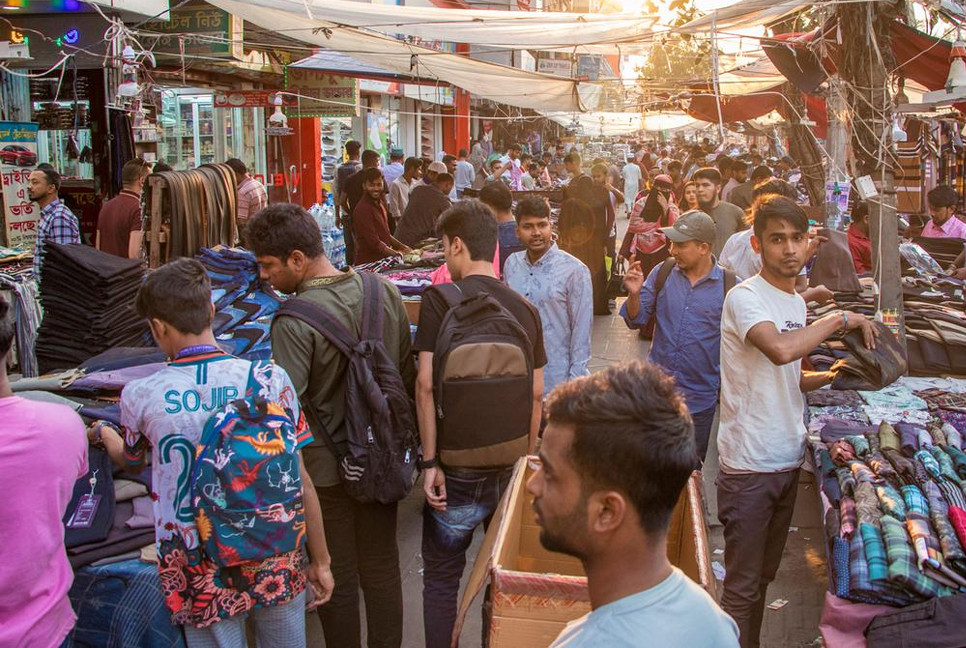
In recent days, visits to Zero Point in Gulistan, Baitul Mukarram and surrounding areas showed that pavements had once again been taken over by hawkers selling goods from mobile vans. Local business owners and pedestrians said that without regular monitoring, it would not take long for the previous situation to return completely.
Sirajul Islam, a private employee travelling from Nawabpur to Paltan, said: “We felt much more comfortable once the pavements were cleared. Now I see they have been fully occupied again. If hawkers are simply given cards and legitimised, what will happen to the city’s residents? How will we move around comfortably?”
On the other hand, hawkers argue that eviction alone cannot provide a lasting solution without alternative employment or rehabilitation. One hawker in the New Market area said: “We heard they’ll let us sit on the pavements. We haven’t received any cards yet, so we’re continuing business as usual. If cards are required, we’ll pay and get them.”
New hawker policy of the Local Government Division
The policy proposes registration through smart cards, designated places and hours for trading, fixed monthly or annual fees, and the introduction of “holiday markets” and “evening markets”. Relevant sources said work is already underway to identify potential hawker zones in Gulistan, New Market and Mirpur-10.
According to the policy, at least five feet of pavement space must remain clear for pedestrians. Hawkers will not be allowed within specified distances of metro rail stations, bus stands and important intersections. Information on registered hawkers will be stored through QR code-enabled smart cards.
The policy states that hawkers must be at least 18 years old. Thirty per cent quotas will be reserved for women, persons with disabilities and third-gender individuals. Central and regional committees will oversee hawker management. The central committee will include representatives from the city corporations, Local Government Division, traffic authorities and RAJUK, while regional committees will include representatives from the city corporations, RAJUK and the traffic department.
Extortion worth billions of taka
According to an investigation by the BRAC Institute of Governance and Development, around Tk18.25 billion is extorted annually from nearly 500,000 hawkers in the capital. Each hawker pays an average of Tk192 per day in extortion money. Police personnel, political leaders and activists reportedly receive shares of this money. In Gulistan alone, extortion amounts to around Tk200 million a month.
In Gulistan — including Shahid Abrar Fahad Avenue, the south gate of Baitul Mukarram, the road beside the Maulana Bhasani National Hockey Stadium, the stretch from the Gulistan SAARC Fountain to Hazrat Golap Shah Shrine, Dhaka Trade Centre, Hanif Flyover and roads in front of the Awami League office — there are between 25,000 and 30,000 hawkers operating in alleyways and on pavements. These include stalls selling clothes, fruit, food and various other products, ranging from small to large in scale. Powerful extortion syndicates known as “linemen” collect daily and monthly payments from these traders. Each stall pays between Tk50 and Tk500 daily, while some pay Tk5,000 to Tk10,000 monthly.
Who are the extortionist “linemen”?
It is reported that Gulistan alone has around 20 such extortionists known as linemen. Among them, Nabi controls the Capital Hotel and Belt Lane area, while Harun controls the pavement and road in front of Gulistan Cinema Hall. Others such as Rajjab, Lomba Babul, Selim, Bimal, Bacchu, Khorshed, Nipu, Mohammad Ali and Shahjahan control various stretches from Gulistan Building to Trade Centre and the eastern side of Osmani Udyan. Kadir controls the area in front of Khaddar Market, while Khalil and Puton control the stadium’s south gate. Rahim oversees the area in front of the JASAD office, Kala Nuru controls the area in front of the Communist Party office, and Akhtar and Jahangir control Belt Lane to Bangabandhu Avenue. Salam (known as “Bearded Salam”) controls the GPO area, while Mohammad Ali dominates Fulbaria and the bus terminal. Ali Mia controls the western side of Ramna Bhaban and Bhasani Stadium. These linemen are themselves controlled by leaders of hawkers’ and labour organisations. Similar situations exist across different areas of the capital. Intelligence sources say extortion from hawkers amounts to hundreds of crores of taka every month.
Source: Kaler Kantho
Bd-pratidin English/ ANI