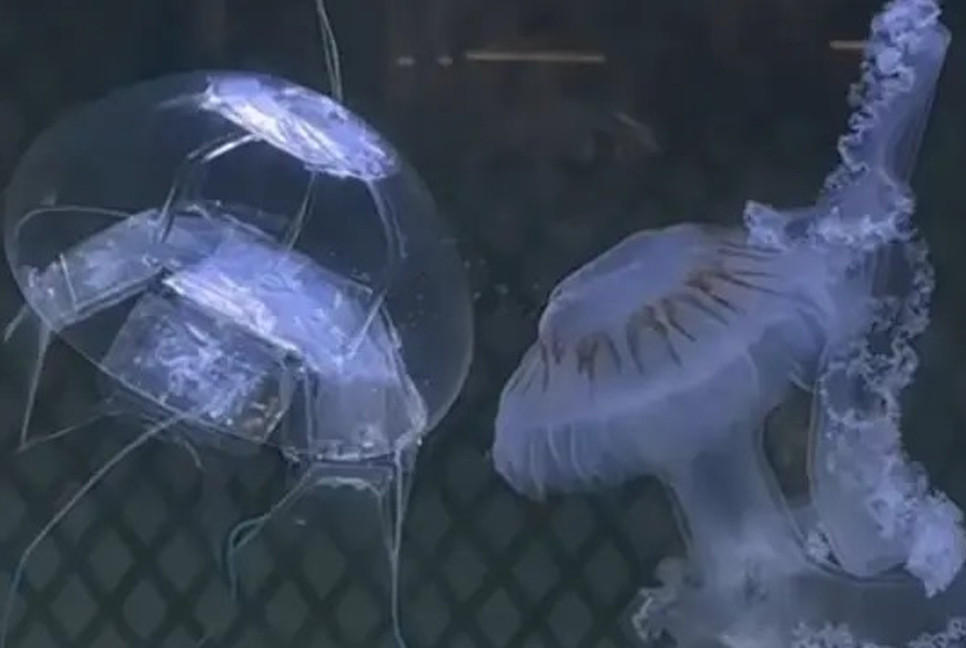
In a breakthrough of biomimetic innovation, Chinese researchers have revealed a jellyfish-like underwater robot capable of stealthy marine operations. The completely see-through bionic drone, nicknamed the "Ghost Jellyfish" or "Underwater Phantom," can glide quietly across the ocean while merging nearly seamlessly with its surroundings.
Researchers at Northwestern Polytechnical University in Xi’an, China, have unveiled a bionic “ghost” jellyfish robot capable of carrying out stealth operations beneath the sea.
Led by Professor Tao Kai from the university’s School of Mechanical and Electrical Engineering, the team designed the robot to mimic the movement and appearance of real jellyfish.
According to the university, the robot is nearly indistinguishable from real jellyfish when submerged, enabling intelligent detection and real-time monitoring in aquatic environments.
According to Science and Technology Daily as quoted Tao, the robot’s low power consumption, near-silent motion, and realistic design make it ideal for deep-sea surveillance, monitoring delicate ecosystems, and inspecting underwater infrastructure with precision.
The robot’s transparent form, complete with an umbrella-like body and tentacles, closely mimics a jellyfish and is made from a hydrogel electrode material developed by the research team.
The result is a compact device measuring 120mm (4.7 inches) in diameter and weighing just 56 grams (two ounces).
The robot moves underwater using an electrostatic hydraulic actuator, which mimics the neural signals that control muscle contraction and relaxation in jellyfish.
Operating at just 28.5 milliwatts, it produces almost no physical or acoustic disturbance, making long-term covert underwater missions possible.
The robot is equipped with a miniature camera module and an embedded artificial intelligence processing chip, allowing it to accurately identify specific underwater targets through machine learning.
In August, the bionic jellyfish was featured in a science programme on state broadcaster CCTV alongside other bioinspired robots, including a robotic bird, a mechanical locust, a gecko robot and a robotic fish.
During the programme, Tao showed the robot’s intelligent abilities, demonstrating how it could maintain a stable hover in dynamic water conditions and accurately identify specific objects, including the school’s emblem and clownfish. The demonstration showed that a robot inspired by nature could independently perceive its environment and identify targets.
A team member said the robotic jellyfish could be used to observe and track underwater fish populations without disturbing them.
The programme praised the robot as an innovative solution to key challenges in deep-sea exploration, such as energy “endurance”, stealth and environmental compatibility.
Source: South China Morning Post
Bd-pratidin English/ ANI