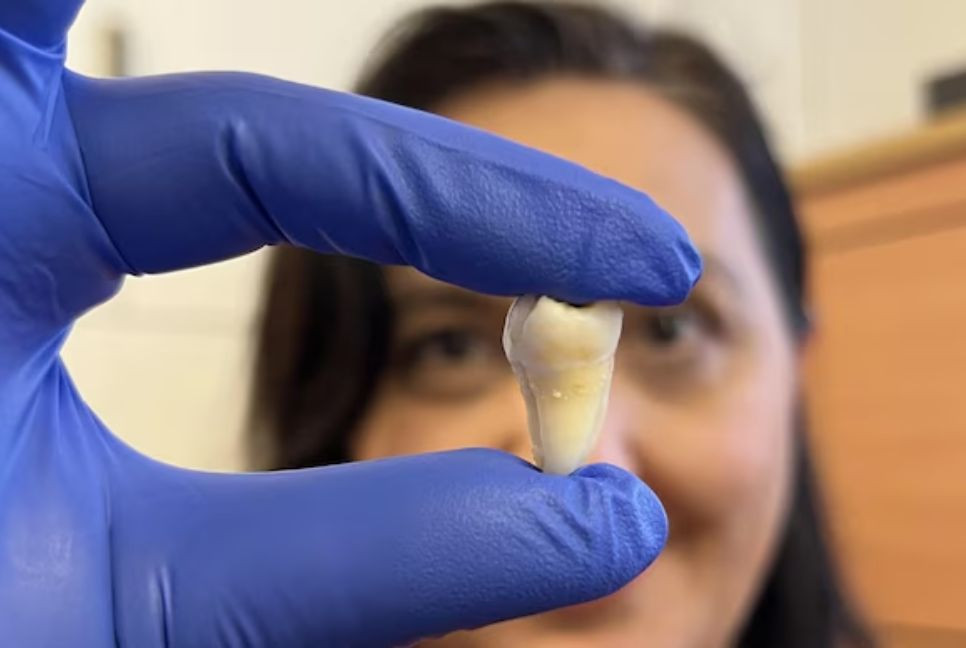
Research groups around the world are working to find ways to implant or grow real biological teeth in a human jaw.
At King’s College London, Ana Angelova Volponi, director of the postgraduate program in regenerative dentistry, has been experimenting with lab-grown teeth for almost two decades, and was part of a team that in 2013 grew a tooth from human and mouse cells.
This year, she led a study that built upon that work and achieved a breakthrough in the material used to house the growing tooth in the lab, which better mimics the actual environment where biological teeth grow in the mouth. It’s a key step on the way to replacing the mouse cells with human cells and stimulating them to form a tooth.
The idea of creating lab-grown teeth dates back to the 1980s, Volponi said, but the one that she and her colleagues created over a decade ago was the first that used adult human gingival cells — which make up the gums and are obtained by lightly scratching the inside of the mouth — and combined them with “progenitor” tooth cells taken from a mouse embryo.
“It’s almost like a tripod,” she said about the elements that contribute to growing a tooth in a lab setting. “The two types of cells are engaging in tooth making, in a sort of conversation, and then we have the environment where this happens.”
At the end of the eight days, tooth-like structures will have formed inside the hydrogel, which was developed in collaboration with Imperial College London. In the 2013 research, these “tooth primordia” were transferred into a mouse where they developed into a tooth structure complete with developing roots and enamel.
Many challenges remain before a lab-grown tooth can be used in a human patient, but the new material helps with some pieces of that puzzle, Volponi said, by improving the “conversation” between the cells that are tasked with making a tooth.
A real, biological replacement tooth grown from a patient’s own cells would offer many advantages over a crown or implant. First, it would be accepted into the tissue without inflammation or rejection, but it would also feel exactly like a real tooth — unlike implants that lack feeling and elasticity as they are simply fused into the bone.
Other researchers working in the same field are using a variety of different techniques to grow teeth.
Katsu Takahashi and his colleagues at the Medical Research Institute Kitano Hospital in Osaka are developing an antibody-based treatment aimed at promoting the growth of teeth in people with conditions such as anodontia, or the congenital lack of teeth. The treatment has entered human clinical trials and could be ready by the end of the decade.
In late 2024, a team led by Pamela Yelick at the School of Dental Medicine of Tufts University, grew human-like teeth — created from human and pig cells — in pigs.
At the University of Washington, a team led by Hannele Ruohola-Baker, a professor of biochemistry and an associate director of the university’s Institute for Stem Cell and Regenerative Medicine, has successfully grown dental pulp stem cells from human stem cells.
As for when the fruits of all this research will become available, Ruohola-Baker believes we won’t have to wait that long. “Although clinical translation will take time, momentum in this field is accelerating, heralding a future in which biological tooth repair or replacement becomes a realistic option within the coming decade,” she said.
Source: CNN
Bd-pratidin English/FNC