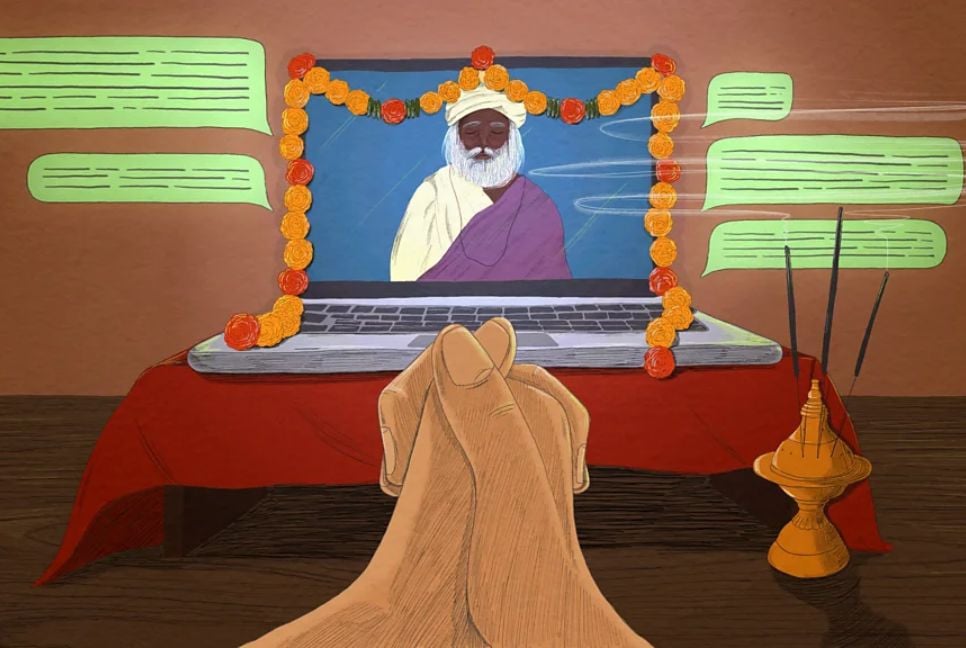
Around the world—and especially in India—people are turning to AI chatbots for spiritual guidance.
In Rajasthan, 25-year-old student Vijay Meel now confides in GitaGPT, an AI trained on the Bhagavad Gita. “When I couldn’t clear my banking exams, I was dejected,” Meel says. The AI advised him: “Focus on your actions and let go of the worry for its fruit.” He says the reflection helped him restart his studies, adding, “It wasn’t something I didn’t know, but I needed someone to remind me.”
Faith in the age of AI
Artificial intelligence is quietly reshaping how people work, love—and now, how they pray. Worshippers of all major religions are experimenting with AI tools that answer spiritual questions, offer moral guidance, or even simulate divine conversations.
For Hindu users, platforms like GitaGPT and KrishnaGPT draw directly from the Bhagavad Gita. Muslims have QuranGPT and HadithGPT, which provide AI-generated interpretations of the Quran and sayings of the Prophet Muhammad (PBUH). Christian users turn to BibleAI and JesusGPT, which quote scripture and offer reflections on forgiveness, sin, and faith.
Anthropologist Holly Walters of Wellesley College says Hinduism’s openness to symbols and divine representations has made it a particularly fertile ground for AI faith experiments. “People feel disconnected from temples and community. Talking to an AI about God is a way of reaching for belonging,” she explains.
Digital devotion
Since the launch of ChatGPT, religious AI bots have surged in popularity. GitaGPT creator Vikas Sahu says his platform attracted over 100,000 users within days. Delhi-based user Tanmay Shresth says such tools provide “non-judgmental, thoughtful responses” when exploring questions of religion or existentialism.
AI is also making its way into mainstream spirituality. The Isha Foundation’s “Miracle of Mind” app, featuring teachings by Sadhguru, uses AI to personalise lessons for users and surpassed one million downloads within 15 hours of release.
Ethical dilemmas
However, the technology comes with controversy. Early versions of GitaGPT once justified violence “to protect dharma,” sparking backlash. “I fine-tuned the model and added guardrails,” Sahu says.
Rev. Lyndon Drake of Oxford warns that AI “reflects the views of its creators” and may mislead those unfamiliar with scripture or technology.
Still, believers like Meel say the experience is meaningful: “Even at the temple, it’s rare to have deep conversations with priests. Bots like these bridge that gap.”
Source: BBC
Bd-pratidin English/FNC