The coexistence of truthfulness and falsehood in politics is a complex and long-practised phenomenon that has remained at the centre of political discourse throughout history. Questions have often been raised about the necessity and consequences of deception in governance, particularly in the administration of many Third World countries. Yet those who experience the taste of power tend to believe — both personally and politically that important national interests can only be protected through political manipulation and carefully crafted falsehoods.
Truthful politicians, however, argue that leaders who use seductive lies to attract public support and cling to power ultimately damage democratic integrity, obstruct the development of democratic institutions and normalise dishonesty across society.
As children, we memorise the moral lesson: “Always speak the truth; lying is a great sin.” Yet as we grow older, many abandon that principle. Falsehood is often viewed as a key to success. Politicians, perhaps more than anyone else, are adept at this practice. Through eloquent speeches, persuasive rhetoric and theatrical delivery, they elevate deception to an art form. No matter how contradictory their statements may be, or how inconsistent their positions become over time, the loyalty and admiration of their supporters rarely diminish. The larger the political party, the more accustomed its leaders often become to political falsehoods.
In the context of Bangladesh’s political culture, it may not be an exaggeration to say that “falsehood is the key to success”. Yet such success is rarely permanent.
Sheikh Mujibur Rahman spent much of his political life praising parliamentary democracy and risking his life fighting against Pakistan’s military rulers to establish such a system. However, once he gained the opportunity to govern an independent and sovereign Bangladesh, he saw nothing wrong in abolishing parliamentary democracy and replacing it with a one-party rule aimed at consolidating his own authority.
His supporters also saw no wrongdoing in that decision. Because he possessed extraordinary rhetorical skills and could inspire deep emotional loyalty among followers, many became so mesmerised by his political narrative that they failed to distinguish between parliamentary democracy and personal or party dictatorship. Those who did recognise the difference often lacked the courage to speak out.
When he was eventually assassinated through a secret plot by those angered by his actions, and thousands of people poured onto the streets in celebration, it became clear that a large section of the population had not accepted his abrupt political shift. The fate of such a popular leader demonstrated that popularity cannot endure if words and actions do not align. Whatever he achieved through persuasive rhetoric ultimately lost credibility within his own lifetime because it was not rooted in genuine belief.
Despite this, a section of supporters in Bangladesh continues to glorify him, promoting narratives of greatness through monuments, praise-filled textbooks and political propaganda. This culture of adulation endured for more than fifteen years.
The grandstanding, deception and manipulation of state leaders eventually erode public trust and confidence, destroying political achievements and even placing leaders’ lives at risk. The most recent example, according to the writer, is former prime minister Sheikh Hasina.
Yet despite repeated historical examples, political leaders rarely learn the value of honesty. Instead, they continue to treat deception as a strategic instrument for achieving political goals. Are they becoming modern political philosophers themselves, or are they simply following the teachings of ancient theorists who justified deception as a tool for preserving power?
Political philosophers have long debated this issue.
Plato referred to deception in an ideal state as a “noble lie”, arguing in his work The Republic that it could help maintain social harmony, inspire civic responsibility and strengthen citizens’ loyalty to the state. According to Plato, such deception was not intended for personal gain but for the broader welfare of society. Nevertheless, while he acknowledged that deception might sometimes be strategically useful, he did not consider it a moral virtue.
In contrast, eighteenth-century German philosopher Immanuel Kant stressed the moral obligation of truthfulness for everyone, including politicians. He argued that morality must be guided by rational and unconditional principles, leaving no room for falsehood in society. Even for strategic purposes, he believed lying would damage the moral fabric of society.
Some philosophers, however, discussed political deception in ways that led many to believe that lying was an essential ingredient of political success, indirectly legitimising manipulation and dishonesty.
Bangladeshis live in a society where distinguishing between truth and falsehood is not particularly difficult. The public has repeatedly fallen victim to political deception and betrayal. As a result, people often distrust politicians more than they trust them. Yet during elections they continue to vote for politicians at different levels, partly because refusing to do so can invite intimidation or threats.
The public also knows that most electoral promises are rarely fulfilled after politicians come to power. From union parishad members to members of parliament, elected representatives swear to perform their duties honestly, impartially and without personal interest. Yet many quickly abandon those promises and engage in abuse of power, nepotism and competition over state resources.
Politicians continue to lie because deception often helps them achieve their objectives. There is little transparency in their actions, and they are seldom held accountable. Political dishonesty therefore flourishes unchecked.
However, there is a significant difference between the personal falsehoods of an elected representative and misleading statements made by a government minister, especially one responsible for official policymaking.
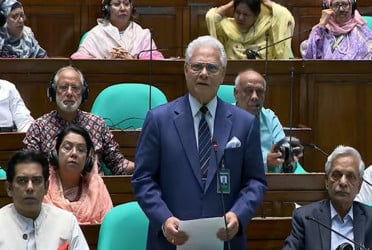
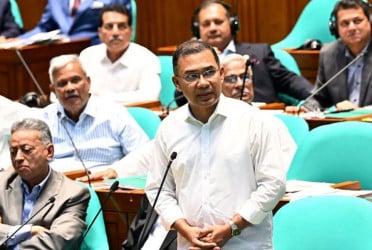
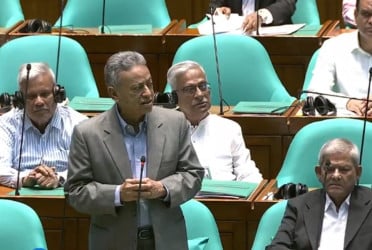
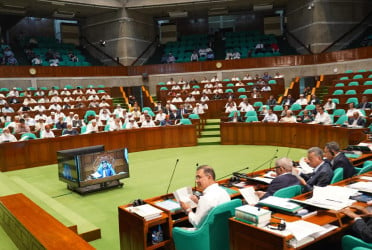
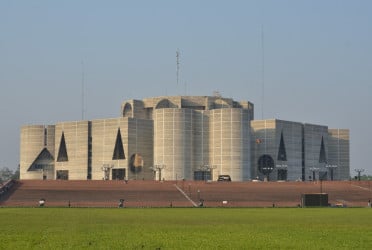
On 30 April, during the closing session of the first sitting of the 13th Jatiya Sangsad, Home Minister Salahuddin Ahmed reportedly said: “We were under pressure to ensure that elections were not delayed in the name of reforms. For that reason, we compromised on many issues and even signed the July National Charter. For the sake of the election, we remained silent on many matters.”
According to the writer, the statement made clear that the government’s verbal support for the July mass uprising had been little more than a political strategy.
Despite being one of the principal beneficiaries of the July movement, the ruling Bangladesh Nationalist Party has already shown, through the tone of its leaders’ statements, how committed it truly is to implementing the July Charter.
The writer argues that opposition parties are likely to continue demanding implementation of the charter and referendum verdict both inside and outside parliament, while the government may seek to calm opponents with periodic promises without genuine intent to act.
The article further claims that the political imbalance created during the rule of the Awami League between 2008 and July 2024 now appears to be repeating itself under the BNP government — a path the writer believes may not lead to a positive outcome.
In politics without genuine democracy, obstacles to truth are created not only by politicians but also by sections of the media and journalism, which must navigate between bias and the pressure to shape public narratives. The rise of social media has further expanded the spread of misinformation and intensified political confrontation.
At a time when democracy is already entangled in these crises, few appear concerned about holding politicians accountable for deception and manipulation. The fundamental democratic value of truth — essential for informed decision-making, accountability and the survival of democracy itself seems increasingly neglected.
The writer is a US-based senior journalist.