In any country, civil society is considered the conscience of the nation. They are the beacons and guides of society. Representatives of civil society provide objective analyses of a government’s actions – both good and bad. They attempt to raise public awareness by criticizing the mistakes of any administration, remaining above partisan interests.
However, most representatives of our country’s civil society are biased toward one side or another. Some are supporters of specific political parties, constantly mixing truth with falsehood to speak in favor of those parties. When their preferred party comes to power, they seek lucrative positions. On the other hand, some members of civil society believe in depoliticisation.
They wish to hold power themselves and harbor a disdain for politicians. Whenever a political government is in power, they arrive with a basket of criticisms; rendering democracy dysfunctional seems to be their primary goal. By being staunch critics of political parties, they wear a mask of neutrality, which occasionally confuses the general public. Taking advantage of this confusion, they seize power.
This segment of Bangladesh’s civil society has managed to seize power without a public mandate on two occasions: first in 2007 (the “1/11” government) and again in 2024 following the student-led mass uprising. Although these two governments assumed power in different contexts, there are striking similarities in their activities.
Both failed miserably in governance and left after causing massive economic damage. Ample evidence of corruption and the betrayal of national interests can be found under the leadership of both “civil society governments.”
The pattern of delayed criticism
The most interesting aspect is that after these governments leave power, the beneficiaries and stakeholders within civil society suddenly become vocal critics.
Yet, while the “civil society government” is in power, they offer not a shred of criticism.
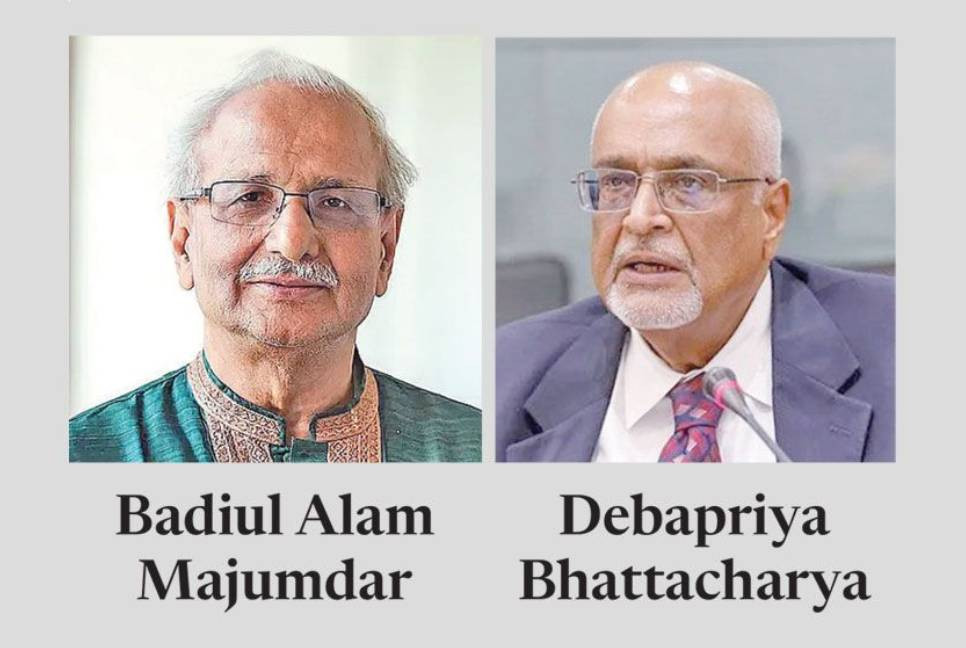
Take the eighteen-month rule of the Yunus government as an example. Those who served as partners in the Yunus interim government are now its harshest critics. Recently, Dr Debapriya Bhattacharya, Distinguished Fellow at the Centre for Policy Dialogue (CPD), stated that the Strait of Hormuz is not a major obstacle to fuel imports. He argued that the “unequal agreement” the interim government signed with the United States at the last minute poses a significant risk to energy security and sovereignty. His statement is objective and correct.
But he was an intimate part of the Yunus government. He served as the head of the White Paper Committee for the interim government. Questions can certainly be raised about how much of his report on the $16 billion money laundering was based on slogans versus actual data. Furthermore, one year into the Yunus administration – when the economy had collapsed and the private sector (the lifeline of the economy) faced a horrific disaster – he was still showering the interim government’s economic management with praise. At that time, he said:
“There is no doubt that success has come in terms of controlling inflation, stopping the fall of the Taka, maintaining interest rates, and controlling the budget deficit as major challenges for macroeconomic stability.”
The reality of the economy was the exact opposite. Thousands of factories had closed.
The government almost paralysed economic activity by harassing private entrepreneurs with false cases and freezing bank accounts. Investment stopped due to high interest rates. The government ran on debt. Unemployment and poverty skyrocketed. Why did Debapriya and the CPD not speak of this economic disaster then?
Silence on mob justice and human rights
During the Yunus administration, the law-and-order situation and “mob terror” were the primary obstacles to domestic and foreign investment. Yet, he did not criticize the government on this. Dr Bhattacharya only spoke up about mob terror just before the government’s departure. After the death of Osman Hadi, when Prothom Alo and The Daily Star were attacked, he and other civil society members finally became vocal.
We do not know the reason for his silence and indifference during the repeated attacks and vandalism at Dhanmondi 32, or the arson and looting of various factories. Had he spoken as the “conscience of the nation” then, perhaps the Yunus government would not have patronised mob terror in such a way.
Dr Debapriya is not alone; many “civil society” members who believe in depoliticisation seemed to be asleep. The Executive Director of Transparency International Bangladesh (TIB), who is so vocal during political governments regarding good governance and human rights, remained remarkably silent during the civil society government. Dr Iftekharuzzaman has seemingly woken up only after the BNP came to power. He has issued strong statements expressing concern over the failure to table the Anti-Corruption Commission Act and the Human Rights Commission Act in Parliament. He is now vocal about the amendment of the Bank Resolution Act.
However, when the Human Rights Commission was not formed for a long time during the Yunus administration, he was not seen to be this vocal. He remained largely silent about the detention of thousands of people without trial. Most glaring was his lack of commentary even when information regarding the Yunus government’s limitless corruption began to surface. Now, he remarks that the corruption of the Yunus government needs to be investigated. Why was he silent during the Yunus era? The Yunus government identified eleven individuals and institutions as money launderers without any evidence, attempting to socially humiliate them – an act contrary to the rule of law and justice. Yet, TIB said nothing against this vendetta and the misuse of the ACC laws. Notably, the Executive Director of TIB was an important member of the National Consensus Commission.
Constitutional violations and the “reform drama”
The Constitution was violated at every step during the Yunus administration. Badiul Alam Majumdar of Shushashoner Jonno Nagorik (SHUJAN) was one of the key protagonists in the Yunus government’s so-called “reform drama.” He possesses vast knowledge of law and the Constitution. Yet, during the meetings of the Consensus Commission, he never once stated that the President does not have the power to issue a Constitutional Amendment Order.
Countless such examples could be given. During the Awami League era, those members of civil society who spoke in favor of the party are now labelled “accomplices” (doshor). Some are in jail, others are fugitives. Awami-supporting academics cannot teach at universities. If they are guilty because of the crimes of the Awami League, why should these members of civil society not bear the responsibility for the misrule of the Yunus government? Why should they not also be called “accomplices”?
Of course, not everyone was the same. During the eighteen-month rule of the Yunus government, we saw some representatives of civil society act as the true conscience of the nation. In this context, the name of constitutional expert Shahdeen Malik must be mentioned. He played a courageous role from the very beginning, speaking candidly about the misrule of the interim government. Albeit a bit late, Professor Anu Muhammad also brought various irregularities of the Yunus government before the public.
Though the number of such virtuous people is small, they are our ideals. They are the true guides of the nation. We do not want sycophantic, opportunistic individuals disguised as civil society; we want truly enlightened human beings.
* Audite Karim is a writer and playwright. Email: [email protected]