More than half a century after gaining independence, Bangladesh has yet to become an “ideal state”. The reason lies largely in the conduct of the political parties that have held power: they have been far more preoccupied with enjoying the privileges of office than with transforming the country into such a state. For most, state power has served merely as a means of amassing wealth and advancing personal fortunes.
Bangladesh achieved independence in December 1971 through immense bloodshed. Regardless of its relatively small geographical size, it is a sovereign and internationally recognised country with defined borders, its own flag, and a functioning government. Nearly all nations of the world recognise Bangladesh, which maintains 83 missions abroad, including 60 embassies and high commissions. For almost four decades, its military and civilian personnel have played a significant role in United Nations peacekeeping operations in conflict zones. Domestically, the country has also seen notable development, particularly in infrastructure. The ousted Awami League government frequently pointed to impressive gains across various indicators, claiming that Bangladesh was on the verge of graduating from a Least Developed Country (LDC) to a middle-income nation.
However, economists outside the Awami League’s sphere remained sceptical, and with reason. Bangladesh has never enjoyed sustained economic stability, and its export base has remained narrow. During the Pakistan era, the eastern wing’s primary export was jute and jute products. With the widespread adoption of synthetic fibres in the early 1970s, demand for these products sharply declined in newly independent Bangladesh, and global prices for raw jute fell. A decade later, the shortfall in export earnings began to ease through labour migration to Middle Eastern countries, and another decade on, the expansion of ready-made garment exports to Europe and the United States further strengthened foreign income. Today, these two sectors dominate Bangladesh’s remittance earnings. Any disruption in either quickly depletes the country’s foreign currency reserves.
Bangladesh was listed by the United Nations as a Least Developed Country in 1975, having emerged from the ranks of the poorer “Third World” nations. It set targets to graduate to a middle-income country by 2026 and to achieve upper-middle-income status by 2031. The Awami League government claimed that buoyant export earnings from the garment sector enabled Bangladesh to attain lower-middle-income status in 2015 and to reduce poverty from 41.9 percent in 1991 to 13.5 percent in 2016. However, the United Nations offered a different assessment, noting that Bangladesh was not yet ready for graduation due to weak institutional capacity, high inflation, and insufficient efforts to capture potential markets.
Despite extensive claims of development, inflation stood at 10.3 percent in the first year of the Awami League’s fourth consecutive term, while food inflation reached a record 14.1 percent in July 2024, just before the fall of Sheikh Hasina’s government. Owing to indecision within the interim administration, little attention was given to these issues over the following eighteen months. The future of Bangladesh’s transition to a middle-income country now depends on the measures adopted by the BNP government that assumed office last February. No foreign direct investment (FDI) flowed into the country during the final term of the Awami League or the interim period. Infrastructure development stalled, and uncertainty has slowed productivity over the past three years. By the time the new government manages to stabilise the situation, it may already be midway through its term.
Over the past five and a half decades, a recurring pattern has emerged: initiatives undertaken by one government are often discarded by its successor, which tends to label them as flawed, corrupt, unnecessary, or driven by personal interests. Projects worth billions are cancelled, and only a handful are continued, disrupting policy continuity and hampering development. Very few governments in Bangladesh’s 55-year history have treated citizens as the backbone of the state or recognised that laws and governance exist to serve the people. Instead, many have behaved like feudal lords, viewing citizens as subjects rather than stakeholders.
Since governments in Bangladesh have been, and remain, centred on party leaders or individuals, there has been little recognition that government is merely an institutional framework through which the state enforces laws, delivers services, and manages foreign relations. It has become almost an established norm that the head of government exercises authority according to personal discretion while simultaneously devising strategies to secure re-election even before completing a full term. Opposition parties, meanwhile, wait for the ruling party to commit major errors and rarely align with the government even on critical national issues—nor does the government seek their cooperation.
During the 2001–2006 BNP government, controversies such as the “10-truck arms haul” and the grenade attack on Sheikh Hasina’s rally were overshadowed by the constitutional amendment raising the retirement age of Supreme Court judges from 65 to 67 in order to appoint Justice K M Hasan as head of a caretaker government. The Awami League government, for its part, was widely criticised for numerous alleged misdeeds, often acting as though the state itself sanctioned such actions. Ultimately, these actions contributed to its downfall, offering a cautionary lesson for future governments.
A lack of national unity among political parties has entrenched chronic instability in Bangladesh. While responsibility may be debated, many attribute a significant share of it to the Awami League, accusing it of co-opting or suppressing opposition parties, using abusive rhetoric, and engaging in actions such as enforced disappearances, politically motivated cases, and other forms of repression. Despite this, it failed to establish lasting stability. Critics argue that the party has historically thrived on political turmoil. Whenever in power, it has been accused of attempting to bring key institutions—including the judiciary, election commission, and parliament—under the control of the prime minister and party leadership. From 2009 to 2024, few obstacles reportedly hindered these efforts. By monopolising the legacy of the Liberation War and independence, it is argued, the broader process of nation-building was undermined. Consequently, despite possessing all the formal attributes of a state—population, territory, government, and international recognition—Bangladesh has not evolved into an “ideal state”.
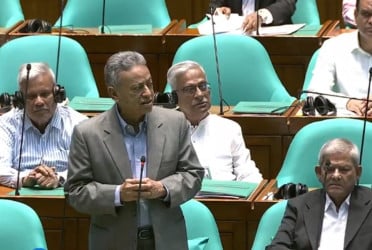
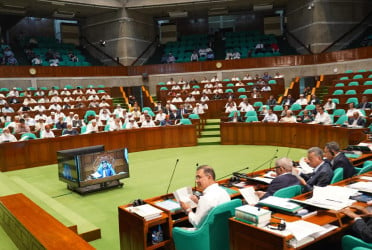
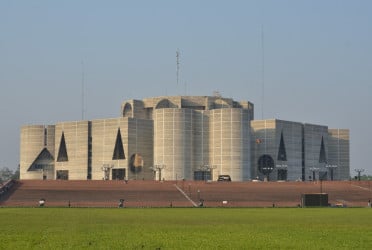
Debate continues in the National Parliament over constitutional reform, including proposals linked to the July Charter and the possibility of a referendum, while protests persist on the streets. Although the February election and referendum had appeared likely to result in sweeping constitutional changes, that prospect now seems uncertain. The majority party has indicated that it will amend the constitution according to its own preferences rather than pursue comprehensive reform, though the specifics remain unclear.
In 1975, Sheikh Mujibur Rahman fundamentally altered the parliamentary constitution, transforming it into a one-party presidential system—despite not having received such a mandate in the 1973 election. While Abrahamic religions are often considered immutable, some have still called for reforms within Christianity and the Church. The French philosopher Voltaire famously argued for reform in both religion and the state, asserting that “the Church must be reformed; our state must be reformed.” Given the extent to which Bangladesh’s institutions have been weakened in the past, meaningful reform is essential to make them effective. Without it, the country is unlikely to become an “ideal state” in the near future, and the nation-building process may grow even more complex. Yet history suggests a recurring pattern: once elected, governments tend to forget their promises—and that pattern appears to persist.
Writer: A senior journalist based in the United States