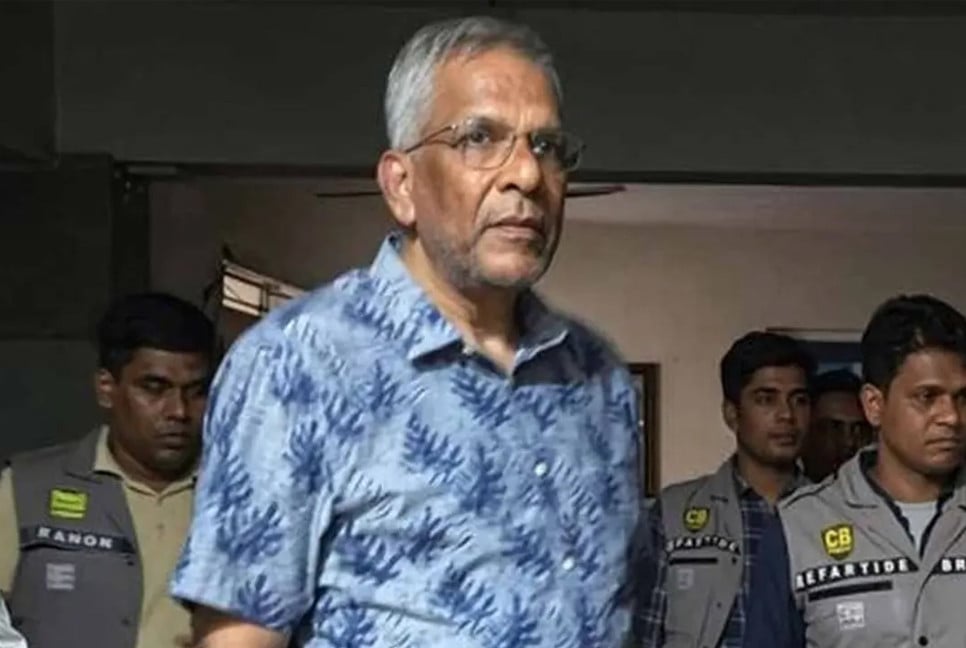
The BNP government is currently investigating the origins of the conspiracy behind the illegal seizure of state power on 11 January 2007. Several former military officers, identified as key players in the 1/11 conspiracy, have been arrested and are being interrogated under remand. Among them is the former head of military intelligence, Maj Gen (retd) Mamun Khaled.
Mamun Khaled has undergone three rounds of interrogation. He was arrested by the Dhaka Metropolitan Detective Branch (DB) on the night of 25 March from his residence in Mirpur DOHS, Dhaka.
• 26 March: Dhaka Metropolitan Magistrate Siddique Azad granted a five-day remand.
• 31 March: In the second phase, Dhaka Metropolitan Magistrate Jewel Rana granted a six-day remand.
• 6 April: After the completion of the second remand, he was produced before the Chief Metropolitan
Magistrate’s Court. Following an application by the investigating officer, Magistrate Siddique Azad granted an additional three-day remand for further investigation.
Responsible sources state that during his remand, Mamun Khaled provided crucial information regarding the masterminds of the 1/11 event. He was primarily questioned about why, how, and by whom the takeover was orchestrated. Regarding the “why”, Mamun Khaled stated that 1/11 was the result of a conspiracy by a section of civil society. This group lobbied the international community to keep an unelected government in power in Bangladesh for the long term. Their activities triggered severe political instability, and they allegedly staged “militancy dramas” to portray Bangladesh as a controversial state to the world.
Mamun Khaled claimed that the military became involved in the 1/11 conspiracy only at the final stage. According to him, the armed forces joined the plot only after receiving messages that Bangladesh’s participation in UN peacekeeping missions might be suspended. He maintained that while the armed forces were not part of the initial planning, they played a role in its execution.
The role of two influential newspapers
During interrogation, the former DGFI chief alleged that the primary planners of 1/11 were two newspapers known as the mouthpieces of civil society. These two outlets reportedly drafted the blueprint for bringing an unelected government to power, controversialising and neutralising political organisations, and maintaining a powerful “civil society government” for an extended period with foreign support. Mamun suggested that the conspiracy is evident in the news reports, editorials, and op-eds published by these two papers before and during the 1/11 period.
He further stated that a specific circle became active as soon as the BNP-led four-party alliance took power in 2001. From the beginning of 2006, an influential Bangla daily and an English daily systematically began negative campaigning against the government. Under the guise of selecting “qualified candidates”, they organised nationwide seminars and roundtables with NGOs and civil society representatives, aimed at inciting public hatred toward politicians.
De-politicisation and the “minus-two formula”
Mamun Khaled alleged that these influential circles worked to push the country’s political situation in a specific direction. He claimed the two dailies created a public narrative where people lost faith in politicians, introducing and popularising the concept of “depoliticisation”. This agenda took advantage of then-U.S. President George W. Bush’s “War on Terror”.
For two years following 1/11, these two newspapers allegedly acted as the undeclared mouthpieces of the DGFI. Fabricated information extracted through the torture of political leaders in intelligence cells was published as “special reports” without any verification. The data suggests these papers created an environment to facilitate the “Minus-Two Formula”, aimed at permanently removing the two top political leaders from the country’s politics.
Mamun claimed the editors of these two papers decided what should or should not go into the media. Sources say the papers also acted as architects of internal division within political parties, promoting “reformist” leaders who broke party discipline. While BNP leaders, including Tarique Rahman, were being tortured in remand, these papers reportedly ignored human rights violations to focus on the de-politicization blueprint. One editor even wrote a front-page column titled “Tarique Rahman must be tried.”
Tea at Moin’s: Finalising the takeover
Mamun Khaled provided several critical leads that investigators are now verifying:
• The meeting: Three days before the takeover, on 8 January, the two editors met with then Army chief Moin U Ahmed at Army Headquarters. Mamun claims they stayed for over two hours, during which the finer details of the power grab were finalised.
• The speech: Mamun informed investigators that when Moin and his associates went to Bangabhaban, they carried a written speech for the President and the chief Aaviser. In this speech, Iajuddin Ahmed announced his resignation as the head of the caretaker government. Mamun alleged that the editor of the Bangla daily wrote this speech, a fact reportedly told to him by the then Army chief himself.
Mamun Khaled concluded by telling investigators that these two editors know everything about 1/11, and the full mystery can only be unravelled by interrogating them.
Bd-pratidin English/ ANI