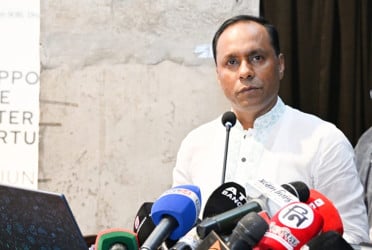
A common belief in our society is that educated people and intellectuals are honest and pure. They are seen as spotless – like freshly washed, sparkling white clothes cleaned with strong detergent.
All our lives we have been told that politicians are the root of all corruption. Because of politicians, corruption exists everywhere. Representatives of the so called civil society have repeated so often that politicians are responsible for corruption in the country that many of us have almost memorized it.
The self important elites of civil society constantly lament the country’s misfortune through their thoughtful writings and serious television talk shows. The essence of their argument is that Bangladesh cannot move forward because of politicians, businessmen, and bureaucrats.
According to them, these groups are responsible for corruption and looting that is destroying the nation. Like enchanted listeners, we hear the words of these enlightened figures. We are moved by their overflowing patriotism and think to ourselves—how can the country be in such a state when there are so many capable people?
Finally, the long awaited moment arrived. Under the leadership of Nobel Peace Prize winner Dr. Muhammad Yunus, a government of civil society figures was formed. They promised to clean up years of state corruption and garbage and build a new Bangladesh. Naturally, we were delighted. A council of advisers was formed with these spotless civil elites. They immediately began by saying that everything was so dirty that it would take time to clean.
Local elites alone would not be enough – experts from abroad had to be brought in. Civil society figures flew in from the United States to draft a new constitution. Experts came from Europe to teach us information technology. Flying consultants were brought in to search for foreign investment. People preferred by these elites were placed throughout the state structure.
We applauded enthusiastically, believing the country would become pure and corruption free. The whole nation celebrated. Bangladesh, we believed, was about to change.
The chief adviser declared that Bangladesh would not go to the world – the world would come to Bangladesh. But in reality, the world’s doors seemed to close to Bangladesh. Passports from Bangladesh began to face difficulty obtaining visas. But that did not stop the chief leader from launching a mission to change fortunes—not the country’s, but his own. Like magic, he secured exemptions from his legal cases and tax issues.
Once seated in power, it was as if he had obtained Aladdin’s lamp—whatever he wished appeared before him. He acquired a university, a recruiting agency license, and a digital bank license. In one lifetime he fulfilled the desires of seven lifetimes. For eighteen months he spoke about serving the people, but worked mainly for himself.
As the leading figure of civil society moved in this direction, it was only natural that others followed. A competition began among advisers to secure their own fortunes. Who could become wealthy the fastest became the new race?
Some started changing their fortunes through sub registrar transfers, others through plastic usage regulations. One adviser widened the road near his own house to demonstrate his power. Another kept grant money meant for a non existent theatre organization in his own pocket. The younger ones learned from the elders.
When the junior advisers saw that the seniors were changing their own fortunes in the name of changing the country, they too joined the competition to make money. Through postings and tender dealings they transformed themselves. Their appearance became glossy; the smell of sweat was replaced by the fragrance of expensive perfume. Appointments to various institutions were also given to members of civil society, because they supposedly understood everything while ordinary citizens understood nothing. A member of the elite civil society was appointed governor of Bangladesh Bank.
Without delay, he allegedly began secretly printing money and treated the central bank as his personal property. Within just 18 months he reportedly built a house in Dubai worth tens of crores of taka. He demonstrated how immense wealth could be accumulated through shortcuts.
One young adviser introduced contract based recruitment in exchange for money. Administrators of the two Dhaka city corporations were effectively appointed through bidding. The managing director of WASA was appointed through transactions worth hundreds of millions of taka. The more money offered, the better the position. Even district commissioner postings were reportedly turned into open auctions, with cheques circulating from one adviser’s table to another.Those who spent money to become city administrators or heads of institutions naturally had one goal—to make money once in office. And that is what they did. Money seemed to be flying everywhere.
Even if the condition of the people worsened, at least some individuals saw their fortunes change overnight. “Make money, change your fate” – this seemed to become the unofficial motto of the interim government. In the court areas, a trade in cases reportedly flourished.
Recently, allegations that ICT prosecutor Md. Saimum Reza Talukder demanded one crore taka in bribes to secure acquittal for former MP A.B.M. Fazle Karim Chowdhury opened what seemed like a Pandora’s box.
Over 18 months, countless crores may have changed hands through bail and case trading – something that only investigative journalism could fully uncover. But even journalists posing as members of civil society appeared to be swept up in the tide of corruption.
Even the elite figure occupying the top position at the Press Institute of Bangladesh seemed to develop an appetite for money. While money flowed everywhere, why would he sit like a saint?
Without even conducting training, he reportedly pocketed Tk2.4 million in just two days.
Even if the lives of ordinary citizens did not change in eighteen months, the fortunes of those connected with the interim government changed dramatically. Whenever discussions arise about their wealth, figures in the billions are mentioned.
A year earlier, the current cabinet secretary had already exposed some of these realities, though many people were uncomfortable hearing such criticism of civil society figures. Yet 18 months later it appears that what he revealed was only the tip of the iceberg. The tale of plunder by civil society over these months could rival the stories of the Arabian Nights. Over the past 18 months, our civil society has proven two things. First, civil society members are human beings of flesh and blood. If honey is placed before them, how can they resist tasting it? Once in power, they discovered unlimited opportunities to make money—and many used those opportunities fully. Second, in corruption they may be even more efficient than politicians or bureaucrats.Politicians and officials may engage in corruption, but often with some restraint.
After 5 August 2024, however, many civil elites reportedly wasted no time in securing their own interests once they gained power.
Wherever possible, they seized what they could. Even if this excessive greed damaged the country, it gave the people one clear lesson: they witnessed with their own eyes how greedy civil elites can become once they obtain power.
Audite Karim
Writer and Playwright
Email: [email protected]