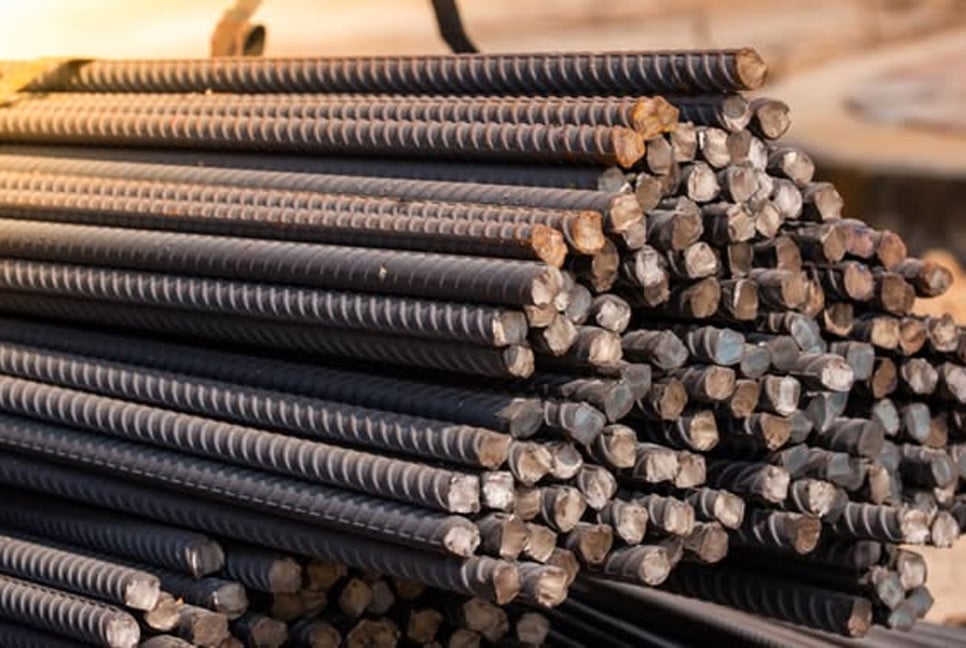
The price of steel rods has suddenly increased in Bangladesh’s domestic market, causing concern among businesses in the housing and infrastructure sectors. As one of the key raw materials in construction, the sharp price hike could affect not only private projects but also government infrastructure development.
Real estate developers claim that some traders have begun raising rod prices through a syndicate, using the Iran conflict as a pretext. On Monday alone, the price rose by nearly Tk10,000 per tonne.
However, re-rolling mill owners rejected the allegation of syndication, arguing that the current market conditions leave little scope for such practices. They said the ongoing war has disrupted international shipping, and due to difficulties in obtaining insurance coverage, the cost of raw materials for the steel and cement industries has increased by more than 130 per cent, which is influencing the local market.
Government officials, meanwhile, noted that the energy sector has been the most severely affected by the Middle East conflict. Despite this, the government has refrained from raising domestic fuel prices in the public interest. They argued that the sudden increase in rod prices is not a positive sign, especially since existing stock in the market should not yet reflect the impact of the conflict.
When contacted on Monday night, Industries and Commerce Minister Khandaker Abdul Muktadir said the matter would be investigated. He added that the government would take necessary measures to ensure that public interest is not compromised.
Market inquiries show that rods which were selling at Tk75,000–Tk80,000 per tonne only recently were sold on Monday at Tk90,000–Tk91,000 per tonne. Prices varied by brand: CSRM rods were around Tk84,000 per tonne, Anwar Ispat Tk90,000, while rods produced by companies such as KSRM and Akij reached Tk91,000. Rahim Steel rods were priced at Tk87,000 or higher.
Industry insiders said the rising cost of scrap in international markets is also increasing production expenses for local steel manufacturers. Prices of coal, petcoke and clinker have risen as well, pushing up cement production costs. In addition, the higher value of the US dollar in the kerb market is creating extra pressure on import-dependent industries.
Analysts noted that although local mill owners are often blamed for rising rod prices, the impact of global markets is significant. Currently, the market faces a threefold pressure, particularly in the construction materials sector, where higher energy costs, increased freight charges for international shipping, difficulties in sourcing raw materials, and domestic price adjustments are collectively pushing up production costs. As a result, Bangladesh’s construction and infrastructure sectors may face a slowdown in the near future.
During the Covid-19 pandemic, when global scrap shortages were acute, the price of premium-grade rods in Bangladesh climbed to as high as Tk110,000 per tonne. However, due to the global economic slowdown and reduced local demand, prices fell to Tk70,000–Tk80,000 per tonne last year.
Liakat Ali Bhuiyan, senior vice president of the Real Estate and Housing Association of Bangladesh (REHAB), said the housing sector is already facing numerous challenges. “The sudden increase in rod prices is difficult to justify. The impact of the Iran conflict on rod production should take more time to appear. It is unclear whether a syndicate is behind the current price hike,” he told reporters by phone on Monday night. Bhuiyan is also chairman of Brick Works Ltd.
He urged the new government to strengthen market monitoring to address the situation. “REHAB, the FBCCI and the rod traders’ association can work together with the government in monitoring the market. Without effective monitoring, there is no alternative to controlling prices,” he said, warning that the housing sector could face another difficult period if the situation remains unchecked.
Bhuiyan added that the real estate sector plays a significant role in Bangladesh’s economy, employing around four million workers directly and more than ten million when linked industries are included. A sudden rise in rod prices would affect both workers and business owners.
“To protect the national economy, this sector must remain stable,” he said. “If business conditions deteriorate further, it will have a major impact on the overall economy.”
He also revealed that the industry plans to seek a Tk15 billion loan from Bangladesh Bank to support businesses affected by the ongoing challenges. The formal application is expected to be submitted on Tuesday.
Meanwhile, Mohammad Saifur Rahman Khokon, Chairman of Rahima Ispat Ltd, said the country’s steel industry has been struggling with a prolonged slowdown. After the newly elected government took office, business leaders had hoped for a market recovery, and rod prices began to rise slightly towards the end of December.
“However, the recent Iran conflict has created serious instability in the market. International shipping is facing major disruptions, and insurance companies are reluctant to provide coverage. As a result, shipping companies are charging higher freight rates,” he said.
He added that blaming businesses alone for the price increase would not be accurate and stressed that the government should closely monitor the situation. “Unless the real picture of the global market is properly communicated to the public, misunderstandings among traders and consumers will continue,” he said.
Bd-pratidin Engolish/TR