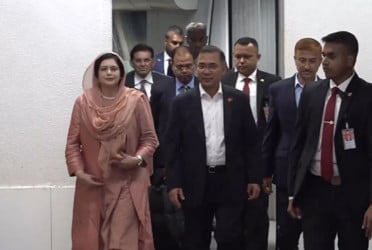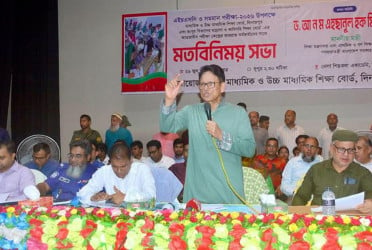
Even on government holidays, leader of the parliament and Prime Minister arrives at the office by 9am, issuing firm warnings against extortion while guiding colleagues and officials. After performing the Fajr prayer, the opposition leader of parliament personally takes on environmentally friendly tasks, such as putting up posters and cleaning walls. Daily, he speaks at party events about the fight against extortion.
Wherever ministers and MPs—both from the government and opposition—go, they emphasise a zero-tolerance policy on extortion. The country’s police chief, the IGP, conducts midnight inspections of local police stations, instructing officers to suppress extortion decisively. The business community eagerly anticipates a nation free from extortion.
Shopkeepers and small- to medium-sized entrepreneurs insist that without extortion, they could sell goods at lower prices, benefiting the wider economy. In effect, a national consensus against extortion and forced levies has emerged.
Extortion is not merely a crime—it is a social wound, combining symptoms of various societal maladies. Even the Federation of Bangladesh Chambers of Commerce and Industry (FBCCI) recognises this. FBCCI administrator Abdur Rahim Khan told a seminar on Saturday that extortion disrupted trade during the 18 months of the unelected government. He stressed that, in the post-election period, immediate and effective measures to eradicate extortion are essential to establish a stable, business-friendly environment.
The Dhaka Chamber of Commerce and Industry has similarly called for rigorous steps to tackle extortion, warning that without actual implementation of zero-tolerance policies, the country’s economic recovery will remain difficult. Business leaders note that trust in any country’s economy depends on the rule of law and a stable environment.
In this context, alongside macroeconomic stability, entrepreneurs demand secure business conditions. A functioning democratic environment and sound market management are prerequisites for law and order. Despite the removal of certain extortion networks after the August 24 uprising, some areas—such as Hajipara and Kazipara—still experience pockets of extortion. Many bus stands, tempo stands, and markets remain affected.
Historically, extortion in Bangladesh has involved local strongmen or organised gangs, often operating under the protection of influential political figures, coercing ordinary traders, shopkeepers, and street vendors for money. Refusal to pay frequently invites threats, harassment, or even abuse of legal provisions to enforce demands.
Extortion is not simply a crime committed by a few powerful individuals; it is both a social ill and an economic problem. Criminologists and analysts stress that viewing it as a “disease” is misleading—it is a symptom of a deeper structural problem. Addressing only the surface issues leaves the root causes intact, allowing the practice to re-emerge in new, often more severe forms.
With the current nationwide consensus against extortion, optimism is cautiously rising. It is widely understood that citizens under unelected administrations are deprived of dignity, and even under elected governments, undemocratic practices can leave the public vulnerable. A structured, rule-based economy is essential to ensure citizens have sufficient opportunities for livelihood.
Writer: Journalist and Columnist; Deputy Head of News, Banglavision