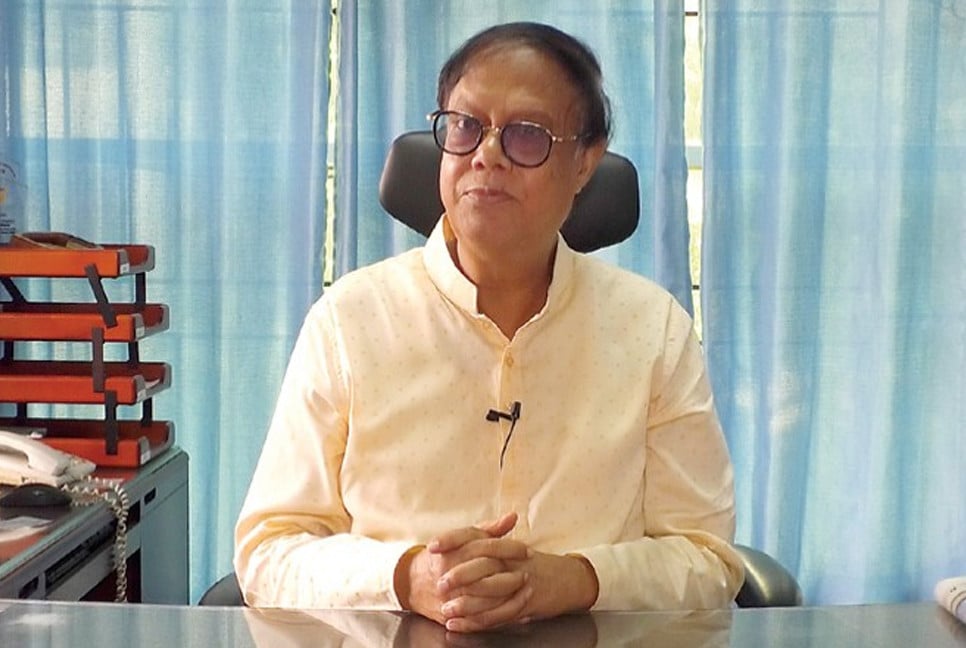
Ahsan H Mansur – regarded as a prominent representative of Bangladesh’s civil society – is a reputed economist, a former full-time official of the IMF, and a former professor of Economics at the University of Dhaka.
When he was appointed Governor of Bangladesh Bank following the July mass uprising, many people were hopeful. There were great expectations that under his leadership, Bangladesh’s economy would achieve something extraordinary.
But gradually, those hopes began to fade as business, trade, and the broader economy started sliding toward decline. Inflation remained high, even after 18 months of contractionary monetary policy. Businesses shrank, many factories closed, and non-performing loans increased every quarter.
While people sought solutions, Bangladesh Bank continued to point to mounting challenges without delivering effective remedies. The Governor, critics say, offered only lofty assurances and promises – but failed to produce tangible results.
Upon assuming office, Ahsan H Mansur declared that bringing back laundered money from abroad would be his top priority. In December 2024, he announced that some of the funds siphoned out of Bangladesh would be repatriated within six months.
Spending public money, he traveled to the United States, the United Kingdom, Switzerland, and other countries in pursuit of asset recovery. However, no visible results emerged. A year later, his position shifted: he stated that it would take four to five years to recover laundered funds, and that it was impossible to do so in less time.
When asked about progress, he claimed that significant advancement had been made. Yet in 18 months, not a single taka was reportedly recovered, while crores were spent in the name of asset retrieval. Critics question who will hold the Governor accountable for what they describe as wasteful public expenditure.
Beyond the issue of money laundering, critics argue that during these 18 months, the Governor effectively crippled the economy by strictly following IMF prescriptions.
He had thundered about cleansing the economic system, declaring war against irregularities in the capital market, banking sector, and industrial conglomerates, particularly against allegations of money laundering and loan fraud.
Under instructions from the interim government, 11 joint investigation committees were formed to probe leading industrial groups and members of the former Prime Minister’s family. Allegations included abuse of power, massive loan fraud amounting to thousands of crores, and capital flight.
However, even after a year and a half, no visible proof of money laundering or corruption was established against any major industrial group. While investigations were announced with much publicity, the outcomes remained uncertain. Meanwhile, investor confidence gradually eroded. Strict surveillance and an atmosphere of uncertainty surrounding large industrial groups dampened new investment, and the capital market became stagnant.
Critics allege that after weakening the banking sector, Ahsan H Mansur left office having secured his own interests. Even members of civil society who understand economics have reportedly criticized him following his departure.
After the Governor’s exit, Dr Debapriya Bhattacharya, Distinguished Fellow of the Centre for Policy Dialogue (CPD), stated at a media briefing titled “The New Government’s Starting Point: An Economic Review” that printing money is undesirable under any circumstances.
He emphasized that whether openly or secretly, printing money is wrong. Although the Governor initially attempted not to print money, he eventually did so and kept it undisclosed, later admitting that Bangladesh Bank had printed currency.
Dr Bhattacharya further remarked that the current government inherited an economy in a worse condition than what the interim government had originally inherited. Macroeconomic stability, he said, is now fragile.
One of the previous government’s stated goals was controlling inflation. Yet despite Bangladesh Bank’s restrictive measures over the past 18 months, inflation did not decline significantly. Shortly after taking office, the Governor raised the policy interest rate three times, bringing it to 10%. Instead of reducing inflation, lending rates surged to 16%-17%, which business leaders view as a major barrier to investment.
Dr Bhattacharya noted that markets can detect when money has been printed. If currency expansion is not matched by production, inflation becomes inevitable. If controlling inflation is a priority, he argued, printing money should not even be considered. He suggested that flaws in Bangladesh Bank’s policies contributed to the failure to control inflation.
In this regard, Dhaka Chamber of Commerce and Industry (DCCI) President Taskin Ahmed stated that despite maintaining a prolonged contractionary monetary policy with a 10% policy rate, inflation has not been controlled.
Instead, the expected results have not materialized, severely harming productive economic activities. Private sector credit growth has fallen to its lowest level in 22 years – reaching 6.1% in December. Lending rates climbed to record highs, stalling industrial expansion, new investment, and job creation. According to him, such ineffective monetary policy cannot deliver economic growth.
He also pointed out that the former Governor artificially maintained the exchange rate, yet exports declined for six consecutive months, falling to negative 14.25% in December. This, he warned, weakens Bangladesh’s competitiveness in global markets and poses a serious threat to economic stability.
Under these circumstances, he expressed hope that the newly elected government would adopt a realistic and growth-friendly monetary policy, including reducing the policy rate. He emphasised the need for coordinated fiscal and monetary management, flexible liquidity measures, and a balanced approach between macroeconomic stability and economic recovery.
According to CPD, restoring stability to the fragile macroeconomy requires action in four key areas: controlling inflation, lowering interest rates, allowing some depreciation of the currency, and managing liabilities effectively – all of which fall under Bangladesh Bank’s responsibility. Critics argue that Ahsan H Mansur either failed or did not attempt to address these issues adequately.
One Bangladesh Bank official went so far as to allege that Ahsan Mansur primarily acted in the interest of the IMF, following its directives rather than prioritizing the welfare of the country and its people. As a result, they claim, the national economy has suffered severe damage.
Bd-pratidin English/TR