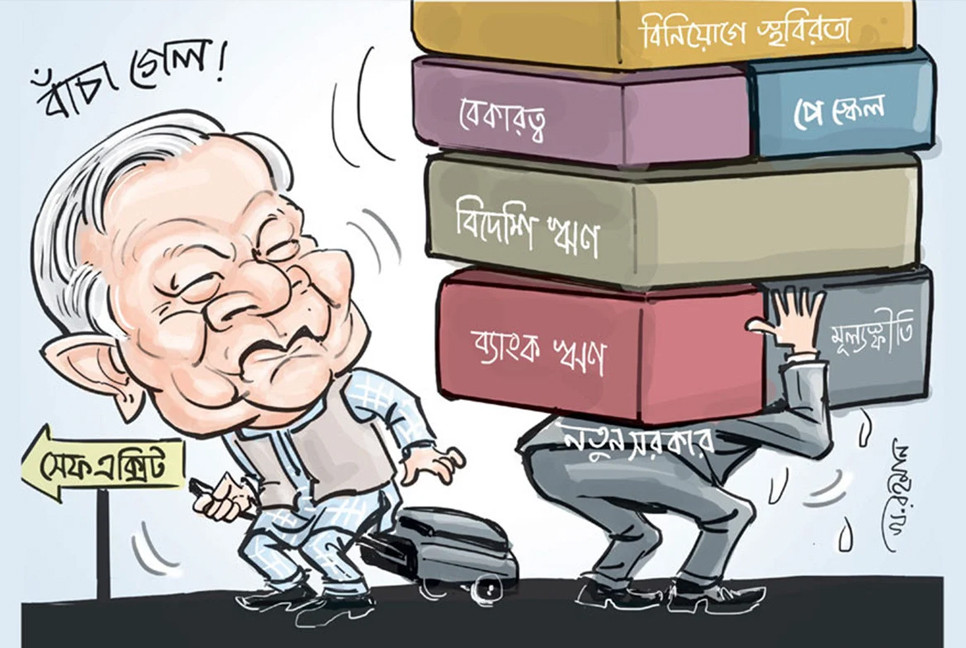
The newly elected government led by Prime Minister Tarique Rahman has taken office amid what economists describe as seven major economic crises, including soaring debt, record loan defaults, high inflation and rising unemployment.
Analysts say the outgoing interim administration deepened fragility in the economy instead of restoring momentum in business and trade after the fall of the Awami League government. They point to a weakened banking sector, eroding business confidence, sluggish investment, widening revenue shortfalls and mounting debt burdens. Factory closures, job losses, mob violence and concerns over governance have further strained public life.
Bangladesh now carries a total debt burden of Tk23 trillion, according to data from the Bangladesh Institute of Development Studies. Domestic debt exceeds Tk16 trillion, while foreign debt has crossed Tk7 trillion. The government will spend nearly Tk1.25 trillion on debt servicing in the 2025-26 fiscal year, accounting for almost one-fourth of the national budget.
Defaulted loans in the banking sector have surpassed a record Tk6.44 trillion, nearly 16 percent of total disbursed loans, according to Bangladesh Bank. Capital shortfalls and weak governance continue to unsettle the financial system.
The Bangladesh Bureau of Statistics reported a 12-month average inflation rate of 8.77% in January, far above the central bank’s 7% target. Rising housing, healthcare and education costs have eroded real incomes, as wage growth has failed to keep pace with inflation.
A survey by the Citizen’s Platform for SDGs showed that about 2.1 million people lost jobs during the first half of fiscal 2025, as growth in industry and services slowed. Each year, nearly 2 million young people enter the job market, intensifying pressure on employment.
Revenue collection has also weakened. The tax-to-GDP ratio has fallen to 6.8%, one of the lowest in South Asia. The National Board of Revenue achieved only 58 percent of its target in the first seven months of the current fiscal year. Private sector credit growth has dropped to around 6%, the lowest in two decades, reflecting political uncertainty and weak investor confidence.
Although foreign exchange reserves stood at $34.53 billion as of 17 February, economists warn that higher imports and external payment pressures could limit relief. Implementation of the Annual Development Programme has hit a decade low, with only 21% completed in the first half of fiscal 2025.
The new government must now balance election pledges, including a revised pay scale and expanded social safety nets, with rising debt repayments and the need to restore investor confidence. Economists argue that the administration may need to adopt bold and potentially unpopular reforms to stabilise the economy and revive growth.
Bd-pratidin English/TR