For the past 16 years, Bangladesh was not only steeped in corruption—it was a suffocating, fascist state. People couldn’t speak, couldn’t lift their heads, and couldn’t even believe that the people were the true owners of the state. The government, judiciary, and laws had all turned into the walls of a massive prison. Democracy had been exiled. What occurred in the name of elections was a farce, and any dissenting voice was labeled treasonous and driven out. No one was free—not students, not teachers, not journalists, not ordinary citizens.
I was a protesting prisoner of that prison. Simply for expressing my opinion, I was unjustly removed from Dhaka University. I had to leave the university under the burden of countless fictitious charges including sedition. On the day I was evicted from my home, my cancer-stricken wife was crying, and our daughter stood at the window silently watching.
That university had risen again. But I, an exiled teacher, felt from afar—this awakening was not just of the students, it was a kind of rebirth for me as well. I saw in the news, in videos, in student voices—some students stood silently at TSC. One held a handwritten poster: “In my golden Bengal, there’s no place for inequality.” In that single line, it felt as though all the country’s despair, anger, and hope were fused together.
On July 4, when the Appellate Division upheld the quota system, I saw in the students’ eyes a mix of rage and confidence—it was as if my own vision had returned. A spontaneous resistance exploded called “Bangla Blockade.” I’ve seen many blockades, but this time, the placards, graffiti, slogans, and the language in their eyes—all were different. They chanted, “Quota or merit? Merit, merit!” But I could feel—this was not just a movement against quotas. It was a fight for the dignity of a humiliated generation. On July 7, Prime Minister Sheikh Hasina, who had clung to power illegally for more than a decade by robbing people of their voting rights, said to the nation: “This movement has no justification.” I was stunned. Slogans everywhere, the determination in the students’ eyes, crowds at the Shaheed Minar—and she calls it unjustified?
On July 14, Sheikh Hasina said: “Those protesting quotas are descendants of Razakars (collaborators of the Pakistani army).” The most meritorious, courageous, and sensitive generation of the country was insulted. An illegitimate ruler threw vile accusations of character assassination against the children of the nation. Over the years, I’ve been called “seditious,” “traitor,” “enemy of the people.” But this time, I saw an entire generation being labeled Razakars—just for their rightful demands. The response was widespread. New slogans echoed across university walls:
“You and I—who’s the Razakar, who’s the Razakar?
Who said it, who said it? Dictator, dictator!”
These lines became the voice of the movement—a voice of a threatened generation that the state tried to silence.
On July 15, at noon, the crackdown began—state forces and helmet-wearing Chhatra League members descended. Female students at Dhaka University were scalded with hot water; male students’ heads were bashed with iron rods. Chhatra League leaders and activists roamed with faces covered and weapons in hand—like hyenas stalking the streets. They stormed hospitals—attacking already injured students receiving treatment. One wounded female student said with a bloodied face: “I’ll return to the rally once I recover, I won’t give up on my demand.” I understood then—history was changing.
On July 16, a video spread on social media. A student, standing calmly with chest out and both hands raised, unarmed—was shot and killed by police. His name was Abu Sayeed. Age: 23. A student of Begum Rokeya University—not affiliated with any organization. He was in the front row of the rally.
That afternoon, students roared across the nation. Fists raised to the sky. They didn’t just chant—they organized resistance. In Chattogram, Wasim became a martyr. University students began taking control of Chhatra League-dominated dormitories. I saw—what I had lost my teaching career, faced lawsuits, and lost identity for—that struggle had been taken a step further by today’s generation. I hadn’t disappeared—my successors were fighting, heads held high.
The next morning, symbolic funeral prayers were held nationwide. Dhaka University, Rajshahi, Sylhet, Chattogram—students gathered on every campus with black banners and cloth around their heads. Echoes rang out from all sides: “We demand justice for our brother’s murder!” This wasn’t mourning—it was a blood oath. The state couldn’t bear it. Tear gas, rubber bullets, rods, and batons rained down again at Dhaka University’s TSC, Rajshahi University’s Shaheed Minar, and in front of Jahangirnagar’s admin building. That noon, another order came—vacate all university dorms. Students were returning to campus after funeral prayers—some searching for injured friends, some hadn’t eaten in two days. Suddenly, announcements blared: “Leave the dorms. Campus is closed.” Not just in Dhaka—this order was enforced simultaneously in Rajshahi, Chattogram, Khulna, Barishal, Rangpur—everywhere. It was a state strategy—to uproot the movement by isolating the students. That evening, the Prime Minister addressed the nation—crocodile tears over lost lives, a traditional farce to justify injustice, misrule, and oppression.
After vacating the dorms, the government thought the movement would die down. But they miscalculated. On the morning of July 18, a new wave hit the streets of Dhaka—students of private universities. BRAC, East West, North South, IUB, AIUB, Northern, Milestone—and many more—students from all walks joined the streets. In the scorching, dusty heat, they chanted: “We want justice for the genocide!” ID cards hung around their necks, backpacks on shoulders, flags on heads—but inside, a fire blazed in their chests. School and college students joined their seniors on the streets. Many of them never returned home. While handing out water, some were shot in the head and became martyrs. 17-year-old Faiyaz was martyred in Dhanmondi. Uttara, Badda, Jatrabari, Mirpur turned into battlefields. From noon, tear gas and bullets rained from helicopters. Inside homes, on rooftops, in mothers’ laps—even children died. At every corner, bus stand, alleyway in Dhaka—resistance spread. Curfew was imposed. Soon after, the internet was shut down.
Another wave of oppression hit opposition party workers. Street activists were disappeared, beaten before they could gather. To avoid arrest, I couldn’t stay home—I moved from place to place, leaving family, staying at friends’ homes, phones turned off. My crime—I questioned, I wrote, I inspired dreams.
The movement marched toward its climax. On the morning of August 4, one slogan echoed across Dhaka: “We demand Sheikh Hasina’s resignation!” Thousands gathered at Shahbagh, TSC, Shaheed Minar, Curzon Hall. From the Shaheed Minar came the declaration: “There’s no turning back after this mountain of blood.” That same day came the first call: “Long March to Dhaka.” It was initially planned for August 6, but by afternoon—fueled by protest pressure, public fury, and the growing list of martyrs—the decision was made: the Long March would be the next day, August 5. The air in Dhaka grew heavy with a silent vow—no retreat until resignation.
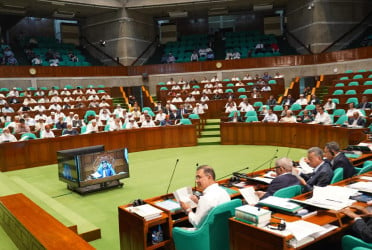
August 5, morning—the long-awaited moment. Dhaka held its breath. Everyone knew—something would happen, an explosion, a bloodbath. Around the Ganabhaban (Prime Minister’s residence), preparations for war—machine guns mounted. Every entry point to Dhaka was fortified. But fear had already been conquered. People came from all directions—east, west, north, and south—by the hundreds of thousands. They were unarmed, steadfast in resolve. They marched toward the Ganabhaban—calm, unwavering. “Sheikh Hasina doesn’t flee”—she herself had said just days earlier, arrogantly, in public. But by noon on August 5, Sheikh Hasina had fled—on a cargo flight to India. A short message spread like wildfire—“Sheikh Hasina has fled.” The people erupted in joy—some laughed, some cried, some screamed. Sweet shops emptied in moments. The endless nightmare suddenly ended. Jatrabari, Chankharpul, Savar—some "rogue forces" fired bullets at the last moment. Many were killed—their blood soaked the flag of that day. But nothing could stop the awakened, victorious masses. They stormed the Ganabhaban. Another group ran to the Parliament building. They declared: this Parliament is no longer a party’s—it belongs to the whole nation now. On the Prime Minister’s Office roof, thousands of youth flew the flag. Dhanmondi 32, Awami League’s central office, and all divisional offices of Dhaka—all burned in flames. “Sheikh Hasina has fled”—these words were not just a victory chant—they were a release from a long, crushing burden. This history cannot be erased. Now is the time—to preserve this history, honor the martyrs’ names, and build monuments to the resistance.
I was once a teacher of this state, called a traitor. Today I say—the true patriots of this nation were those brave young men and women who dared to raise their heads and say: “You and I—who? The alternative! The alternative!”
The writer is a Professor, University of Dhaka; Convener, Sada Dal