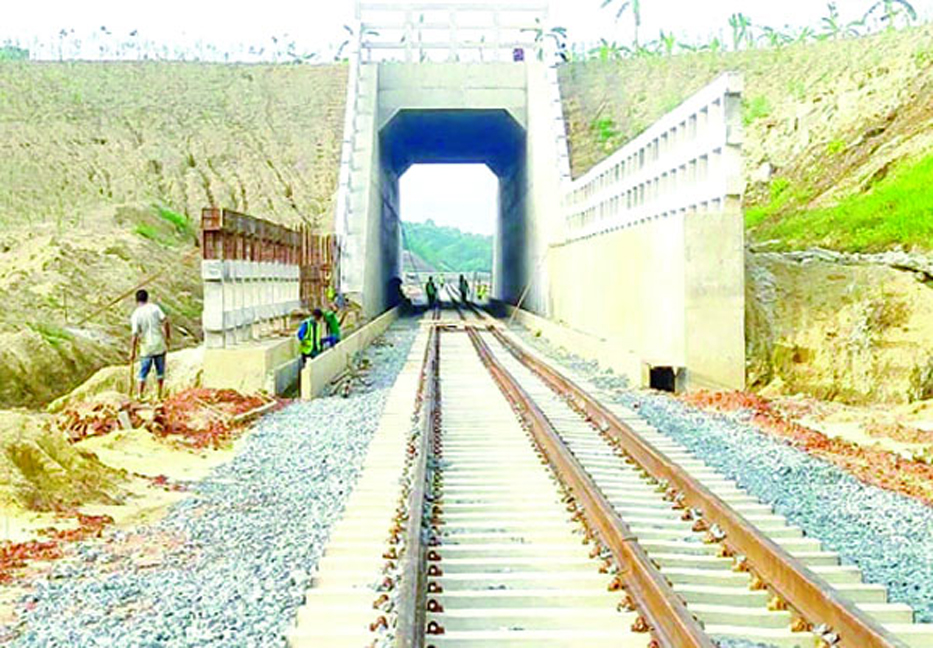
The Lohagara Chunati Sanctuary is located beside the Dohazari-Cox’x Bazar Railline where the herds of elephants wander freely. However, the wandering areas of the elephants weren’t spoiled even after implementing the railline project. For facilitating the free movement of the elephants, the first elephant overpass in the South-East Asia region was constructed over the railine. The tourists on the rail route to Cox’s Bazar will get pleasure by enjoying the beautiful scenario here.
The trial trains run on Dohazari-Cox’s Bazar railline will start from October 15. 90% of the total works of this project has been completed and the commercial operation of the train will be commenced latterly.
According to the source of Railways East region, the works of 50 meters long overpass was completed. Bannana, bamboo and some other kinds of trees were planted on it, along with the construction a lake of salt water. Safety walls on both sides of it have also been constructed.
Three underpasses and one overpass have been constructed throughout the sanctuary. Elephants’ flocks can travel from one hill to another through the overpass. Most Asian elephants traveling between India-Bangladesh-Myanmar pass through the Chunti Wildlife Sanctuary. Elephants can move from one hill to another through the overpass. Moreover, salt water lakes are being created to prevent wild animals from coming to the railway line in the sanctuary as the wild elephants like to drink salt water. Herds of wild elephants also like to stay where they see water like this. The wildlife conservation team of Asian Development Bank (ADB) has been working for almost two years to determine the location for the elephant overpass.
Mofizur Rahman, director of the Dohazari-Cox's Bazar railway project, said, “The elephant overpass has been constructed as a pleasure experience for the tourists and a suitable medium for elephant movement. The overpass is constructed with the opinion of the concerned experts and necessary planning. Its construction is over.”
He said that the progress of the whole project work is 90 percent and the progress of construction of railway line is 98 percent. We are working on a trial run plan on October 15.
According to project sources, the Dohazari-Cox's Bazar railway line is being implemented at a cost of Tk 18,034 crores. On April 3, 2011, Prime Minister Sheikh Hasina laid the foundation stone for construction of meter gauge railways up to Dohazari-Ramu-Cox's Bazar and Ramu-Ghundhum. 88 km rail path from Dohazari to Ramu and 12 km from Ramu to Cox's Bazar is being constructed. Under the project, the country's first state-of-the-art iconic railway station in the shape of an oyster has been constructed at Cox's Bazar. Through this, the country's tourism sector will advance another step. It will create a safe, comfortable, cost-effective transportation system for tourists and local people.
Coxabazar will be reached by train in seven and a half hours from Dhaka and two and a half hours from Chittagong. Distance from Chittagong to Cox's Bazar is 150 km. Distance from Dohazari to Cox's Bazar is 100 km. At present, there is a railway line up to Dohazari. For this reason, the railway is going to Cox's Bazar encompassing Ban-Pahar river from Dohazari via Ramu. Nine stations are being constructed in Dohazari, Satkania, Lohagara, Harbang, Chakria, Dulahazra, Islamabad, Ramu and Cox's Bazar. These stations will have computer based interlock signal system and digital telecommunication system.
(The report was published in Bengali on print and online versions of The Bangladesh Pratidin on October 10 and rewritten in English by Lutful Hoque)